
IoT transforms personal health tracking by replacing periodic, clinic-based measurements with continuous, real-time physiological monitoring through interconnected wearable devices and sensors. The specialized branch of this technology, known as the Internet of Medical Things (IoMT), connects smartwatches, glucose monitors, blood pressure cuffs, and sleep trackers into unified data ecosystems that feed directly into healthcare workflows. A 2026 systematic review confirms that IoMT enhances healthcare management through connected devices and analytics, though security and interoperability remain active challenges. The practical result is a shift from reactive care to preventive, data-driven wellness management that puts clinically meaningful information in your hands every minute of the day.
How IoT transforms personal health tracking through IoMT

The Internet of Medical Things is defined as a network of interconnected medical devices, wearables, and sensors that collect physiological data and share it across healthcare systems in real time. IoMT is the healthcare-specific subset of broader IoT, and the distinction matters. A general IoT device might track your home's temperature. An IoMT device tracks your atrial fibrillation.
The device categories within IoMT cover a wide functional range:
- Smartwatches with ECG capability (Apple Watch Series 10, Withings ScanWatch) detect irregular heart rhythms and log continuous heart rate data across the day and night.
- Continuous glucose monitors (CGMs like Dexterity and Libre) measure interstitial glucose every few minutes, replacing finger-stick tests and enabling real-time dietary feedback.
- Sleep and activity trackers (Oura Ring, Fitbit Sense) capture sleep stages, respiratory rate, and step counts, building longitudinal wellness profiles over weeks and months.
- Connected blood pressure monitors sync readings automatically to cloud platforms, removing the manual logging step that most users skip.
The critical shift IoMT creates is from episodic to continuous measurement. A blood pressure reading taken once at a clinic appointment gives your doctor a single data point. A connected cuff used daily gives a trend line across 90 days. That trend line is what IoMT-driven analytics convert into actionable clinical decisions, personalized alerts, and preventive interventions. For health enthusiasts, this means your fitness tracker is no longer just counting steps. It is building a physiological record that can detect anomalies before symptoms appear.
How do edge computing and cloud architectures power real-time health data?
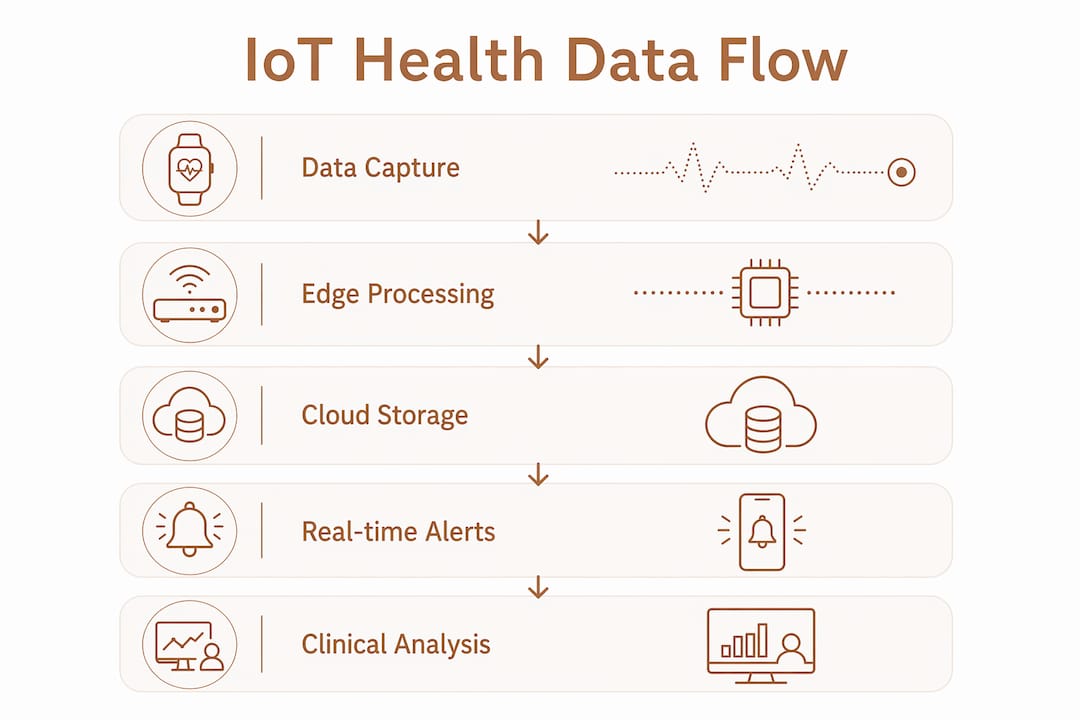
Raw sensor data from a wearable is useless until it reaches the right system at the right time. The architecture that makes this possible follows a three-stage pipeline: device, gateway, and cloud. Each stage has a distinct role, and the performance of the overall system depends on how well they coordinate.
- Device layer. The wearable or sensor captures raw physiological signals, applies basic filtering, and transmits data to a local gateway via Bluetooth or Zigbee. Some devices perform initial anomaly detection on-chip, which reduces the volume of data sent upstream.
- Gateway layer (edge). A local hub, such as a smartphone or dedicated home gateway, preprocesses incoming data streams. Edge inference at this layer handles tasks like smoothing noisy readings, compressing data, and flagging critical values for immediate alert generation. This is where latency is controlled.
- Cloud layer. Processed, compressed data moves to cloud infrastructure for longitudinal storage, population-level analytics, and integration with electronic health records (EHRs). Machine learning models trained on historical data run here, identifying patterns that edge devices cannot detect alone.
The latency requirement for this pipeline is strict. Home-monitoring architectures achieve alert delivery under 7 seconds in 99.5% of cases, which is the threshold that makes real-time health alerts clinically meaningful rather than just informational. Miss that window on a cardiac event, and the alert arrives too late to matter.
Edge buffering also protects data integrity during network outages, a common problem in home environments. Open-source implementations like the medmonitor-iot-gateway use local caching with catch-up flushes, so no telemetry is lost when a Wi-Fi connection drops. The combined edge-cloud approach reduces bandwidth costs and cloud dependency while maintaining the longitudinal data depth needed for meaningful health trend analysis.
Pro Tip: When evaluating a smart health monitoring device, check whether it performs local edge processing or sends all raw data to the cloud. Devices with on-device preprocessing respond faster to critical readings and continue functioning during connectivity gaps.
Why data standardization determines whether IoT data becomes clinical insight
Collecting physiological data is only half the problem. The harder challenge is making data from a Garmin watch, a Libre CGM, and a Withings blood pressure monitor readable by the same clinical system. Each device uses different data formats, sampling rates, and transmission protocols. Without normalization, the data sits in isolated silos.
Healthcare data standards solve this by creating a shared language for device output:
| Standard | Primary use | Clinical relevance |
|---|---|---|
| FHIR (Fast Healthcare Interoperability Resources) | Structures wearable telemetry as standardized Observation records | Routes data directly into EHR systems for clinician review |
| HL7 | Messaging protocol for clinical data exchange | Connects IoT data streams to hospital information systems |
| LOINC | Universal codes for lab and clinical observations | Labels sensor readings so any system can interpret them correctly |
Middleware platforms sit between raw device output and these standards, managing the translation layer. A middleware solution ingests heterogeneous sensor data, applies the correct FHIR or HL7 schema, and routes the normalized record to the appropriate clinical workflow. Interoperability via middleware and standards is what allows a cardiologist's EHR to display your Apple Watch ECG data alongside your lab results.
The clinical impact is significant. Wearable telemetry normalized into FHIR Observations can trigger automated clinical alerts when readings cross predefined thresholds, reducing the manual review burden on care teams. One practical technique for managing alert volume is reducing data upload volume through smoothing and anomaly-only transmission. Edge preprocessing reduces upload volume by 83% while preserving the clinically relevant signals, which directly cuts alert fatigue for both clinicians and patients.
How does IoT improve health tracking security and data privacy?
Connected health data is among the most sensitive personal information that exists. A compromised glucose reading or cardiac alert is not just a privacy violation. It is a potential safety risk. The security architecture of IoT health systems must address three distinct threat categories:
- Data integrity threats. Sensor readings can be tampered with in transit, producing false alerts or masking real ones. Cryptographic hashing and digital signatures verify that data has not been altered between the device and the clinical system.
- Privacy exposure. Continuous physiological monitoring in home environments generates intimate behavioral data. Federated learning approaches process data locally on the device rather than uploading raw readings to central servers, preserving privacy by design.
- Unauthorized access. IoT devices with weak authentication are entry points for broader network attacks. Blockchain-based validation creates tamper-evident audit trails for health data transactions, making unauthorized modification detectable.
The Scientific Reports 2026 analysis documents rising cyber threats targeting IoT healthcare systems and identifies cryptographic integrity methods as the most effective current defense. Security and interoperability are consistently identified as the top two barriers to broader IoMT adoption, and they are connected. A system that cannot securely exchange data across platforms cannot achieve true interoperability.
Pro Tip: Before purchasing a connected health device, verify that it uses end-to-end encryption for data transmission and supports two-factor authentication for account access. These two features alone eliminate the majority of common attack vectors.
What practical benefits and challenges does IoT bring to personal wellness tracking?
The benefits of connected health technology for fitness and wellness enthusiasts are concrete and measurable. Real-time feedback loops change behavior in ways that periodic measurements cannot.
- Continuous heart rate monitoring during exercise allows you to train in precise intensity zones rather than estimating effort. Devices like the Polar H10 chest strap deliver beat-by-beat accuracy that wrist-based sensors cannot match.
- Sleep quality tracking across weeks reveals patterns that single-night observations miss. Consistent REM deficits, for example, correlate with recovery impairment and increased injury risk in athletes.
- Glucose monitoring without diabetes. CGMs are increasingly used by metabolically healthy individuals to understand how specific foods, workouts, and sleep patterns affect blood sugar stability.
- Personalized adaptive alerts. Federated learning frameworks dynamically adjust alert thresholds based on your individual baseline, reducing false alarms by learning what is normal for your physiology rather than applying population averages.
The challenges are equally real. False alarms remain a persistent problem when devices apply generic thresholds to individual users. Network reliability in rural or low-connectivity environments limits the effectiveness of cloud-dependent systems. Device cost creates access barriers, with clinical-grade CGMs still priced beyond casual wellness use. And the sheer volume of data generated by multiple simultaneous trackers can overwhelm users who lack tools to synthesize it into clear decisions. The impact of IoT on wellness is real, but it scales with the quality of the analytics layer sitting above the raw data.
Key takeaways
IoT transforms personal health tracking by converting continuous sensor data into clinically actionable insights through edge-cloud pipelines, standardized data formats, and adaptive analytics.
| Point | Details |
|---|---|
| IoMT enables continuous monitoring | Wearables like CGMs and ECG watches replace episodic measurements with real-time physiological data streams. |
| Latency under 7 seconds is critical | Home-monitoring architectures must deliver alerts within this threshold to make health data clinically useful. |
| Standardization unlocks clinical value | FHIR, HL7, and LOINC normalize heterogeneous device data so it integrates directly into EHRs and clinical workflows. |
| Security requires layered defenses | Cryptographic hashing, blockchain validation, and federated learning together address integrity, privacy, and access threats. |
| Adaptive AI reduces false alarms | Edge-based federated learning adjusts alert thresholds to individual baselines, improving alarm accuracy and user trust. |
What I've learned about IoT health tracking that most articles miss
I have followed the IoMT space closely enough to say this plainly: the technology is not the bottleneck. The bottleneck is the data layer between the device and the decision.
Most health enthusiasts focus on which wearable to buy. The more important question is what happens to the data after the device captures it. A premium smartwatch feeding into a fragmented, non-standardized app ecosystem delivers less clinical value than a mid-range device connected to a properly structured FHIR pipeline. The hardware is commoditizing. The intelligence layer is where the differentiation lives.
Security is the issue I see underestimated most consistently. People treat connected health devices like fitness accessories rather than medical data endpoints. They are both, and the security posture should reflect that. Choosing devices that support federated learning and on-device processing is not just a privacy preference. It is a data quality decision, because local processing reduces the noise that degrades alert accuracy.
The near-term future I find genuinely interesting is the convergence of body composition tracking with continuous physiological monitoring. Devices that combine precise body metrics with real-time metabolic data will give health enthusiasts a feedback loop that current single-metric trackers cannot approach.
— Jacob
Take your health tracking further with Uvirello
If you are building a connected health tracking setup, the foundation matters as much as the wearables you add to it. Uvirello's Smart Electronic Weight Scale integrates body composition metrics, including body fat percentage and BMI, with the precision that IoT-driven health management demands.
With over 12,000 verified customer reviews and a 4.8 out of 5 average rating, Uvirello delivers the measurement accuracy that makes longitudinal health data meaningful. Body composition data logged consistently over time becomes the baseline against which your wearable alerts and fitness metrics are interpreted. Explore Uvirello's health tracking solutions to see how precise body metrics integrate with your broader IoT wellness ecosystem.
FAQ
What is IoMT and how does it differ from IoT?
IoMT (Internet of Medical Things) is the healthcare-specific subset of IoT, consisting of connected medical devices and wearables that collect physiological data and integrate with clinical systems. General IoT covers consumer and industrial devices; IoMT is purpose-built for health monitoring and medical data exchange.
How fast do IoT health monitoring systems deliver alerts?
Well-engineered home-monitoring architectures deliver alerts in under 7 seconds in 99.5% of cases. This latency threshold is the benchmark for clinically meaningful real-time health alerts.
Why do IoT health devices produce false alarms?
False alarms occur when devices apply population-average thresholds to individual users whose normal ranges differ from the baseline. Adaptive federated learning systems reduce false alarms by learning your personal physiological baseline and adjusting alert thresholds dynamically.
What data standards make IoT health data clinically usable?
FHIR, HL7, and LOINC are the primary standards that normalize raw sensor data into formats that EHRs and clinical decision systems can read and act on. Without these standards, data from different devices remains siloed and clinically inaccessible.
How can I protect my privacy when using connected health devices?
Choose devices that use end-to-end encryption, support two-factor authentication, and perform on-device or federated processing rather than uploading raw physiological data to central servers. Blockchain-based data validation adds an additional audit layer for detecting unauthorized data modification.