
Weekly fitness tracking best practices are defined as the structured, consistent methods of logging and reviewing your workout activity, health metrics, and recovery data to drive measurable progress. Tools like Fitbit, Apple Watch, and apps such as MyFitnessPal or SetGraph make this process more precise and sustainable than ever before. The core benefit is simple: when you track with intention, you stop guessing and start improving. This article gives you the exact framework to do that every week.
1. What core metrics should you track weekly?
The foundation of any effective weekly workout monitoring system is knowing what to measure. Not every number deserves daily attention, and tracking the wrong things creates noise instead of clarity.
Start with physical activity minutes. The CDC recommends 150 minutes of moderate-intensity activity per week, which breaks down to roughly 22 minutes daily or 30 minutes across five days. That single benchmark gives you a concrete weekly target to hit and log.

Beyond cardio, track your strength training sessions. Mayo Clinic advises at least two strength sessions per week, with at least one rest day between sessions targeting the same muscle group. Log the weights lifted, reps completed, and total session duration so you have a baseline to build from.
Also record effort levels using perceived exertion or heart rate zones. These tell you whether a session was genuinely challenging or just comfortable. Workout frequency, session duration, and exercise variety round out the core weekly data set.
Pro Tip: Avoid logging daily weight as a performance metric. Daily weight is noisy due to hydration, food volume, and hormonal shifts. Check it weekly at the same time of day instead.
2. How fitness trackers and journaling apps improve your habits
Modern fitness tracking tools fall into two broad categories: device-based monitors and self-report methods. Both work. The best choice depends on your lifestyle and how much manual effort you want to invest.
| Method | Best for | Limitation |
|---|---|---|
| Wearables (Fitbit, Apple Watch) | Passive, automatic data collection | Accuracy varies by feature and wear consistency |
| Fitness apps (MyFitnessPal, SetGraph) | Structured workout logging and nutrition | Requires manual input discipline |
| Workout journals (paper or digital) | Reflection, goal notes, and effort ratings | No automatic data syncing |
| Hybrid (wearable + app) | Comprehensive health picture | Can create data overload if not managed |
Physical activity assessment broadly divides into self-reports and device-based monitoring, and research confirms both methods capture meaningful data when used consistently. The critical variable is not which tool you pick. It is whether you actually review the data.
Fitness trackers alone don't improve health. Benefits come from wearing them, reviewing the stats regularly, and acting on what you see. A $400 smartwatch sitting on your nightstand produces zero results.
Pro Tip: Pick one primary tracking method and stick with it for at least four weeks before switching. Consistency in your logging method is what makes week-over-week comparisons meaningful.
3. Separate your metrics by cadence, not by category
One of the most overlooked fitness tracking tips is that not all metrics belong on the same review schedule. Mixing daily, weekly, and monthly data into one review creates confusion and false conclusions.
The baseline and cadence approach works like this: review performance metrics (reps, weights, heart rate) after each session, assess adherence and effort weekly, and re-evaluate body composition every two to four weeks. This separation removes the emotional reaction to daily fluctuations and keeps your focus on actual trends.
Think of it like a stock portfolio. You would not panic over a single bad day if the monthly trend is positive. The same logic applies to your fitness data. Weekly adherence is your most reliable short-term signal.
4. Set realistic and adjustable weekly goals
Effective weekly wellness assessment starts with goals that are specific enough to measure but flexible enough to survive a busy week. "Work out more" is not a goal. "Complete three strength sessions and 150 minutes of cardio" is.
Write your weekly goal at the start of each week and review it on the same day every Sunday or Monday. If you hit it, increase the target slightly. If you missed it, identify the single biggest obstacle and adjust the plan rather than the ambition.
Goals should also account for life variability. A travel week calls for a modified goal, not an abandoned one. Tracking a 60% adherence week honestly is more useful than skipping the log entirely.
5. Use the data-to-decision loop for weekly reviews
The most effective exercise logging systems are built around a simple three-question review: What did I do this week? How hard did I work? What will I change next week? SetGraph describes this as the "data-to-decision" loop, and it is the difference between a fitness diary and a genuine progress tool.
"Weekly fitness logs should form a continuous improvement cycle addressing workout frequency, effort, and adjustment plans to remain actionable and focused."
Spend no more than 10 minutes on this review. Look at your total active minutes, your strength session count, and one effort metric like average heart rate or perceived exertion. Then write one sentence about what changes next week. That sentence is your plan.
6. Track progressive overload, not just completion
Completing a workout is not the same as progressing. The most common mistake in weekly workout monitoring is logging sessions as done or not done without recording whether the work got harder.
Progressive overload means gradually increasing the demand on your body, whether through more weight, more reps, shorter rest periods, or greater range of motion. Log the specific numbers after every strength session so you can compare week over week. If the numbers are not moving after three weeks, your program needs adjustment.
Strength changes require consistent benchmarking and retesting after four to six weeks for meaningful progress tracking. Set a benchmark test date in your calendar now and repeat it under identical conditions.
7. Schedule rest and recovery as tracked data points
Recovery is not the absence of training. It is a measurable input that directly affects your output. Log your sleep hours, rest days taken, and subjective fatigue score (a simple 1 to 10 rating) alongside your workout data each week.
When fatigue scores trend upward over two or three consecutive weeks, that is a signal to reduce training volume before injury forces you to. Most fitness apps allow custom fields or notes where you can add these scores without disrupting your main log.
AI-driven systems like Fortivus are increasingly using recovery data to auto-adjust weekly training loads, which shows how seriously the industry now treats rest as a performance variable.
8. Incorporate sleep and nutrition data into your weekly review
Fitness progress does not happen in isolation. Sleep and nutrition data give context to your performance numbers. A week of poor sleep explains a drop in strength output far better than any training variable.
You do not need to track every macro or every sleep stage. Log total sleep hours nightly and note whether your nutrition felt on track using a simple green, yellow, or red rating for each day. When you review your weekly data, these two inputs will explain most of the variation in your workout quality.
AI personalization in coaching increasingly integrates sleep and nutrition signals alongside workout data to generate more accurate weekly recommendations. Even without AI tools, you can apply the same logic manually.
9. Avoid data overload by focusing on three key numbers
The biggest threat to consistent tracking is not laziness. It is overwhelm. When your dashboard shows 47 metrics, you stop looking at any of them.
Choose three numbers that matter most to your current goal and make those your weekly headline stats. For fat loss, that might be active minutes, weekly weight average, and strength session count. For performance, it might be average heart rate, total training volume, and sleep hours. Everything else is context, not the story.
Inconsistent device use or incomplete data entry skews weekly summaries and reduces insight quality. A complete log of three metrics beats a partial log of fifteen every time.
10. Conduct a monthly body composition check
Weekly tracking gives you momentum data. Monthly body composition checks give you outcome data. These are different things and should not be confused.
Body fat percentage, BMI, and muscle mass measurements change slowly. Checking them weekly creates anxiety without insight. A monthly check, conducted under consistent conditions, gives you a true picture of whether your weekly habits are producing the results you want.
Pro Tip: Weigh yourself and take body composition measurements on the same day of the month, at the same time of day, after the same pre-measurement routine. Consistency in conditions is what makes the numbers comparable.
Key takeaways
Effective weekly fitness tracking requires separating metrics by cadence, acting on weekly review data, and measuring both effort and outcome consistently.
| Point | Details |
|---|---|
| Separate metrics by cadence | Review performance daily, adherence weekly, and body composition monthly to reduce noise. |
| Use the data-to-decision loop | Ask what you did, how hard you worked, and what changes next week after every review. |
| Track progressive overload | Log specific weights and reps every session so you can confirm progress week over week. |
| Limit your headline metrics | Choose three key numbers per goal to prevent data overload and maintain consistency. |
| Include recovery data | Log sleep hours and fatigue scores weekly to explain performance variation and prevent injury. |
Why I stopped tracking everything and started tracking what matters
I spent two years logging every possible metric: steps, heart rate variability, sleep stages, macros, hydration, mood, and more. My spreadsheet was impressive. My progress was not.
The turning point came when I stripped my weekly review down to three numbers: total training volume, average sleep hours, and weekly weight average. Within six weeks, I could see patterns I had completely missed before. My strength stalled every time my sleep dropped below six hours. That single correlation changed how I structured my recovery weeks more than any training program had.
The tools I now rely on consistently are a quality body composition scale, a simple workout log in SetGraph, and a weekly Sunday review that takes less than 10 minutes. I retest strength benchmarks every six weeks under identical conditions, which is the only way I have found to know whether a program is actually working.
The most common mistake I see is people treating tracking as the goal rather than the tool. Your log is not the achievement. The progress it reveals is. If your tracking system is taking more energy than your workouts, simplify it immediately.
— Jacob
Take your weekly tracking further with Uvirello
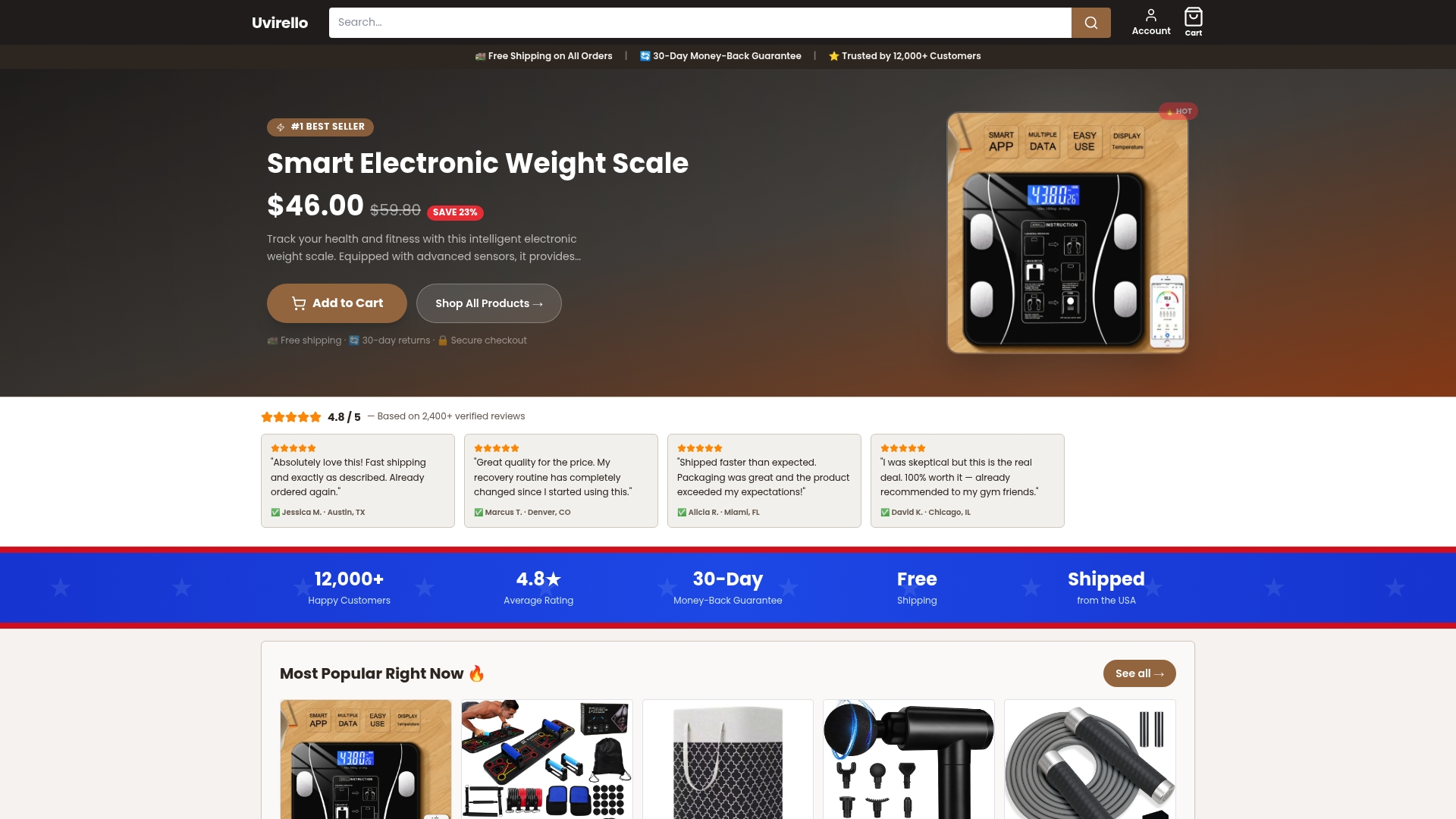
The data you collect weekly is only as good as the tools measuring it. Uvirello's Smart Electronic Weight Scale gives you precise body composition metrics, including body fat percentage and BMI, so your monthly outcome checks are built on accurate numbers rather than estimates. Over 12,000 users rate it 4.8 out of 5 for a reason: it turns a daily weigh-in into a genuine health data point. If you are serious about building a tracking system that produces real results, explore Uvirello and see how accurate body composition data fits into your weekly routine.
FAQ
What metrics should I track every week for fitness?
Track total active minutes, strength session count, and at least one effort metric like average heart rate or perceived exertion. Body composition metrics like weight and body fat percentage are better reviewed monthly to avoid reacting to normal daily fluctuations.
How often should I review my fitness tracker data?
Review performance data after each session, adherence and effort data weekly, and body composition data every two to four weeks. This cadence approach reduces noise and keeps your focus on meaningful trends rather than daily variation.
Do fitness trackers actually improve health outcomes?
Fitness trackers improve outcomes only when you review the data and act on it. Wearing a tracker without a regular review habit produces no measurable benefit, regardless of how advanced the device is.
How do I avoid data overload when tracking fitness weekly?
Choose three headline metrics aligned with your current goal and treat everything else as supporting context. Complete data on three metrics is more useful than partial data across fifteen, and it makes your weekly review faster and more consistent.
When should I retest fitness benchmarks?
Retest strength and endurance benchmarks every four to six weeks under identical conditions. Consistent benchmarking intervals are the only reliable way to confirm whether your training program is producing real gains.