
A safe, sustainable body fat loss rate is 0.5–1% of your body weight per week, or roughly 1–2 pounds. That pace comes from a daily calorie deficit of about 500–750 calories, not a crash diet. Your exact number shifts based on how much fat you're carrying, your sex, and your training history. The leaner you get, the slower that rate should become.
TL;DR:
- Losing 0.5 to 1% of body weight weekly typically equals about 1 to 2 pounds for most adults, depending on their weight.
- Faster fat loss rates require larger calorie deficits, increase hunger, and risk more muscle loss, especially beyond 1 kilogram per week.
- Starting body fat percentage influences achievable speed, with higher levels allowing quicker absolute loss and leaner individuals needing slower rates.
- Precise tracking of weight trends, body composition, and strength is essential, as water fluctuations can obscure real fat loss progress.
- A smart scale that measures body fat percentage helps confirm if weight changes reflect fat loss rather than water retention or muscle loss.
Table of Contents
- What "Safe Rate" Actually Means in Practice
- Turning Your Weekly Rate Into a Real Timeline
- Your Starting Body Fat Changes the Right Pace for You
- Keeping Muscle While the Fat Comes Off
- How to Track Progress Without Losing Your Mind
- Choosing Your Pace: Trade-Offs Worth Understanding
- Why a Smart Scale Makes This Math Easier to Trust
- Sources
What "Safe Rate" Actually Means in Practice
Coaches and clinicians measure fat loss as a percentage of body weight per week instead of a flat number because a flat number lies. Losing 2 pounds a week means something completely different for a 300-pound person than it does for a 140-pound person. The percentage scales with you.
That 0.5–1% range translates into real numbers once you plug in your own weight:
- At 154 lbs (70 kg): typically about 1 to 2 pounds per week
- At 187 lbs (85 kg): typically about 1 to 2 pounds per week
- At 209 lbs (95 kg): typically about 1 to 2 pounds per week
Notice these numbers land close to the standard "1–2 lbs/week" guideline you've probably heard before. That's not a coincidence. The percentage-based rule and the flat guideline converge for most adults in a typical weight range, which is why both versions show up in different sources.
Here's the part people miss: tracking percent body fat directly is less useful week to week than tracking body weight trend. Body fat percentage estimates from scales and calipers bounce around with hydration and measurement error. Body weight, tracked as a weekly average, is steadier. A pound of scale weight lost under a calorie deficit with adequate protein and training is usually mostly fat. That's the practical shortcut worth remembering.

Turning Your Weekly Rate Into a Real Timeline
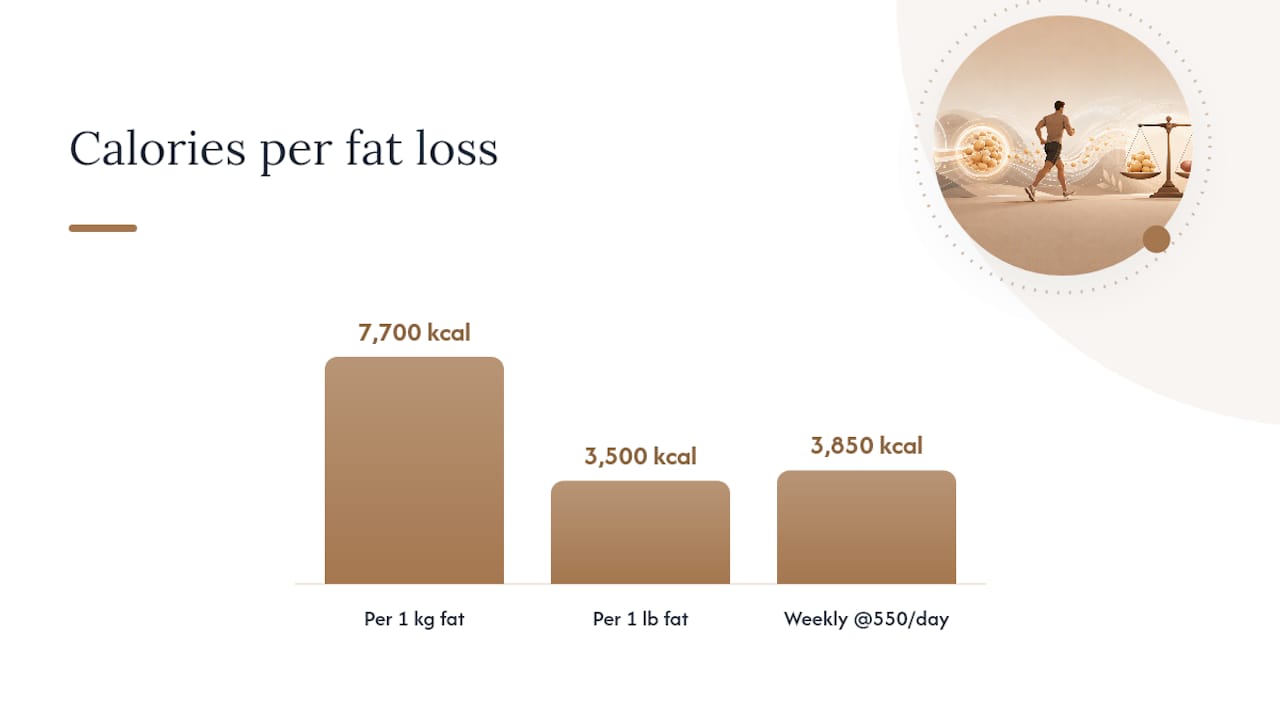
The math behind fat loss planning rests on one number: it takes roughly 7,700 kcal of a calorie deficit to burn through 1 kilogram of fat, or about 3,500 kcal per pound. A daily deficit of 550 calories gets you to about 0.5 kg (1.1 lbs) of fat loss per week. It's an approximation, not a law of physics, because your body adapts as you lose weight. But it's good enough to build a plan around.
At a conservative pace of 0.25 kg/week, that's 17 weeks. Push to 0.5 kg/week and you cut it to about 9 weeks, but you're now asking more of your training and protein intake to protect muscle along the way.
Here's how the numbers stack up across common paces:
Three things to keep in mind when you run these numbers for yourself:
- Weekly deficit totals matter more than daily precision, so one indulgent Saturday doesn't wreck a week if the other six days stay on target.
- Faster rates on the right side of that table demand a bigger daily deficit, which increases hunger and makes muscle loss more likely.
- A fat loss timeline calculator can run these numbers for your exact weight and goal faster than doing it by hand, though the math above will get you close.
Your Starting Body Fat Changes the Right Pace for You
Someone carrying 30% body fat can lose weight faster, in absolute terms, than someone at 15%. The body simply has more fat available to mobilize when there's more of it. Precision Nutrition's coaching framework treats this as a sliding scale rather than a single target, and it lines up with what most experienced coaches see in practice.
Rough starting points by situation:
- Higher starting body fat (10+ kg/22+ lbs to lose): 0.5–1% body weight/week is comfortable and often necessary just to hit the calorie deficit needed.
- Average starting point: roughly 0.5 kg/week is a sensible middle ground that balances speed with muscle retention.
- Leaner individuals (already close to a healthy range): 0.25–0.5 kg/week, favoring the lower end as you approach your goal.
The physiological reason for slowing down near lower body fat levels isn't just about willpower. Hormonal signals that regulate hunger and energy expenditure shift as fat stores shrink, and the body resists further loss more aggressively. This is where diet breaks, planned periods of eating at maintenance for a week or two, tend to pay off, both for adherence and for blunting the metabolic pushback.
Pro Tip: If you've been stuck at the same weight for three or more weeks despite tracking your intake honestly, that's your body telling you to take a one to two week diet break at maintenance calories before dropping the deficit further.
Keeping Muscle While the Fat Comes Off
Protein intake is the lever most people underuse. Research cited by Precision Nutrition points to 2.0–2.4 grams per kilogram of lean body mass for people running an aggressive deficit, with 1.6 g/kg as a reasonable floor for more moderate rates. That's not total body weight, it's lean mass, so someone at 20% body fat should calculate protein off roughly 80% of their scale weight.
Resistance training is the other half of the equation. Three to four sessions a week that hit the major muscle groups gives your body a reason to hold onto muscle tissue even while calories are restricted. Cardio helps the deficit; it doesn't protect muscle the way lifting does.
The trade-off in numbers: at moderate deficits, muscle typically accounts for a modest share of total weight lost. Push past roughly 1 kg (2.2 lbs) per week without strong mitigation, and that muscle share can climb toward 35–50% of everything you're losing.
Faster isn't free. It's a direct trade against the muscle you've built.
How to Track Progress Without Losing Your Mind
A single scale reading is noise. Water retention, sodium intake, and even sleep can swing your weight by two or three pounds overnight, which is exactly why so many people quit two weeks into a plan that's actually working. Track the trend, not the day.
A workable setup looks like this:
- Weigh yourself daily, but judge progress on the weekly average, not any single number.
- Check body composition every two weeks if you have access to a consistent method.
- Take progress photos monthly, under the same lighting and pose.
- Log strength numbers each session, since stalling weights on the bar are an early warning sign of muscle loss.
Body-composition tracking tends to reveal problems that the scale alone hides, especially in the first month when water shifts can mask real fat loss. Most people notice early changes in energy and how clothes fit within 2 to 4 weeks, with visible composition changes showing up between 6 and 12 weeks.
Choosing Your Pace: Trade-Offs Worth Understanding
A conservative rate, closer to 0.25–0.5 kg per week, is the better call whenever long-term body composition matters more than a deadline. It preserves muscle, keeps hunger manageable, and lowers the odds of the rebound weight gain that follows crash diets.
An aggressive pace can be justified for a short-term goal, a wedding, a competition weigh-in, where you're knowingly trading some muscle and metabolic comfort for speed. That's a fair trade only if you go in with eyes open.
Watch for warning signs regardless of pace: stalling strength numbers, persistent fatigue, or a missing period in women are all signals to slow down. Judge your progress by the trend line over three to four weeks, never by what one bad morning on the scale tells you.
— Jacob
Why a Smart Scale Makes This Math Easier to Trust
Every calculation in this article depends on one thing: knowing whether your weight change over time is fat, muscle, or water. Guessing from a single number on a bathroom scale makes that impossible. Consistent, frequent body-composition readings are what let you tell the difference between a stall and a plateau, or between muscle gain and water retention hiding fat loss.

A smart electronic weight scale with high-precision sensors can track body fat percentage and BMI alongside weight, syncing every reading to a connected app so you can see your actual weekly trend instead of one noisy data point. It's built to support the kind of trend-based tracking this article recommends, not replace the calorie math or training plan you still need to follow. If you're ready to stop guessing whether your current pace is working, check out the Uvirello smart scale and start logging a real trend line this week.
This article is general information, not a substitute for advice from a qualified doctor. Consult a qualified healthcare professional about your own circumstances before acting on anything here.
Sources
- What does a healthy, realistic rate of weight loss look like, and why does it matter? - Harvard Health
- Fat loss timeline calculator — Daily-Calc
- Realistic rates of fat loss and muscle gain — Precision Nutrition