
Precision sensors are devices designed to measure position, movement, and physiological data with exceptional repeatability and minimal delay, making them the foundation of accurate health and fitness tracking. Understanding how precision sensors improve tracking means understanding sensor fusion, the technique of combining data from multiple sensor types to eliminate individual weaknesses and produce reliable measurements. Modern wearables and health tools rely on inertial measurement units (IMUs), optical sensors, and GNSS receivers working together. The result is tracking data you can actually train from, not just glance at.
How precision sensors improve tracking: the core technology
The hardware driving modern tracking accuracy has advanced faster than most fitness professionals realize. The TDK ICM-45687 IMU, for example, achieves gyroscope noise as low as 3.8 mdps/√Hz with shock resistance up to 20,000 g. That level of stability means the sensor holds accurate readings even during explosive movements like sprints or heavy lifts, where cheaper sensors drift badly.
Sampling rate matters too, but not in the way most people assume. High update rates improve response time, but true precision depends on noise floor and repeatability, not just how fast the sensor reads. A sensor running at 335 Hz with poor noise management will still produce unreliable data. The real gains come from pairing high sampling rates with systematic calibration.

Sensor fusion is where precision sensor tracking technology reaches its full potential. Integrating IMUs with GNSS or laser tracking systems yields a 30% improvement in positioning accuracy. That improvement comes from combining sensors with complementary failure modes. GPS loses accuracy indoors; IMUs drift over time. Together, they cover each other's blind spots.
| Sensor Type | Typical Precision | Latency | Primary Role |
|---|---|---|---|
| Optical (PPG) | ±2–5 BPM | 10–50 ms | Heart rate, SpO2 monitoring |
| Inertial (IMU) | Sub-degree orientation | 1–10 ms | Motion, step, and posture tracking |
| GNSS | 1–3 m outdoor | 100–500 ms | Distance, pace, route mapping |
| Fusion (IMU + GNSS) | Sub-meter positioning | 4–15 ms | High-accuracy movement tracking |
Pro Tip: When evaluating a wearable or health device, look for multi-sensor fusion specs rather than a single sensor's sampling rate. Fusion is the real accuracy multiplier.
How do precision sensors enhance fitness metrics?
The advantages of tracking with sensors become most visible in fitness applications where small measurement errors compound into bad decisions. A step counter that drifts 5% over a 10,000-step day gives you a 500-step error. Multiply that across a week of training load calculations and your recovery planning is built on bad data.
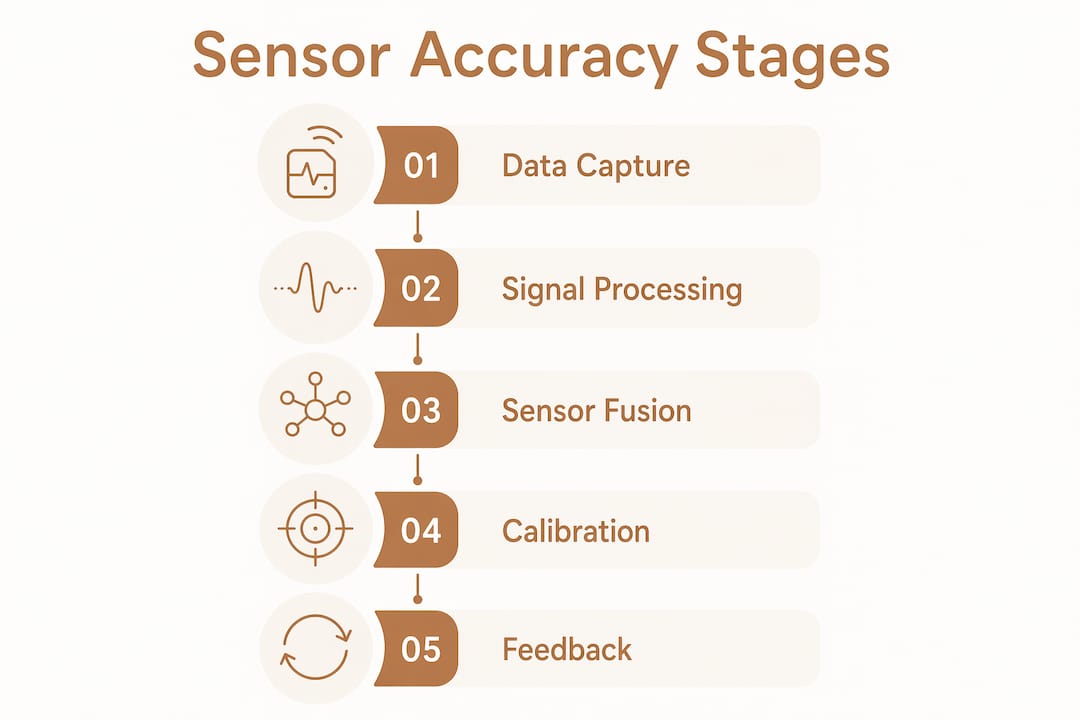
Wearable devices use multi-sensor fusion algorithms combining accelerometers, gyroscopes, magnetometers, and optical sensors to compensate for individual sensor limitations. This is why a modern fitness tracker can distinguish between running and cycling without you manually logging the activity. Each sensor contributes a signal; the algorithm resolves conflicts between them.
Precision sensors for movement tracking unlock specific fitness metrics that were previously unavailable to everyday athletes:
- Heart rate accuracy: Optical sensors combined with motion compensation algorithms filter out movement artifacts, delivering cleaner heart rate data during high-intensity intervals.
- Step counting and cadence: High-frequency IMUs detect foot strike patterns with enough resolution to calculate cadence, stride length, and asymmetry.
- Workout form analysis: Accelerometer and gyroscope fusion tracks joint angles and movement velocity, flagging form breakdowns before injury risk increases.
- Fatigue detection: Changes in movement variability detected by IMUs correlate with neuromuscular fatigue, giving coaches an objective signal beyond perceived exertion.
- Body composition metrics: Bioelectrical impedance sensors paired with precision calibration deliver body fat percentage and BMI readings that track trends reliably over time.
Pro Tip: For body composition tracking, consistency matters more than single-reading accuracy. Use your device at the same time of day, under the same hydration conditions, to get trend data you can act on.
The benefits of precision sensors extend beyond raw numbers. Real-time feedback during a workout lets you adjust intensity before you blow past your target heart rate zone. Personalized calibration means the device learns your movement patterns over time, reducing error further as it accumulates data about you specifically.
What factors affect precision sensor performance in the real world?
Lab specifications and real-world performance are not the same thing. Environmental stressors like thermal fluctuations and electromagnetic interference degrade sensor precision in ways that a clean lab environment never reveals. A sensor rated for high accuracy at 25°C may drift noticeably during an outdoor winter run or a hot yoga session.
The gap between spec and reality closes through adaptive filtering. Kalman filters are the standard tool here. They model the expected state of a system and continuously correct estimates based on incoming sensor data, weighting reliable signals more heavily when noise increases. Machine learning approaches go further, adapting filter parameters based on patterns in historical sensor data from real users.
Here are the four most common real-world factors that degrade tracking accuracy, and how precision sensor systems address each:
- Vibration: High-frequency mechanical vibration from gym equipment or road surfaces creates false motion signals. The TDK ICM-45687's 20,000 g shock resistance addresses this at the hardware level before software filtering even engages.
- Temperature change: Sensor components expand and contract with heat, shifting calibration baselines. Dynamic calibration routines correct for temperature-induced drift during use.
- Electromagnetic interference: Nearby electronics, gym equipment motors, and wireless signals introduce noise into sensor readings. Shielding and signal processing algorithms filter this out.
- Poor time synchronization: Unsynchronized sensor data streams create apparent noise even when individual sensors are accurate. Hardware-level time synchronization using NTP or PPS signals keeps fusion algorithms working with aligned data.
The practical takeaway is that a device's real-world tracking accuracy depends as much on its software and calibration architecture as on its sensor hardware.
Which advanced sensor technologies are setting new standards?
The frontier of precision sensor tracking technology is moving fast. High-end tracking systems like the FusionTrack platform used in robotic surgery achieve 0.08 mm RMS accuracy at 2 meters with 4 ms latency, operating at up to 335 Hz. That level of performance shows where the technology ceiling currently sits and how quickly it is descending toward consumer applications.
Quantum sensors represent the next major shift. Quantum sensors detect minute forces and motion using atoms and light as ultra-steady references, reducing drift issues that plague conventional MEMS sensors. They are progressing toward natural uniformity, which means less recalibration and more stable long-term tracking. The TrolMaster full spectrum quantum sensor demonstrates how quantum sensing is already moving into applied environments beyond pure research.
Displacement sensors are another category worth watching. Real-time displacement feedback at the point of interaction allows adaptive control at micron-level precision in robotics. The same principle applies to wearable health sensors: when a sensor can detect and correct for its own positional error in real time, it shifts from passive monitoring to active control. That shift is what separates a basic fitness tracker from a professional-grade health tool.
| Technology | Precision | Sampling Rate | Key Application |
|---|---|---|---|
| TDK ICM-45687 IMU | 3.8 mdps/√Hz noise | Up to 335 Hz | Wearable motion tracking |
| FusionTrack Optical | 0.08 mm RMS at 2 m | 335 Hz | Surgical robotics, high-stakes tracking |
| Quantum Sensors | Sub-nanometer stability | Variable | Navigation, advanced health sensing |
| Displacement Sensors | Micron-level | Real-time | Robotics, adaptive motion control |
The IoT integration driving health tracking in 2026 connects these sensor advances directly to consumer health platforms, making professional-grade data accessible to individual athletes and fitness professionals.
Key takeaways
Precision sensors improve tracking by combining high-frequency hardware, sensor fusion algorithms, and adaptive calibration to deliver accurate, repeatable health and fitness data in real-world conditions.
| Point | Details |
|---|---|
| Sensor fusion is the accuracy multiplier | Combining IMU, GNSS, and optical sensors yields up to 30% better positioning accuracy than any single sensor alone. |
| Noise floor beats sampling rate | True precision depends on low noise and repeatability, not just high update frequency. |
| Real-world factors require adaptive filtering | Kalman filters and machine learning corrections maintain accuracy despite vibration, heat, and interference. |
| Time synchronization is non-negotiable | Misaligned sensor data streams degrade fusion accuracy even when individual sensors perform well. |
| Advanced sensors are reaching consumer health tools | Technologies like quantum sensors and high-frequency IMUs are moving from industrial to fitness applications. |
Why sensor fusion will define the next decade of fitness tracking
I have spent years watching fitness technology promise more than it delivers. The pattern is always the same: a single impressive sensor spec gets marketed as a breakthrough, and then real-world performance disappoints. What actually changes outcomes is not one better sensor. It is the architecture around the sensor.
Sensor fusion combined with AI-driven calibration is the shift that matters. When a device learns your specific movement signature and adjusts its filtering accordingly, the accuracy gains are not incremental. They are structural. You stop getting data that reflects the device's limitations and start getting data that reflects your body.
The recalibration problem has been the quiet killer of long-term tracking reliability. Quantum sensor advances are addressing this directly. As sensors approach natural uniformity, the drift that makes six-month trend data unreliable starts to disappear. For fitness professionals managing clients over training cycles, that reliability is worth more than any single metric improvement.
My advice: stop evaluating health tracking devices by their headline specs and start asking about their fusion architecture, calibration frequency, and noise floor management. The device that answers those questions clearly is the one worth trusting with your training data.
— Jacob
Track smarter with uvirello's precision health tools
Knowing how sensors work is one thing. Having a device that puts that technology to work for your specific health goals is another.
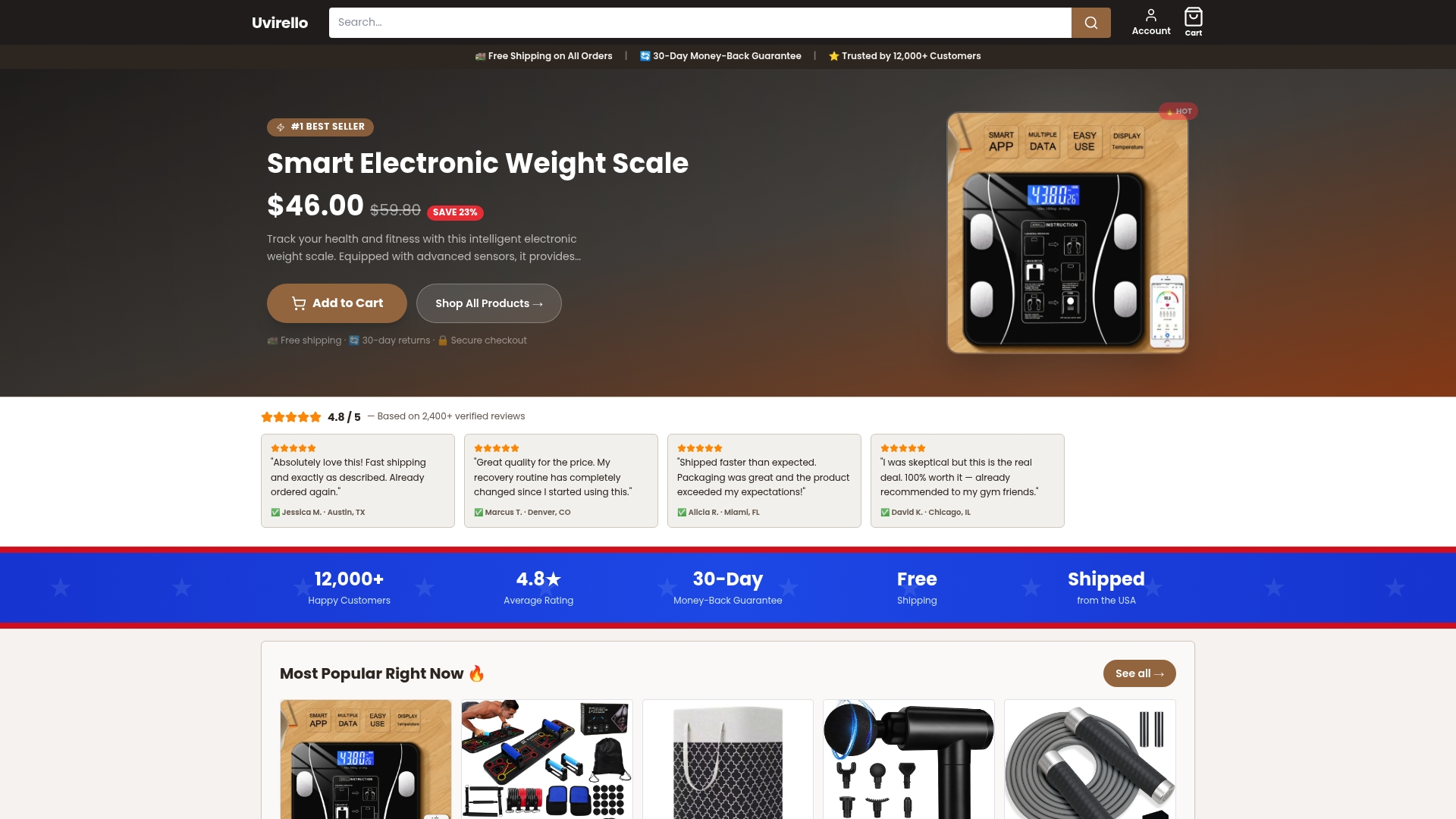
Uvirello's Smart Electronic Weight Scale uses high-precision sensors to deliver body composition metrics including body fat percentage and BMI with the accuracy and consistency that serious fitness tracking demands. Over 12,000 customers rate it 4.8 out of 5, not because it looks good on a shelf, but because the data it produces is reliable enough to act on. If you are ready to move from guessing to measuring, explore Uvirello's health tracking tools and see what precision sensor data can do for your fitness program.
FAQ
What are precision sensors in health tracking?
Precision sensors are measurement devices that deliver highly repeatable, low-latency readings of motion, position, or physiological signals. In health tracking, they include IMUs, optical heart rate sensors, and bioelectrical impedance sensors.
How does sensor fusion improve tracking accuracy?
Sensor fusion combines data from multiple sensors with complementary failure modes, such as GPS and IMU, to reduce individual errors. Integrating these systems produces up to 30% better accuracy than any single sensor delivers alone.
Does a higher sampling rate mean better tracking precision?
Not automatically. High update rates improve latency but precision depends on low noise floor and repeatability, which require systematic calibration and filtering regardless of sampling frequency.
What environmental factors degrade sensor accuracy?
Thermal fluctuations, electromagnetic interference, vibration, and poor time synchronization between sensors all reduce real-world tracking accuracy. Adaptive filtering techniques like Kalman filters compensate for these conditions during use.
How do precision sensors benefit fitness professionals specifically?
Precision sensors enable objective measurement of heart rate, cadence, movement asymmetry, and fatigue indicators. This gives coaches and athletes data-driven feedback that replaces subjective assessment with repeatable, comparable metrics across training sessions.