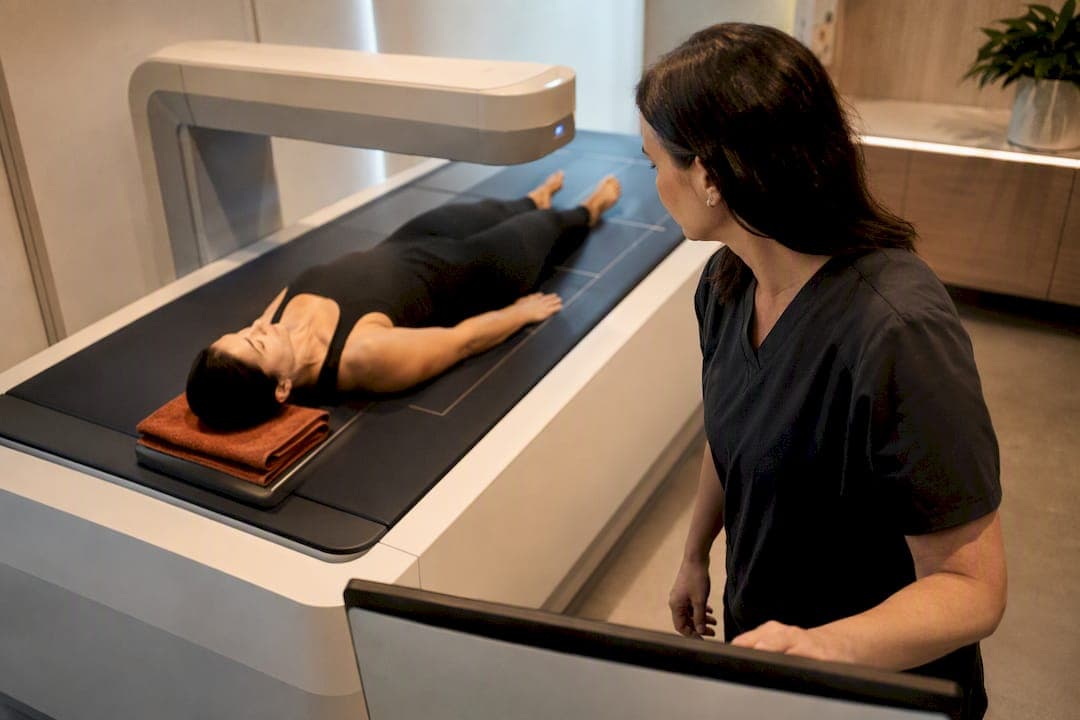
DXA is the clinical reference for absolute body composition accuracy: it directly separates bone, lean tissue, and fat with error margins around 1 to 2%. Consumer bioimpedance (BIA) smart scales typically show average differences from DXA that make them unreliable for one-off diagnosis but genuinely useful for tracking weekly trends. The smartest approach uses both: a DXA scan as your calibration point, a BIA smart scale for everything in between.
TL;DR:
- Consumer bioimpedance scales can vary significantly in accuracy, often differing from DXA by several percentage points in body fat estimation.
- Segmental multifrequency BIA devices track trends closer to DXA than basic foot-to-foot scales, especially for limb and trunk assessments.
- Use DXA for precise measurements like bone density and medical diagnoses, but rely on BIA scales for affordable, frequent trend tracking.
- Consistent measurement conditions and a 7-day rolling average improve BIA data reliability, especially regarding hydration variability.
- Combining an initial DXA scan with regular BIA monitoring offers an effective, cost-efficient approach for tracking body composition changes over time.
Table of Contents
- Bioimpedance vs. DXA: How Each Method Actually Measures Your Body
- How Accurate Is DXA Compared to Bioimpedance Scales?
- When Should You Use DXA vs. a BIA Smart Scale?
- Getting Clean Data From a Bioimpedance Scale
- What the Research Actually Says About Bioimpedance vs. DXA
- My Take: Anchor With DXA, Trend With a Smart Scale
- Track Your Trend Line With the Uvirello Smart Scale
- Further Reading on Body Composition Testing
Bioimpedance vs. DXA: How Each Method Actually Measures Your Body
The two technologies don't just differ in accuracy. They measure completely different physical properties, which is the real reason their numbers rarely match.
DXA (dual-energy X-ray absorptiometry) passes two low-dose X-ray beams through your body and measures how much each tissue type absorbs. Bone absorbs more than soft tissue, and lean tissue absorbs differently than fat, so the scanner can separate all three directly. That's why DXA remains the clinical reference method for body composition. It reports regional data (arms, legs, trunk) and bone mineral density, a metric no BIA device can measure at all.
BIA works on an entirely different principle. It sends a small electrical current through your body and measures resistance. Fat resists the current more than water-rich lean tissue does, so the device estimates your fat and lean mass from that resistance reading, run through a predictive equation calibrated on a reference population.
Not all BIA devices are built the same. The category splits into several tiers:
- Foot-to-foot smart scales: the type you stand on at home, sending current up one leg and down the other, which mostly captures lower-body impedance.
- Hand-to-foot clinical analyzers: used in gyms and clinics, running current from hand to foot for a fuller-body estimate.
- Segmental multifrequency devices: use several current frequencies and multiple electrodes to estimate limb and trunk composition separately.
- Bioimpedance spectroscopy (BIS): a research-grade variant that models fluid distribution across a range of frequencies, mainly used to track hydration status.
The practical distinction matters: DXA measures bone density directly, while every BIA number, including body fat percentage and muscle mass, is a statistical estimate derived from resistance and an algorithm. DXA involves minimal radiation exposure and is generally avoided during pregnancy; BIA is noninvasive but is not recommended for people with pacemakers or implanted defibrillators, since the electrical current can interfere with the device.
How Accurate Is DXA Compared to Bioimpedance Scales?
DXA is considered highly precise on repeated measurements, which is why researchers use it as the benchmark against which every other method gets checked. Consumer BIA smart scales tell a messier story.
**A cross-sectional comparison of three commercially available smart scales against DXA found absolute fat-mass errors often in the kilogram range, translating to body-fat differences commonly around a few percentage points. **That's the gap between a scale telling you're at 22% body fat when a DXA scan says 26 or 27%. For someone tracking a slow, steady fat-loss trend, that offset barely matters, since the direction of change usually still tracks. For someone using the number to make a one-time medical or performance decision, it can be the difference between "healthy" and "concerning."
The deeper issue is that BIA correlates well with DXA at the population level but isn't reliably interchangeable at the individual level. Average a hundred BIA readings against a hundred DXA scans, and the group trends line up nicely. Look at any single person's pair of readings, and the disagreement can be substantial, especially in certain groups:
- Athletes with high muscle density often get their body fat overestimated, since BIA algorithms are typically trained on general-population samples, not lean, muscular bodies.
- People at the extremes of BMI (very lean or very high body fat) see larger errors, because most consumer equations use a fixed formula, not one tuned to their body type.
- Anyone dealing with fluid retention or edema gets skewed readings, since BIA can't distinguish extra water from extra fat tissue.
- Older adults often show altered water distribution, which shifts resistance readings independent of any real change in fat or muscle.
Device model and study year matter too: comparative research shows consistent offsets between different consumer scales, meaning one brand's error pattern doesn't necessarily apply to another. And segmental multifrequency BIA units track closer to DXA than basic foot-to-foot scales do, particularly for trunk and limb estimates, because they use more electrodes and more current frequencies to build the picture. Hydration status, electrode placement, and the algorithm behind the device are the three biggest bias sources, and all three shift from one reading to the next unless you control for them.
When Should You Use DXA vs. a BIA Smart Scale?
The accuracy gap doesn't mean one method is useless. It means each one has a job it's actually good at.
- Choose DXA when precision or bone health is the point. Osteoporosis screening, pre- and post-surgical baselines, and academic research all demand DXA's regional accuracy and direct bone mineral density reading. Clinical guidance generally recommends spacing repeat DXA scans to clinically indicated intervals, typically 6 to 12 months apart, rather than scanning more often than that.
- Choose BIA when you need frequent, low-cost feedback. Weight-loss programs, muscle-building phases, and general habit tracking all benefit more from a weekly number than a perfectly accurate one. A smart scale you can step on every morning beats an annual scan you can't access on demand.
- Combine both for the best of each. Get one DXA scan as your calibration anchor, then use a consistent BIA protocol for the weeks and months in between. Re-check with DXA after a major training block, a significant weight change, or if your smart scale's trend suddenly stops matching how you feel or look.
- Weigh cost and access honestly. A DXA scan typically requires an appointment and involves variable out-of-pocket costs depending on the imaging center. A smart scale is a one-time purchase you use daily without booking anything, which is exactly why it fits the trend-tracking role so well.
Getting Clean Data From a Bioimpedance Scale
Bad BIA readings usually come from bad measurement habits, not a bad device. Fix the routine and the numbers get a lot more trustworthy.
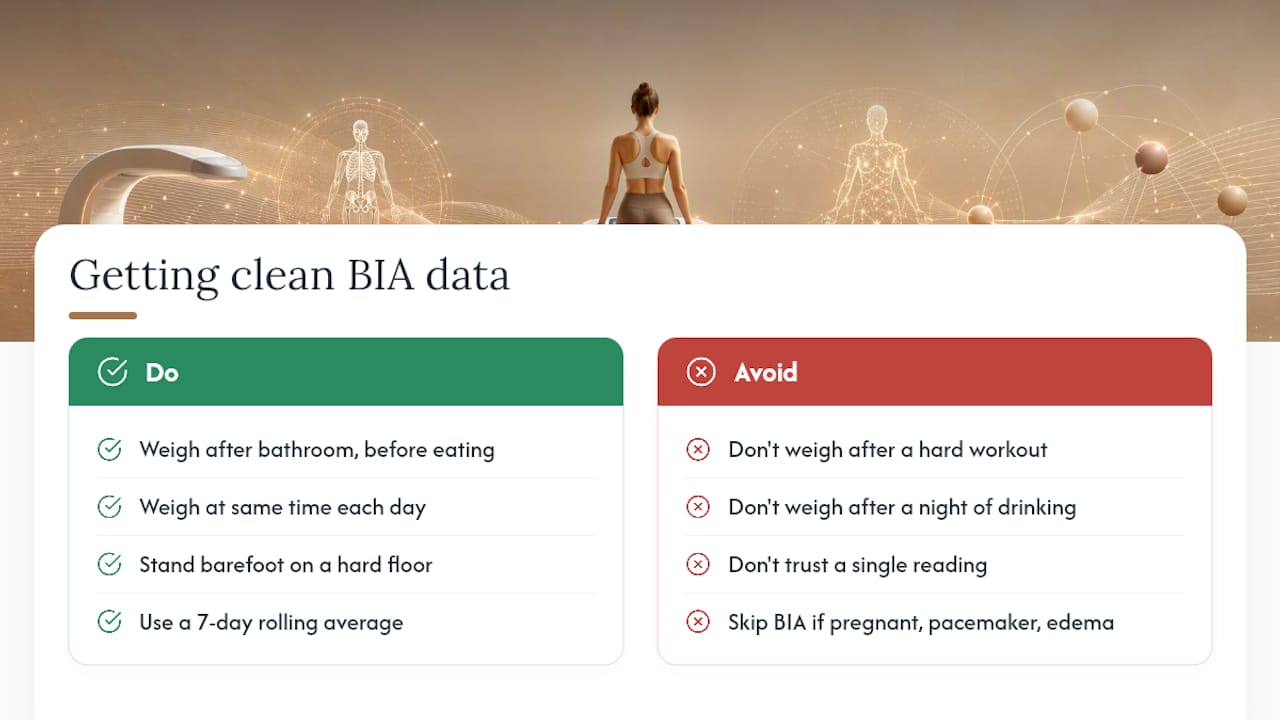
Weigh yourself first thing in the morning, after using the bathroom and before eating or drinking anything. Skip the scale after a hard workout or a night of drinking, since both temporarily shift your hydration and can throw the reading off by several points. Stand barefoot, on a hard floor, in roughly the same state of dress each time, and try to place your feet the same way on the electrodes every session.
Don't trust a single reading. Track a 7-day rolling average instead, since day-to-day fluctuation from water weight and food volume can mask or exaggerate a real trend. Note anything unusual in your log, illness, travel, a salty meal, so a weird spike has an explanation instead of triggering a panic. Hydration is the single biggest variable behind BIA accuracy; a shift of just 2% in body water can move your reported body fat percentage by several points on its own.
Pro Tip: Weigh in at the same time of day, log it in an app that graphs your trend automatically, and ignore any single number that jumps more than a point or two from your rolling average, it's almost always water, not fat.
If you use a pacemaker, implanted defibrillator, or are pregnant, skip BIA scales entirely and talk to your doctor about alternative tracking methods; the same caution applies to anyone with severe edema, since fluid retention makes the reading meaningless anyway. A connected scale app that automatically charts your rolling average removes most of the guesswork from this process.
What the Research Actually Says About Bioimpedance vs. DXA
The scientific literature is fairly consistent on this point: DXA remains the reference standard because it directly separates bone, lean tissue, and fat rather than estimating them from resistance. BIA earns its place as a legitimate tool too, just not for the same job.
- Group-level BIA estimates track DXA closely, which is why researchers still use BIA in large population studies.
- Individual-level disagreement, particularly for people with atypical body composition, is common enough that clinicians don't treat a single BIA reading as diagnostic.
- Clinical-grade multifrequency BIA and bioimpedance spectroscopy offer real segmental and fluid-volume data, but only in the hands of a trained operator with a calibrated device.
The real value of a home smart scale isn't matching a lab-grade scan number for number. It's catching the direction and speed of change, week over week, long before you'd notice it in the mirror.
That's the frame Uvirello builds its Smart Electronic Weight Scale around: not clinical equivalence, but consistent, high-precision trend data you can act on immediately. No single BIA reading should ever override a doctor's clinical judgment or a diagnosed condition; treat it as a habit-tracking tool that complements medical care, not a replacement for it.
My Take: Anchor With DXA, Trend With a Smart Scale
If I were setting this up for myself, I'd get one DXA scan to establish a real baseline, then track weekly with a smart scale and only re-check DXA every six to twelve months or after a major change. This balances what actually matters for most people: cost and access. A once-a-year clinical anchor keeps your home numbers honest, while daily or weekly smart-scale data tells you whether your effort is working long before a scan ever could. Precision has its place, but so does knowing which way the line is moving.
— Jacob
Track Your Trend Line With the Uvirello Smart Scale
Once you've got a DXA baseline (or you're skipping it for now and just want reliable week-to-week feedback), the Uvirello Smart Electronic Weight Scale is built for exactly that role: consistent trend data, not clinical diagnosis. Its high-precision sensors track body fat percentage, BMI, and related metrics with the kind of session-to-session consistency that makes a rolling average actually mean something.
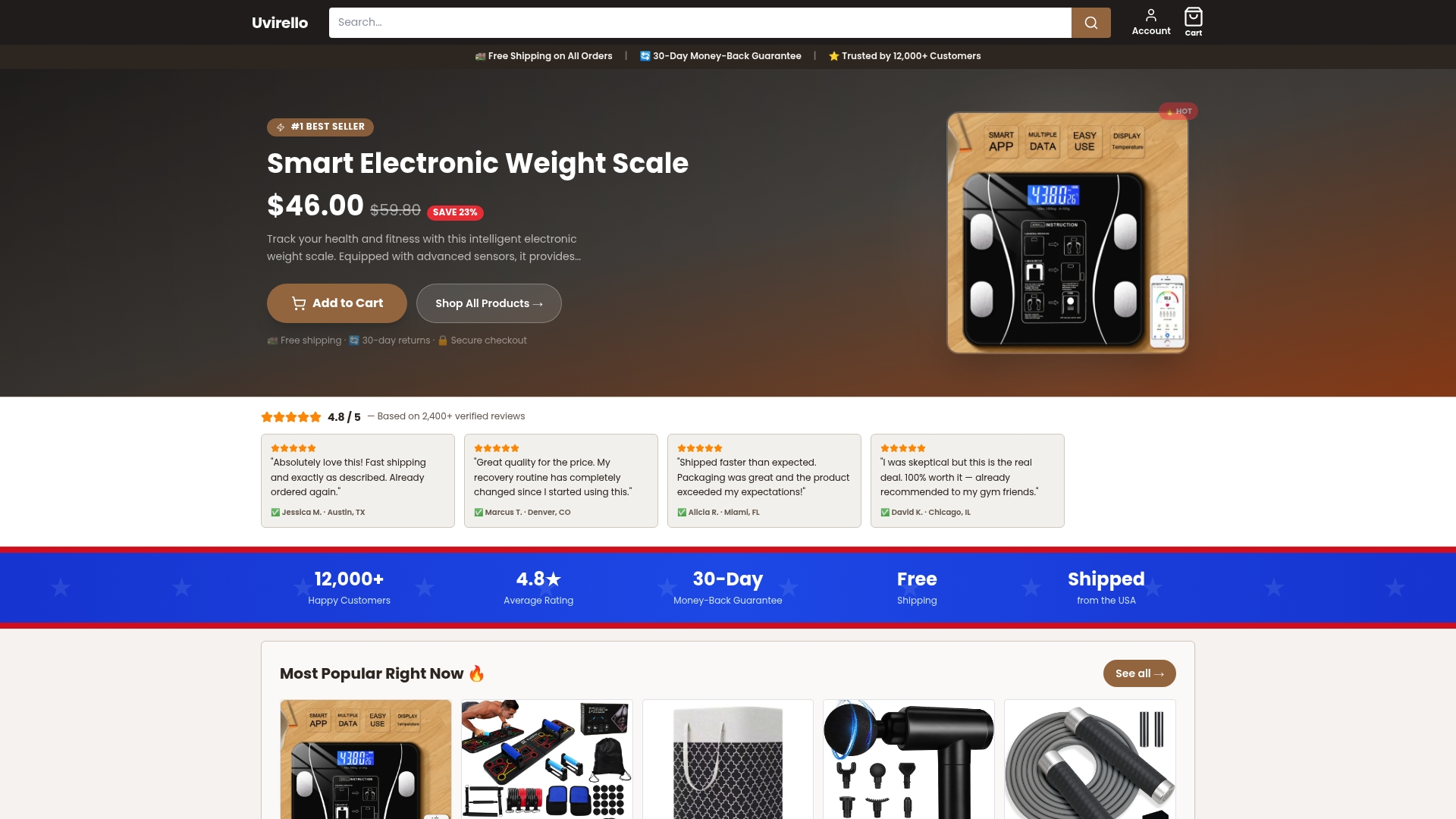
Set it up the same way any solid BIA protocol works: establish your starting numbers in week one, weigh in under the same conditions each morning, and let the app chart your trend instead of reacting to any single reading. If you ever get a DXA scan down the line, you'll have months of consistent home data to compare it against. Many customers use the scale to do exactly this, finding it reliable day to day. Check the Smart Electronic Weight Scale and start your baseline this week.
Further Reading on Body Composition Testing
- Assessment of Body Composition Using BIA and DXA: A Critical Overview
- Accuracy of Three Commercially Available Smart Scales vs. DEXA
This article is general information, not a substitute for advice from a qualified doctor. Consult a qualified healthcare professional about your own circumstances before acting on anything here.