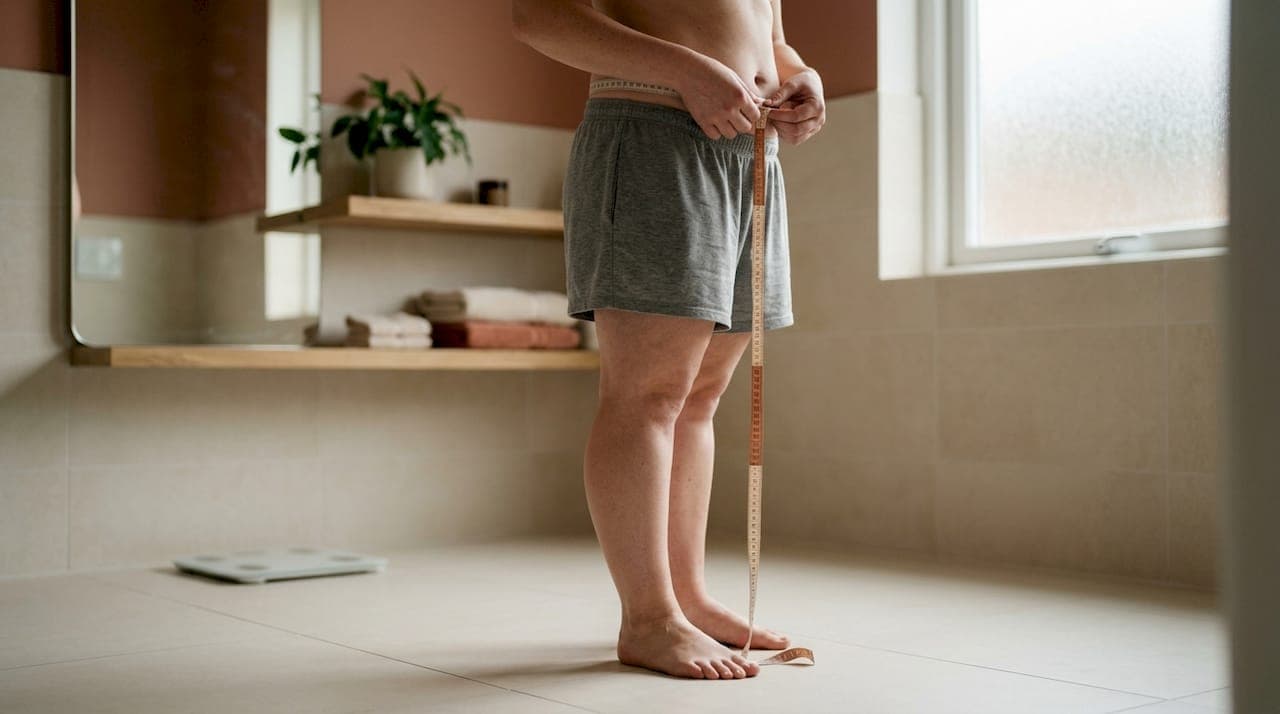
The most practical way to monitor visceral fat at home is a consistent waist circumference measurement, checked against smart-scale trends over time. Imaging tests like CT and MRI measure visceral fat with real precision, but you rarely need them for routine tracking. Here's your one action for today: measure your waist under controlled conditions and write down that number, plus your weight and body fat percentage if you have a scale that tracks it.
Do this now:
- Measure your waist first thing in the morning, before food or drink.
- Log weight and body fat percentage (if your scale provides it).
- Take a front and side photo for a visual baseline.
- Repeat weekly and watch the 4 to 8 week trend, not the daily number.
- See a doctor if your waist consistently sits above the thresholds covered below, or if you notice new symptoms like fatigue, high blood pressure, or unexplained weight gain.
Key Takeaways
Monitoring visceral fat effectively requires consistent waist measurements as the primary signal, corroborated by 4 to 8 week smart-scale trend averages, with imaging reserved for clinical need.
| Point | Details |
|---|---|
| Waist circumference is primary | Measure at the navel, average three readings, and track weekly for the most reliable at-home signal. |
| Trust averages, not single readings | Use a 4 to 8 week moving average for both waist and scale data to filter out daily noise. |
| Control your conditions | Measure barefoot, in the morning, before food or drink, to keep readings comparable over time. |
| Imaging is precise but optional | CT, MRI, and DEXA quantify visceral fat accurately but are usually reserved for specific clinical questions. |
| Uvirello supports the trend | The Smart Electronic Weight Scale's high-precision sensors track body fat percentage and BMI to corroborate your waist log. |
Table of Contents
- How to Prepare for Visceral Fat Level Monitoring Steps
- What Is the Correct Way to Measure Your Waist?
- How Do Smart Scales Estimate Visceral Fat?
- When Do You Need CT, MRI, or DEXA Testing?
- How Often Should You Track Visceral Fat?
- What Does a Meaningful Change in Visceral Fat Look Like?
- Where a Smart Scale Fits Into Your Monitoring Routine
- The Real Problem With Most Visceral Fat Advice
- Track Your Progress With Uvirello's Smart Scale
- Frequently Asked Questions
- Sources
How to Prepare for Visceral Fat Level Monitoring Steps
You need almost nothing to start: a flexible tape measure, a smart scale if you own one, and a notebook or app to log numbers. A camera works fine for progress photos, and you probably already have one in your pocket.
Consistency is what makes the data useful, not fancy equipment. Take measurements in the morning, after using the bathroom, before eating or drinking anything, wearing minimal clothing, and barefoot if you're stepping on a scale.
- Take three waist measurements in a row and average them.
- Record your weight, body fat percentage (if available), the date and time, and a quick photo.
- Save this as your baseline entry before you change anything about your routine.
Pro Tip: Keep the tape measure in the same spot, like a bathroom drawer, so measuring becomes a habit instead of a chore you have to hunt for.
What Is the Correct Way to Measure Your Waist?
Waist circumference remains the most practical at-home method for tracking visceral fat trends, and it costs you nothing but a tape measure and two minutes.
Stand relaxed, arms at your sides, and breathe out gently before you read the tape. Wrap it around your bare stomach, either at the navel or at the WHO midpoint between your lowest rib and the top of your hip bone. The navel site is easier to find consistently on your own, which makes it the better choice for self-tracking even though clinics often use the midpoint method. Take three readings and average them so a single bad measurement doesn't throw off your log.
Where you land on the tape matters, but context matters more. As a rough guideline, waist circumference above 35 inches in women or 40 inches in men signals higher health risk, though Harvard Health notes these cutoffs need to be read alongside your overall body size and ethnicity, not treated as a hard diagnostic line. A waist-to-height ratio under 0.5 is a simpler, more broadly applicable target that holds up reasonably well across different body types.
What counts as real progress? A drop of half an inch to an inch over 4 to 8 weeks, held consistently across multiple readings, usually reflects genuine fat loss rather than measurement noise or a bloated Tuesday. Log every reading with the date, so you can look back at a real trend line instead of guessing from memory.
How Do Smart Scales Estimate Visceral Fat?
Smart scales don't see your organs. They run bioelectrical impedance analysis (BIA), sending a tiny electrical current through your body and estimating fat, muscle, and water based on how fast that current travels. The "visceral fat level" a scale reports is an algorithmic estimate, not a direct measurement of the fat wrapped around your organs.
That estimate is genuinely useful, but only if you control for the variables that throw it off. Step on the scale at the same time every day, ideally the morning, after using the bathroom, barefoot, and before you've exercised or had a drink the night before.
Several everyday factors can swing a single reading noticeably:
- Hydration level, since water content changes how the electrical current travels.
- A recent meal or a lot of sodium, which shifts water retention temporarily.
- Exercise in the past 24 hours, which changes blood flow and hydration.
- Alcohol the night before, which dehydrates and skews the numbers.
Because of these swings, experts recommend focusing on a 4 to 8 week moving average instead of reacting to any single day's reading. Cross-check your scale trend against your waist measurements and progress photos. If all three are moving in the same direction, you can trust the signal.
Pro Tip: Don't panic over a two-day jump on the scale. That's almost always water weight, not fat. Wait for the weekly average to confirm before you change anything about your routine.
When Do You Need CT, MRI, or DEXA Testing?
CT and MRI scans are the most accurate way to quantify visceral fat, giving doctors an actual cross-sectional image of fat around your organs. DEXA scans offer a reasonable middle ground, less precise than CT or MRI for visceral fat specifically, but far more detailed than a home scale.
None of that means you need one. These tests are usually reserved for specific clinical situations, not routine home tracking:
- Your risk assessment is unclear despite normal-looking waist measurements.
- You have related conditions, like type 2 diabetes or fatty liver disease, that a doctor wants quantified.
- You're being evaluated before bariatric or other major surgery.
Cost, limited availability, and radiation exposure with CT scans mean these stay in the clinical toolbox rather than your bathroom routine. If you do pursue testing, bring your waist logs, scale trends, and any recent labs to the appointment. That data gives your clinician months of context instead of a single snapshot.
How Often Should You Track Visceral Fat?
A simple cadence keeps the data honest without turning tracking into a second job. Weekly waist measurements, weekly morning scale readings under the same conditions, and monthly photos give you enough data points to spot a real trend while filtering out daily noise.
- Measure your waist and step on the scale every Monday morning, same time, same conditions.
- After four weeks, average those four waist numbers and four scale readings.
- After eight weeks, compare your two rolling averages against each other.
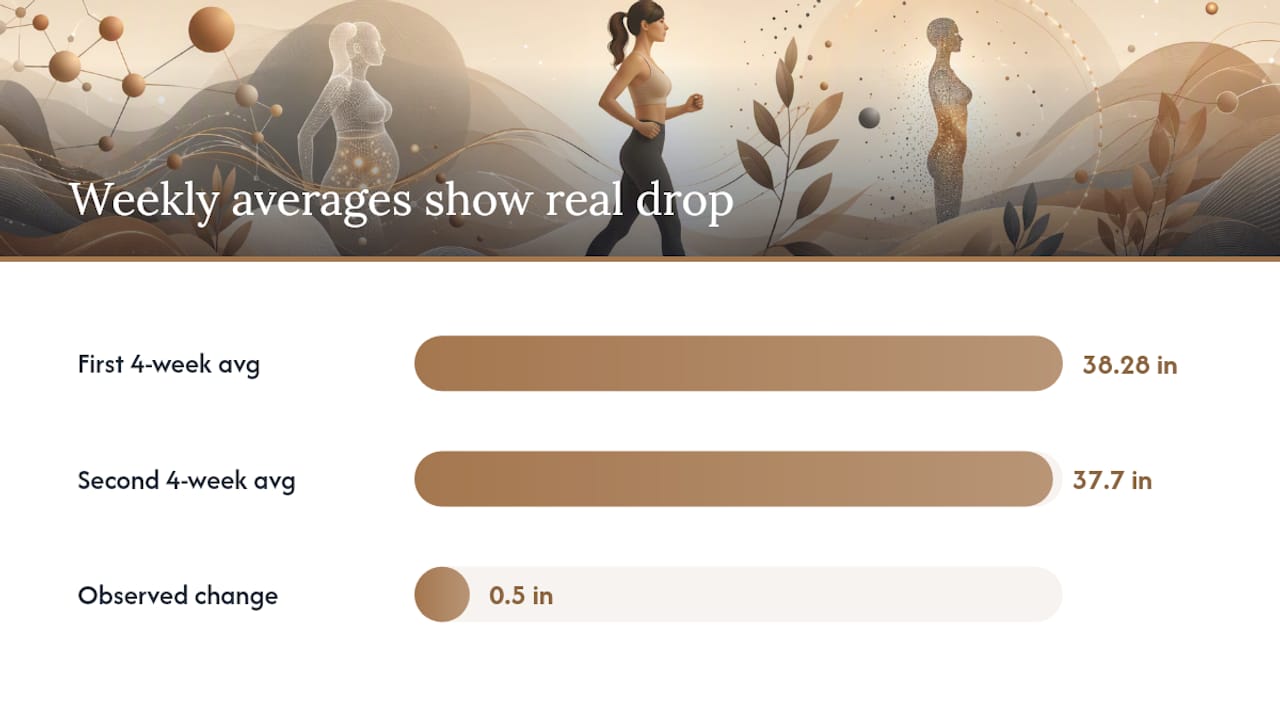
Say your waist readings over eight weeks are 38.5, 38.2, 38.4, 38.0, 37.8, 37.6, 37.9, and 37.5 inches. The first four-week average is 38.28 inches; the second is 37.7 inches. That's a real half-inch drop, not noise, because it shows up consistently across both averaging windows.
| Signal | What it tells you |
|---|---|
| Waist trend | Most direct at-home indicator of visceral fat change |
| Waist-to-height ratio | Confirms whether risk is dropping relative to your height |
| Scale body fat % trend | Corroborates fat loss versus muscle or water shifts |
| Progress photos | Catches visual changes numbers sometimes miss |
Watch for red flags that override the routine: rapid waist gain over a few weeks, new symptoms like breathlessness or swelling, or abnormal bloodwork from a checkup. Any of those warrant a call to your doctor regardless of what your weekly average says.
What Does a Meaningful Change in Visceral Fat Look Like?
A quarter-inch shift in your waist week to week is noise. A consistent inch to two inches lost over 8 to 12 weeks, confirmed by your moving average, is real progress worth noting.
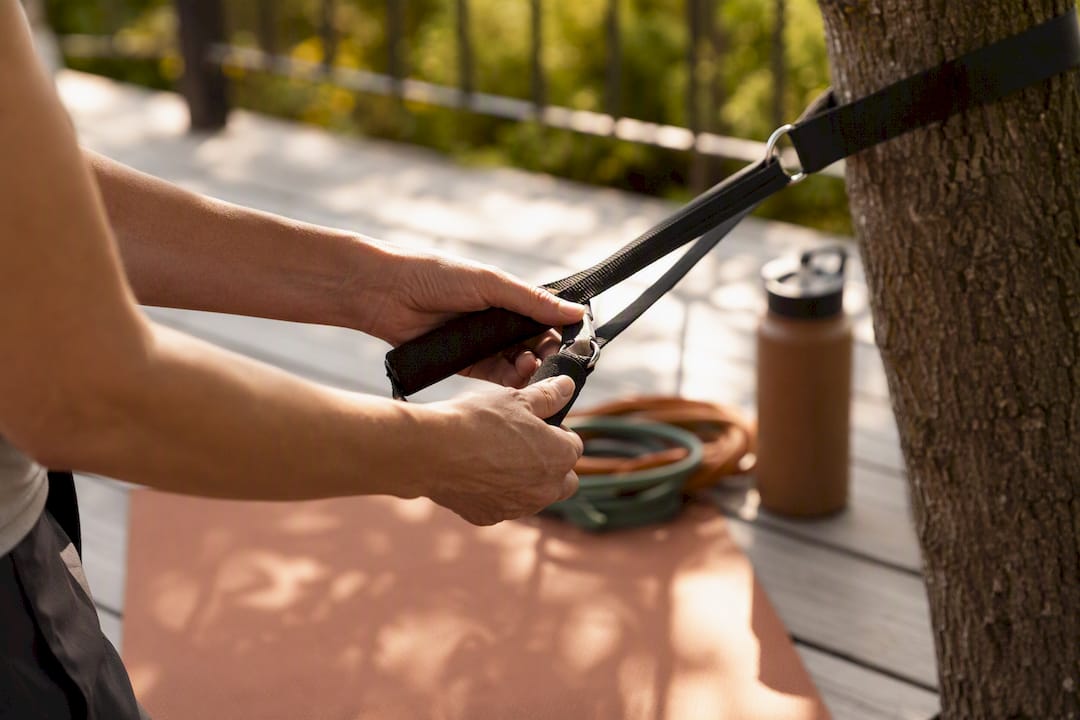
Three levers move visceral fat more than anything else: aerobic exercise, resistance training, and diet quality, with sleep and stress management working in the background to support both. Aim for roughly 150 minutes of moderate aerobic activity weekly alongside two or more resistance sessions. Cleveland Clinic points out that visceral fat responds primarily to lifestyle change rather than any single quick fix, which is why the combination matters more than any one piece.
See a clinician if your waist stays above the thresholds discussed earlier despite consistent effort, if labs come back abnormal, or if you notice symptoms like high blood pressure or persistent fatigue.
If a trend genuinely alarms you, follow this sequence before assuming the worst:
- Re-measure under fully controlled conditions to rule out a fluke reading.
- Pull up your full trend log, not just the latest number.
- Bring that log to a clinician rather than trying to self-diagnose from one data point.
Pro Tip: Write down what changed in your life alongside your numbers, like a new job, less sleep, or a vacation. Context explains spikes that pure numbers can't.
Where a Smart Scale Fits Into Your Monitoring Routine
A quality smart scale earns its place in this workflow as a corroborating data source, not a diagnostic tool. Uvirello's Smart Electronic Weight Scale uses high-precision sensors to track body fat percentage, BMI, and other composition metrics alongside your waist log, and it has built trust with over 12,000 customers at an average 4.8 out of 5 rating.
- Take readings every morning under the same conditions described earlier, then let the app build your trend dashboard automatically.
- Use the body fat percentage output to corroborate your waist trend, never as a standalone verdict.
- Treat every number as a trend point, not a diagnosis. For deeper context on what these metrics mean, see this guide to body composition metrics.
The Real Problem With Most Visceral Fat Advice
Most advice on this topic treats visceral fat like a mystery that requires expensive testing to solve. It doesn't. The research consistently points back to waist circumference and consistent trend tracking as the tools that actually change behavior, because they're the ones people will realistically use every week.
The bigger failure isn't lack of access to imaging. It's inconsistency. People weigh themselves once, panic at a random water-retention spike, and abandon tracking entirely. Or they measure their waist once a year and wonder why the number never seems to move. A moving average smooths out exactly the noise that makes people quit.
If you take one thing from this, prioritize the boring stuff first: same time, same conditions, same tape measure spot, every week. Skip the CT scan unless a doctor specifically recommends it for a clinical reason. The gap between people who successfully manage visceral fat and those who don't usually comes down to who kept a consistent log for three months, not who ran the fanciest test.
Track Your Progress With Uvirello's Smart Scale
Uvirello gives you the trend-based corroboration this whole monitoring workflow depends on, without asking you to interpret raw impedance data yourself. The scale's high-precision sensors calculate body fat percentage, BMI, and other composition metrics automatically each morning, building the exact 4 to 8 week trend line this article recommends you track.
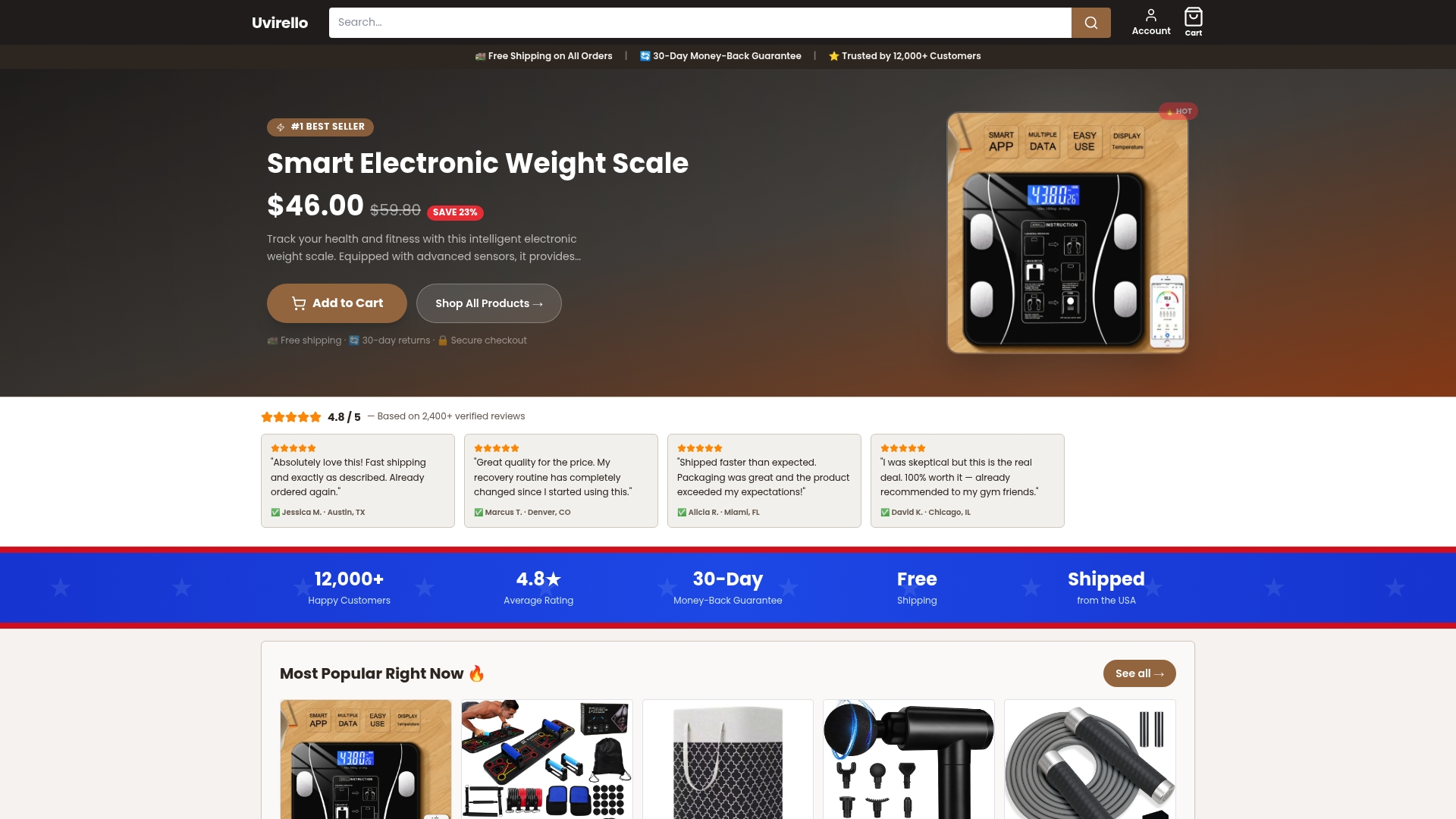
That combination of ease and precision is why over 12,000 customers rate it 4.8 out of 5. You get a device that does the math while you focus on the habit: step on it every morning, log your waist alongside it, and let the pattern tell the real story instead of one noisy day. Check current availability and order details on the Uvirello product page to start building your baseline this week.
Frequently Asked Questions
What is the best way to monitor visceral fat level at home? Waist circumference measured consistently, corroborated by a smart scale's 4 to 8 week trend average, gives you the most reliable at-home signal without needing clinical imaging.
How often should I check my visceral fat level? Measure your waist and step on a smart scale weekly under the same conditions, then compare monthly moving averages rather than reacting to daily numbers.
Can a smart scale accurately measure visceral fat? Smart scales estimate visceral fat using bioelectrical impedance, which correlates with real fat levels but fluctuates with hydration and timing, so treat the number as a trend indicator, not an exact measurement.
What waist size indicates too much visceral fat? A waist above roughly 35 inches in women or 40 inches in men signals elevated risk, though a waist-to-height ratio under 0.5 is often a more useful, body-size-adjusted target.
Do I need a CT or MRI scan to check visceral fat? Most people don't. Imaging is the most precise method available, but it's typically reserved for cases with unclear risk, related health conditions, or pre-surgical evaluation.
This article is general information, not a substitute for advice from a qualified doctor. Consult a qualified healthcare professional about your own circumstances before acting on anything here.
Sources
- Taking Aim at Belly Fat - Harvard Health Publications
- Visceral Fat - Cleveland Clinic
- Visceral Fat vs. Weight: Why Your Waist Matters More - Barbell Medicine