
A desk job actively slows your metabolism by reducing muscle activity, which triggers a cascade of biological changes that raise your risk for obesity, insulin resistance, and cardiovascular disease. This is not simply about burning fewer calories. Prolonged sitting suppresses key metabolic enzymes, disrupts glucose clearance, and causes fat to accumulate in your bloodstream. Over 30% of office workers are overweight or obese, and sedentary behavior increases that risk by a factor of 10. Understanding what desk jobs do to metabolism is the first step toward doing something about it.
What does a desk job do to your metabolism biologically?
Sitting for long periods does not just reduce calorie burn. It actively shuts down metabolic processes that your body needs to function properly. The distinction matters because it means a one-hour gym session cannot simply undo eight hours of inactivity.

The first mechanism involves lipoprotein lipase, or LPL. LPL is an enzyme that breaks down fat in your bloodstream and moves it into muscle cells for energy. Prolonged sitting suppresses LPL, which means fat stays in your blood as triglycerides instead of being burned. Elevated triglycerides are a direct marker of metabolic dysfunction and cardiovascular risk.
The second mechanism involves GLUT4, a glucose transporter that muscle contractions activate. When your muscles are still, GLUT4 activation is impaired, so glucose from your last meal stays in your bloodstream longer than it should. Your pancreas compensates by releasing more insulin. Over time, this cycle drives insulin resistance and increases your risk of type 2 diabetes.
- LPL suppression: Fat stays in the blood as triglycerides instead of being used for energy.
- GLUT4 inhibition: Blood glucose remains elevated after meals, demanding more insulin.
- Insulin resistance: Repeated glucose spikes force the pancreas to overwork, reducing its sensitivity.
- Triglyceride buildup: Excess blood lipids accumulate and contribute to arterial inflammation.
Pro Tip: Set a phone alarm for every 25 minutes during your workday. Even a 90-second walk to refill your water bottle reactivates LPL and GLUT4 pathways that sitting shuts down.
How much do desk workers actually sit, and what does it cost them?
The numbers are more extreme than most professionals expect. Hybrid office workers sit an average of 11.08 hours per day, with home workdays adding roughly 20 minutes more sitting than office days. That is not 8 hours at a desk. That figure includes commuting, meals, and evening screen time, all stacked on top of the workday itself.
The health consequences scale with sitting duration. The table below shows how sitting time and activity levels interact with metabolic and musculoskeletal risk.
| Daily sitting time | Activity level | Key risk outcome |
|---|---|---|
| Under 8 hours | Regular moderate activity | 90% lower obesity risk |
| 8–10 hours | Meets exercise guidelines | Partial risk offset; metabolic markers still elevated |
| Over 10 hours | Meets exercise guidelines | "Active couch potato" effect; exercise does not fully offset risk |
| Over 10 hours | Low activity | Highest risk for obesity, insulin resistance, and musculoskeletal symptoms |
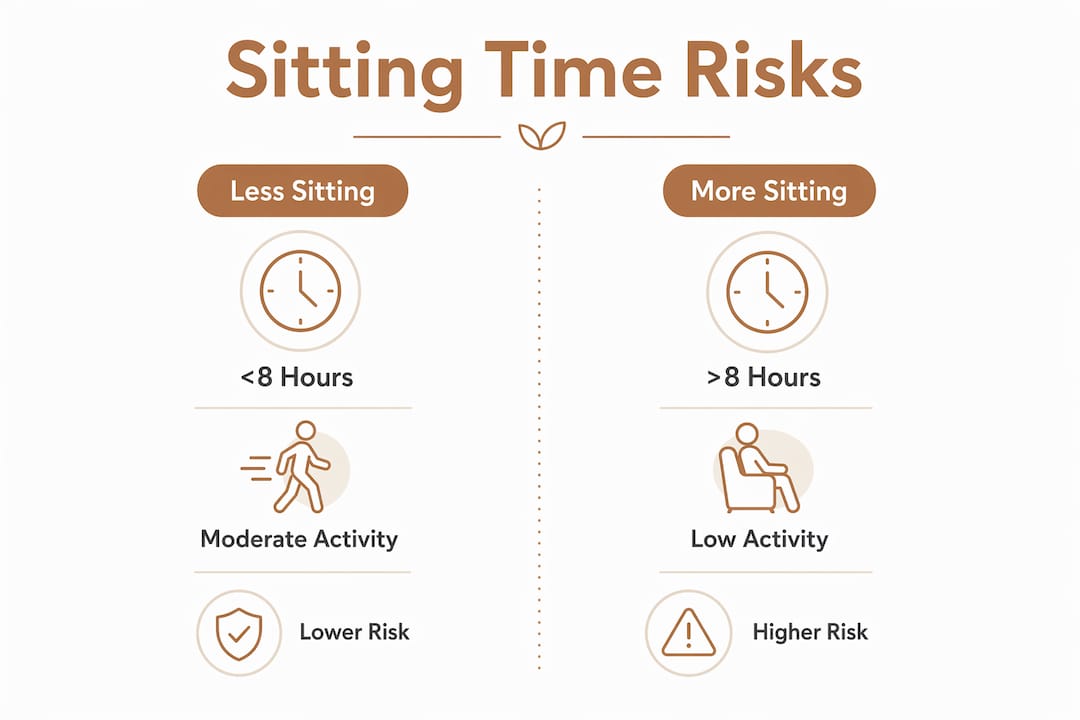
The "active couch potato" effect is one of the most counterintuitive findings in metabolic research. Meeting the standard 150 minutes of weekly exercise does not fully protect you if you sit for more than 10 hours a day. The metabolic damage from prolonged sitting accumulates independently of what you do at the gym. Replacing just 30 minutes of sitting with movement reduces early death risk by 2% among people who sit more than 4 hours daily. That figure compounds meaningfully over years.
Musculoskeletal symptoms add another layer of cost. Sitting time during home office days links directly to increased back, neck, and shoulder pain. These symptoms reduce productivity and often discourage the after-hours exercise that workers rely on to compensate. It becomes a self-reinforcing cycle. For a full picture of the physical risks tied to sedentary work, the desk job health risks checklist covers the most common warning signs office workers overlook.
Why standing desks alone aren't enough
Standing desks became the go-to solution for sedentary work, and they do reduce sitting time. The problem is that prolonged standing carries its own metabolic and physical costs that most people do not anticipate.
Prolonged standing produces similar metabolic and cardiovascular strain as prolonged sitting. It causes muscle fatigue in the legs and lower back, increases venous pooling in the legs, and does not meaningfully activate the LPL or GLUT4 pathways that sitting suppresses. Standing still is not the same as moving. Your muscles need contraction, not just a change in posture.
- Muscle fatigue: Standing for hours tires the postural muscles without providing metabolic benefit.
- Cardiovascular strain: Prolonged standing raises the risk of varicose veins and lower-limb discomfort.
- No enzyme activation: LPL and GLUT4 require actual muscle movement, not static posture changes.
- False security: Workers who stand often feel they have "solved" the sitting problem and move less overall.
Pro Tip: Use your standing desk as a trigger for movement, not a substitute for it. Every time you raise the desk, take a two-minute walk before you start working at the new height.
The real variable is movement frequency, not posture. A worker who sits but stands and walks every 25 minutes has better metabolic outcomes than one who stands for three uninterrupted hours. The body responds to the rhythm of contraction and rest, not to a single sustained position.
Practical strategies to counter metabolism changes in office jobs
The research is clear: frequent movement breaks every 20–30 minutes maintain insulin sensitivity and lipid metabolism better than a single daily workout. This finding reframes the entire approach to desk job fitness. The goal is not to exercise harder after work. The goal is to move more often during work.
-
Set a movement timer. Use a phone alarm, smartwatch vibration, or a browser extension to prompt a two-minute activity break every 25 minutes. Walk to a colleague's desk, do 10 squats, or pace during a phone call.
-
Habit-stack movement onto existing routines. Pairing short activity bouts with calls or meals is more effective than exercising only outside work hours. After every video call, stand and walk for 90 seconds before your next task.
-
Use a desk stepper or resistance band. A compact under-desk stepper keeps your leg muscles contracting while you work. Even low-intensity leg movement activates LPL and helps clear post-meal glucose.
-
Walk after lunch. A 10-minute walk after eating is one of the most metabolically effective habits a desk worker can build. It activates GLUT4 at exactly the moment your blood glucose peaks, reducing the insulin spike.
-
Batch your errands. Instead of sending an email to a colleague on the same floor, walk to their desk. Replace one elevator ride with stairs. These micro-decisions accumulate into meaningful movement volume across a week.
-
Track your sitting time, not just your steps. Step counts miss the critical variable, which is uninterrupted sitting duration. Monitoring how long you sit between breaks gives you the data you actually need to change behavior. Tools that track fitness progress for desk workers make this visible and measurable.
The underlying principle is movement distribution. Metabolic risk is more about how often you move than how hard you exercise. Spreading activity across the day keeps your metabolic enzymes active, prevents glucose from stagnating in your bloodstream, and reduces the cumulative damage that prolonged sitting causes.
Key Takeaways
Desk jobs slow metabolism by suppressing LPL and GLUT4 activity, and frequent movement breaks throughout the workday are the most effective way to reverse that damage.
| Point | Details |
|---|---|
| Sitting suppresses key enzymes | LPL and GLUT4 shut down during inactivity, causing fat and glucose to accumulate in the blood. |
| Office workers sit over 11 hours daily | Hybrid workers average 11.08 hours of sitting per day, far exceeding safe metabolic thresholds. |
| Exercise alone is not enough | Meeting weekly exercise guidelines does not fully offset the risk of sitting more than 10 hours a day. |
| Movement frequency beats workout intensity | Two-minute breaks every 20–30 minutes protect metabolic health better than a single daily gym session. |
| Track sitting duration, not just steps | Monitoring uninterrupted sitting time gives you the data needed to change behavior and reduce risk. |
What I've learned about metabolism after years at a desk
The conventional advice is to hit the gym before or after work and call it done. I followed that logic for years, and my metabolic markers still crept in the wrong direction. The research eventually confirmed what my body was already telling me: the problem is not the absence of exercise. The problem is the presence of uninterrupted sitting.
The standing desk phase was no better. I bought one, felt virtuous, and stood for long stretches without moving. My back hurt more, my energy did not improve, and I was still not activating the metabolic pathways that matter. The desk was a prop, not a solution.
What actually worked was treating movement as a work habit rather than a health habit. I stopped thinking of activity as something that happens outside the office and started building it into the structure of my day. Two minutes after every call. A walk after lunch without exception. Squats while waiting for a file to load. None of these feel like exercise. All of them add up.
The hardest part is accepting that there is no single intervention that fixes sedentary work. Not a gym membership, not a standing desk, not a step goal. The fix is distributed, frequent, and unglamorous. Small contractions, repeated throughout the day, keep your metabolism doing what it is designed to do.
— Jacob
How Uvirello helps desk workers track what actually matters
Knowing that sitting hurts your metabolism is one thing. Seeing the data on your own body is another.

Uvirello's Smart Electronic Weight Scale goes beyond body weight to measure body fat percentage, BMI, and other composition metrics that reflect the real impact of sedentary work on your health. When you can see how your body composition shifts over weeks of consistent movement breaks versus weeks of uninterrupted sitting, the motivation to keep moving becomes concrete. Over 12,000 people rate Uvirello at 4.8 out of 5, and the most common feedback is that the data changed their daily habits. Visit Uvirello to see how body composition tracking fits into a desk worker's health routine.
FAQ
What does a desk job do to your metabolism?
A desk job slows metabolism by suppressing LPL and GLUT4 enzyme activity during prolonged muscle inactivity. This causes fat to accumulate in the bloodstream and blood glucose to remain elevated after meals, increasing the risk of insulin resistance and obesity.
Can desk jobs cause weight gain?
Desk jobs increase weight gain risk significantly. Sedentary behavior raises the risk of overweight and obesity by a factor of 10 compared to more active work patterns.
Does sitting all day slow your metabolism permanently?
Metabolic slowdown from sitting is not permanent, but it requires consistent daily movement to reverse. Frequent two-minute activity breaks every 20–30 minutes restore insulin sensitivity and lipid metabolism more effectively than occasional intense exercise.
Does a standing desk fix the metabolic impact of sitting?
Standing desks reduce sitting time but do not solve the underlying problem. Prolonged standing carries similar metabolic and cardiovascular strain as sitting, and neither posture activates the muscle contractions needed to restore LPL and GLUT4 function.
How often should desk workers move to protect their metabolism?
Desk workers should take a short movement break every 20–30 minutes. Even two minutes of walking or light activity at that interval maintains insulin sensitivity and lipid metabolism better than a single daily workout session.