
Weekend physical activity is defined as concentrated moderate-to-vigorous exercise performed on Saturday and Sunday that, when meeting weekly thresholds, produces mortality risk reductions comparable to daily exercise. This pattern, known in sports medicine as the "weekend warrior" approach, directly addresses how weekend activity offsets weekday sitting by targeting the World Health Organization's guideline of 150 minutes of moderate-to-vigorous physical activity per week. The catch is that prolonged sitting carries its own metabolic risks that weekend exercise alone cannot fully erase. Understanding both the power and the limits of weekend workouts gives you a real plan for protecting your health across the entire week.
How weekend activity offsets weekday sitting: what the science says
Weekend warrior exercise is associated with a 30% lower risk of all-cause mortality, matching the benefit seen in people who spread activity evenly across the week. That finding comes from 2026 meta-analyses published in the Journal of the American Heart Association, and it carries a clear implication: total weekly volume of physical activity matters more than how you distribute it across days.
The WHO's 150-minute weekly target is the threshold that drives this benefit. When you hit that number on weekends alone, your body registers the same cardiovascular and metabolic gains as someone who exercises 30 minutes every weekday. For busy professionals who genuinely cannot carve out weekday workout time, this is not a consolation prize. It is a clinically supported strategy.
Still, the science draws a firm line between physical inactivity and sedentary behavior. Physical inactivity means not meeting exercise guidelines. Sedentary behavior means sitting or lying still for extended periods, regardless of whether you exercise. Both carry independent health risks, and weekend workouts address only one of them. That distinction shapes everything that follows.
What are the health risks of prolonged weekday sitting?
Prolonged sitting impairs glucose metabolism and vascular function in ways that accumulate across a workday, even in people who exercise regularly. Each hour of unbroken sitting reduces the efficiency of insulin at clearing blood glucose. Over a full workday, that adds up to measurable metabolic stress.
The vascular effects are equally direct. Sitting compresses blood vessels in the legs, reduces blood flow, and lowers what researchers call flow-mediated dilation, which is the ability of arteries to widen in response to increased demand. Reduced flow-mediated dilation is an early marker of cardiovascular disease. Exercise only partly offsets these sitting-related harms; consistent movement throughout the day is needed to manage blood glucose and blood pressure effectively.
"Weekend exercise helps reduce health risks from prolonged sitting but doesn't fully erase them. Daily movement remains critical for cardiovascular health." — Bengaluru physician on weekend workouts
The specific risks that accumulate from weekday sitting include:
- Elevated blood glucose: Unbroken sitting suppresses glucose uptake in muscle tissue, raising post-meal blood sugar levels.
- Increased systolic blood pressure: Prolonged inactivity reduces arterial flexibility, pushing resting blood pressure upward.
- Reduced leg circulation: Sitting compresses the femoral artery, slowing blood flow and increasing clot risk over time.
- Musculoskeletal stiffness: Hip flexors, hamstrings, and lower back muscles shorten and tighten, creating postural imbalances that compound over years.
Checking your desk job health risks against a structured list is a practical first step toward understanding your personal exposure to these effects.
How effective is weekend-only exercise at reducing health risks?
The cardiovascular evidence for weekend warrior exercise is strong and specific. An analysis of 10,210 participants found that weekend warriors had an adjusted hazard ratio of 0.73 for cardiovascular disease incidence and 0.55 for CVD mortality compared to inactive individuals. That means weekend warriors cut their CVD death risk nearly in half relative to people who do not exercise at all.
The benefits extend beyond heart health. Active weekends and health outcomes in osteoarthritis patients show that both weekend warrior and regularly active patterns produce significant reductions in CVD risk, with weekend warriors showing a substantial mortality benefit even in a population with joint disease. This matters because osteoarthritis often discourages daily exercise, making weekend concentration a practical and effective alternative.
| Activity pattern | CVD incidence risk vs. inactive | CVD mortality risk vs. inactive |
|---|---|---|
| Weekend warrior (meets WHO guidelines) | 27% lower (aHR 0.73) | 45% lower (aHR 0.55) |
| Regularly active (distributed exercise) | Comparable reduction | Comparable reduction |
| Inactive (no exercise) | Baseline | Baseline |
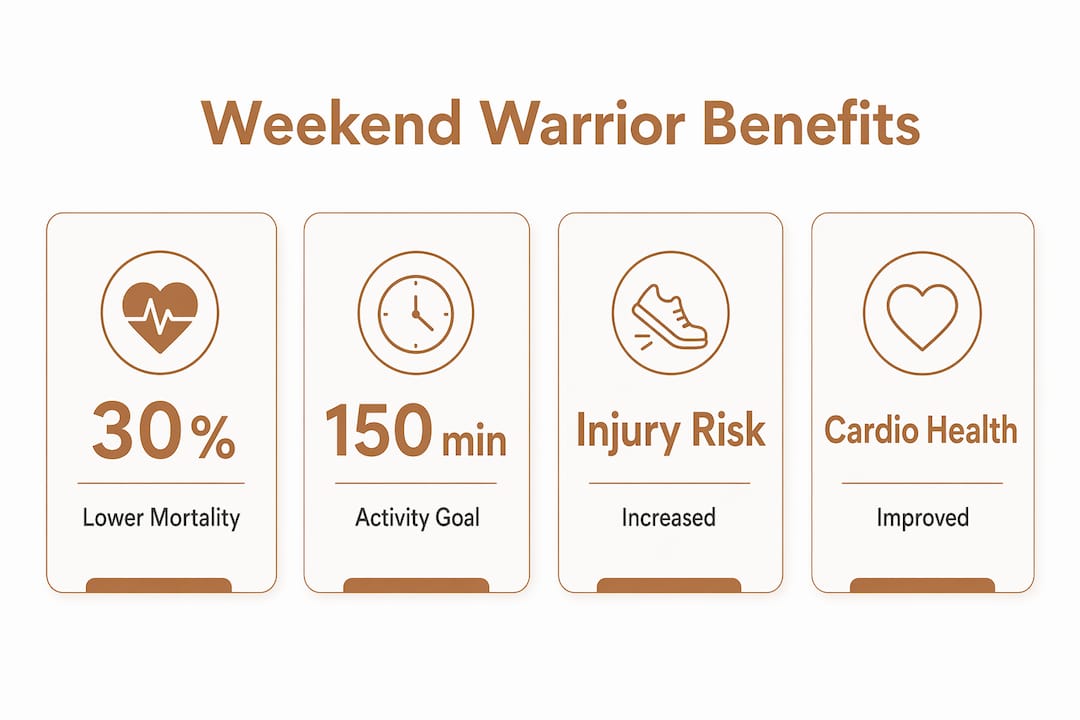
The one area where weekend-only exercise falls short is injury risk. Sudden intense weekend exercise after five days of sitting stresses unconditioned muscles and tendons. Tendonitis, muscle strains, and cartilage damage are the most common results of this "sudden violent gear shift," as physicians describe it. The solution is not to exercise less on weekends. It is to add light midweek movement that keeps muscles and connective tissue ready for weekend loads.
Pro Tip: Before any intense weekend workout, spend 10 minutes on dynamic warm-ups: leg swings, hip circles, and arm rotations. This primes connective tissue that has been compressed by five days of sitting and cuts acute injury risk significantly.
Why weekday movement snacks matter even with active weekends
Exercise snacks are defined as short bouts of physical activity, typically 2–5 minutes, performed every 30–60 minutes throughout the workday. The term is informal, but the physiology behind it is well established. Exercise snacks during prolonged sitting improve flow-mediated dilation and reduce systolic blood pressure in ways that a single weekend workout cannot replicate.
The reason is timing. Your arteries and glucose metabolism respond to movement in real time. A Saturday morning run does not protect your vascular function at 3:00 PM on Wednesday. Short movement breaks do. Cumulative daily activity produces more favorable metabolic and vascular outcomes than isolated weekend bursts, because the body's systems reset and respond each time you move.
Practical weekday movement snacks that fit into any office schedule:
- Stand and walk to a colleague instead of sending an internal message. A 2-minute walk every hour adds up to 16 minutes of light activity across a workday.
- Take the stairs for any floor change under four flights. Stair climbing raises heart rate, activates glutes and calves, and breaks the sitting cycle in under 90 seconds.
- Set a phone or smartwatch timer for 45-minute intervals and do 10 bodyweight squats or calf raises when it fires.
- Use a standing desk for one to two hours per day. UK office studies show movement interventions reduce sitting time by 1 to 1.5 hours, improving both wellbeing and work performance.
- Walk during phone calls. Most calls require no screen, and a 10-minute walking call delivers meaningful cardiovascular stimulus without disrupting your workflow.
Pro Tip: Personalized step goals matter more than generic targets. Those sitting 14 hours per day may need 1,700–5,300 additional steps daily depending on individual health conditions like obesity or diabetes. Track your baseline before setting a target.
Practical strategies to maximize weekend workouts safely
The goal is not to choose between weekend exercise and weekday movement. The goal is to build a week where both work together. Weekend warrior exercise suits busy professionals best when it is complemented by midweek low-intensity movement to avoid injuries and maximize benefits.
Here is how to structure that balance:
- Warm up progressively on weekends. Start with 10–15 minutes of light cardio before any vigorous activity. Your tendons and cartilage need time to absorb load after days of compression from sitting.
- Add one or two midweek sessions of light activity. A 20-minute walk on Wednesday and Thursday keeps muscles conditioned and reduces the gap between your last workout and your next one.
- Use technology to interrupt sitting. Fitness trackers, smartwatch apps, and IoT-enabled health tools can send movement reminders at set intervals, removing the need to remember on your own.
- Track body composition, not just weight. Metrics like body fat percentage and BMI reveal whether your weekend workouts are producing real physiological change or simply burning calories without building metabolic fitness.
- Balance intensity across the week. If Saturday involves a long run or heavy lifting, Sunday should be active recovery: a walk, light cycling, or yoga. This keeps total weekly MVPA high without overloading recovery systems.
- Monitor your weekly fitness patterns to spot weeks where sitting time spikes and weekend volume drops. Catching that pattern early prevents it from becoming a habit.
The impact of weekend workouts on all-cause and cardiovascular mortality is well documented across multiple large prospective studies. The consistent finding is that total MVPA volume drives the benefit, not the specific days on which you accumulate it.
Key Takeaways
Weekend activity meets WHO physical activity guidelines and produces mortality risk reductions comparable to daily exercise, but weekday movement snacks remain necessary to protect vascular and metabolic health between sessions.
| Point | Details |
|---|---|
| Weekend warrior pattern works | Meeting 150 minutes of weekly MVPA on weekends cuts all-cause mortality risk by 30%. |
| Sitting carries independent risks | Prolonged sitting impairs glucose metabolism and vascular function regardless of weekend exercise. |
| Exercise snacks fill the gap | Two to five minutes of movement every 30–60 minutes improves blood pressure and arterial function during the workday. |
| Injury risk is real | Jumping from five sedentary days to intense weekend exercise causes tendonitis and muscle strains without midweek conditioning. |
| Personalize your step targets | People sitting 14 hours daily may need 1,700–5,300 extra steps per day based on their specific health conditions. |
The weekend warrior trap I see people fall into
Most people treat weekend workouts as a debt-repayment system. They sit all week, feel guilty, and then push hard on Saturday and Sunday to "make up for it." I understand the logic. The research on weekend warrior exercise is genuinely encouraging. But the debt-repayment mindset creates a binary relationship with movement that eventually breaks down.
What I have observed is that people who frame weekends as compensation tend to skip weekday movement entirely because they feel it is covered. That leaves their vascular system unprotected for five consecutive days. The arteries do not know that a long run is coming on Saturday. They only respond to what is happening right now.
The mindset shift that actually works is treating movement as a daily maintenance task, not a weekly event. Weekend workouts become the high-intensity anchor of your week, not the whole week. Weekday movement snacks become the maintenance layer that keeps your metabolic systems functional between anchors. These two things are not competing. They are complementary.
The other thing worth saying plainly: tracking matters. You cannot manage what you cannot measure. Knowing your body fat percentage, BMI trend, and weekly activity volume gives you real data to work with instead of guesswork. That data changes behavior in a way that motivation alone does not.
— Jacob
Uvirello and the active week you are building
Tracking the full picture of your health means going beyond step counts.

The Uvirello Smart Electronic Weight Scale measures body fat percentage, BMI, and other key body composition metrics with high-precision sensors, giving weekend warriors and weekday movers alike a clear view of whether their activity patterns are producing real physiological results. Over 12,000 people have rated Uvirello 4.8 out of 5 for exactly this reason: it turns weekly effort into visible, trackable progress. Whether you are refining your weekend workout load or building a weekday movement habit, the Uvirello body composition scale gives you the data to do it with confidence.
FAQ
How much weekend exercise offsets a sedentary week?
Meeting the WHO guideline of 150 minutes of moderate-to-vigorous physical activity over the weekend produces a 30% reduction in all-cause mortality risk, comparable to spreading that activity across the week.
Does weekend exercise fix the damage from sitting all week?
Weekend exercise reduces mortality and cardiovascular risk significantly, but it does not fully reverse the metabolic and vascular effects of prolonged daily sitting. Short movement breaks throughout the workday are needed to address those effects in real time.
What are exercise snacks and how often should I do them?
Exercise snacks are 2–5 minute bouts of light activity, such as walking or bodyweight squats, performed every 30–60 minutes during the workday. Research shows they improve arterial function and reduce blood pressure during prolonged sitting periods.
Is the weekend warrior pattern safe for beginners?
The pattern is effective but carries elevated injury risk for people who are sedentary all week and then exercise intensely on weekends. Gradual warm-ups and at least one or two light midweek sessions significantly reduce tendon and muscle strain risk.
How do I know if my weekend workouts are actually working?
Tracking body composition metrics like body fat percentage and BMI over time gives you objective evidence of whether your activity pattern is producing metabolic change. Weight alone does not capture the full picture of fitness progress.