
A bone density tracking home device is any consumer tool designed to estimate skeletal strength outside a clinical setting, ranging from ultrasound heel scanners to smart scales with bioimpedance sensors. Bone mineral density (BMD) is the clinical measure of calcium and mineral content in bone tissue, and it predicts fracture risk more reliably than any other single metric. The gold standard for measuring BMD is dual-energy X-ray absorptiometry, or DXA, which is not replicable by consumer devices. Home devices offer accessibility and convenience, but they vary widely in accuracy and clinical relevance. Understanding that difference is what separates useful monitoring from false reassurance.
What are the common types of bone density tracking home devices?
Home bone health monitors fall into three broad categories, each using a different technology and measuring a different thing.
Peripheral ultrasound devices scan a single site, usually the heel or finger, using sound waves to estimate bone stiffness. These are the closest consumer equivalent to clinical screening tools. Some mail-in versions send a sample or data to a lab, with results typically taking weeks to return. That turnaround makes them poor tools for rapid feedback but reasonable for annual trend checks.

Smart scales with bioimpedance send a low electrical current through the body to estimate body composition, including a figure labeled "bone mass." This number reflects an estimated weight of bone tissue, not bone mineral density. The distinction matters enormously for anyone trying to assess fracture risk or osteoporosis risk. Smart scales measure bone mass, not density, and cannot diagnose osteoporosis.
Clinical peripheral devices used outside hospitals represent a third category. Devices like the MiniOmni from BeamMed are designed for physician offices and pharmacies, not home use. Peripheral ultrasound scanners marketed for clinical settings offer more reliable screening data than consumer products, but they still require clinical interpretation.
Here is a quick breakdown of how these categories compare:
| Device type | Technology | What it measures | Diagnostic value |
|---|---|---|---|
| Peripheral ultrasound (home) | Ultrasound | Bone stiffness at heel or finger | Screening only |
| Smart scale | Bioimpedance | Estimated bone mass (weight) | Not diagnostic |
| Clinical peripheral device | Ultrasound | Bone stiffness at peripheral site | Screening, needs DXA to confirm |
| DXA scan (clinical) | Dual-energy X-ray | Bone mineral density (hip, spine) | Diagnostic gold standard |
The key takeaway: no consumer device currently measures true BMD. They measure proxies, and proxies have limits.
How do home bone density devices compare to clinical DXA scans?
DXA is the gold standard for bone mineral density measurement because it uses differential X-ray absorption to quantify calcium content in bone tissue directly. That process requires specialized equipment that no consumer product replicates. A standard DXA scan takes 10–30 minutes and delivers a radiation dose of roughly 0.001 mSv, which is far lower than a standard chest X-ray.

DXA produces a T-score, which compares your BMD to a healthy young adult reference population. A T-score at or below -2.5 indicates osteoporosis. Scores between -1.0 and -2.5 indicate osteopenia, a precursor condition. Home devices do not produce T-scores. They produce proprietary readings that vary by brand and cannot be mapped to clinical diagnostic thresholds.
Home personal bone density trackers are screening tools, not diagnostic instruments. They can flag a potential concern and motivate you to seek clinical testing. They cannot confirm or rule out osteoporosis. If a home device flags an abnormality, a central DXA scan of the hip and spine is the standard next step to confirm any diagnosis.
Pro Tip: Never use a home bone health monitor reading as a reason to start or stop medication. Bring the reading to your doctor as a conversation starter, not a conclusion.
The data turnaround also differs sharply. A DXA scan produces results the same day, often within minutes of the scan. Mail-in peripheral screening kits can take weeks. Smart scales give instant readings, but those readings carry the least clinical weight of any option.
How to choose the right bone density measurement device for your needs
Choosing a personal bone density tracker starts with understanding why you want one. The right device depends on your risk profile, your relationship with a healthcare provider, and what you plan to do with the data.
Start by assessing your risk factors. Postmenopausal women, adults over 65, people with a family history of osteoporosis, and those on long-term corticosteroids face higher fracture risk. If you fall into any of these groups, a clinical DXA scan is the right first step, not a home device. Home monitoring makes the most sense as a supplement to established clinical care, not a replacement for it.
When evaluating devices, focus on these factors:
- Measurement site: Heel ultrasound devices correlate more closely with clinical data than finger or wrist devices. Peripheral measurements are less predictive of fracture risk than central DXA sites like the hip and spine.
- Technology type: Ultrasound-based devices provide more bone-specific data than bioimpedance scales, which estimate bone mass as a byproduct of body composition modeling.
- Portability vs. accuracy: Portable bone health trackers trade some accuracy for convenience. If trend tracking over time is your goal, consistency of measurement conditions matters more than portability.
- Marketing claims vs. clinical evidence: Any device claiming to diagnose osteoporosis or measure true BMD without X-ray technology is overstating its capability. Look for devices that describe their output as "screening" or "estimation."
- Price and accessibility: Entry-level smart scales with bone mass estimates cost under $50. Peripheral ultrasound home kits run significantly higher. Neither replaces a DXA scan, which is often covered by insurance for at-risk adults.
Pro Tip: Before buying any at-home bone density test device, ask your doctor whether your insurance covers a DXA scan. Many plans cover it fully for adults over 65 or those with documented risk factors.
A holistic health tracking system that combines body composition data, activity tracking, and nutrition logging gives home bone monitoring more context and makes the data more useful over time.
How to use a bone density tracking home device effectively
Using a home bone density assessment tool correctly is as important as choosing the right one. Inconsistent technique is the most common reason home readings vary wildly between sessions.
- Read the device instructions completely before your first use. Some peripheral ultrasound devices require you to avoid calcium supplements for 24 hours before testing. Others require specific foot positioning or gel application. Skipping these steps introduces error from the start.
- Test at the same time of day, every time. Body composition and hydration levels shift throughout the day. Morning readings before eating or drinking produce the most consistent baseline for smart scales.
- Use the same surface and conditions. Smart scales are sensitive to floor type. Hard, flat surfaces produce more accurate bioimpedance readings than carpet. Test barefoot with clean, dry feet.
- Record every reading with the date and conditions. A single reading tells you almost nothing. A series of readings over six to twelve months reveals a trend. Use a simple spreadsheet or a health app to log results.
- Space measurements appropriately. Meaningful bone density changes occur over months to years, not days. Testing weekly creates noise, not signal. Monthly or quarterly readings are sufficient for trend tracking.
- Bring your logged data to clinical appointments. A printed or digital log of home readings gives your doctor useful context, especially if you are tracking the effect of lifestyle changes like calcium intake, weight-bearing exercise, or vitamin D supplementation.
- Seek clinical confirmation if readings change significantly. A sudden drop in your device's bone mass estimate warrants a conversation with your doctor, not a self-diagnosis.
Understanding how precision sensors work in at-home health devices helps you interpret readings more accurately and recognize when a result falls outside normal variation.
What are the limitations and common misconceptions about home bone density trackers?
The biggest misconception about home bone density trackers is that they measure the same thing as a DXA scan. They do not. Bone mineral density and bone mass are fundamentally different metrics. BMD reflects the concentration of minerals in bone tissue. Bone mass is simply an estimated weight. A person can have heavy bones with low mineral density, which means high fracture risk despite a reassuring bone mass number.
Several other misconceptions are worth addressing directly:
- "A normal reading means I don't have osteoporosis." Home devices cannot rule out osteoporosis. They can only suggest that a clinical test may or may not be urgent.
- "I can track my response to treatment at home." Treatment-related BMD changes are small and require DXA precision to detect reliably. Home devices lack that resolution.
- "Peripheral readings reflect my spine and hip density." Heel or finger measurements do not reliably predict central bone density. The hip and spine are the clinically relevant sites for fracture risk.
- "More frequent testing gives better data." Bone remodeling is slow. Testing more often than monthly adds no useful information and can create unnecessary anxiety.
Home bone density devices are best understood as a prompt, not a verdict. A concerning reading should send you to a doctor, not to a conclusion. Health experts caution that these tools should supplement, not replace, clinical evaluation for osteoporosis diagnosis and management.
The most responsible way to use a home bone health monitor is as one input among many, alongside diet, exercise habits, family history, and periodic clinical DXA scans.
Key Takeaways
Home bone density tracking devices are useful screening tools, but they cannot replace DXA scans, which remain the only clinically validated method for diagnosing osteoporosis through T-score measurement.
| Point | Details |
|---|---|
| DXA is the only diagnostic standard | DXA scans measure true BMD and produce T-scores; home devices measure proxies only. |
| Smart scales measure bone mass, not density | Bioimpedance estimates bone weight, which differs fundamentally from mineral density. |
| Peripheral readings have limits | Heel or finger measurements do not reliably reflect hip or spine bone density. |
| Consistency matters more than frequency | Space home measurements months apart and log conditions to build a valid trend. |
| Home devices prompt, not diagnose | Use home readings to start a clinical conversation, not to draw health conclusions. |
What I've learned from tracking bone health at home
Portable bone health trackers are genuinely useful, but only for people who understand what they are buying. The problem is that most people don't. They see a number on a scale or a device, assume it maps to something clinical, and either panic or feel falsely reassured. Neither response serves their health.
What I find most valuable about home monitoring is the habit it builds. People who track their bone mass monthly, even with an imperfect tool, tend to pay more attention to calcium intake, weight-bearing exercise, and vitamin D levels. That behavioral shift matters more than the accuracy of any single reading. The device becomes a prompt for healthy behavior, which is a legitimate and underrated benefit.
The risk I see most often is over-reliance. Someone gets a stable reading for six months and decides they don't need a DXA scan. That logic is flawed. Home devices cannot detect the kind of bone loss that DXA catches early. Proactive discussions with a healthcare provider after home screening are what lead to timely formal testing and real intervention.
My honest advice: use a home device to stay engaged with your bone health between clinical appointments. Treat every reading as a data point in a longer conversation with your doctor, not as a standalone answer. The technology is improving, but it has not yet closed the gap with clinical DXA. Until it does, the most effective approach combines home monitoring with regular professional evaluation.
— Jacob
Uvirello's approach to body composition and bone health tracking
Body composition tracking is most useful when the device behind it is accurate and consistent. Uvirello's Smart Electronic Weight Scale delivers advanced body metrics, including body fat percentage, BMI, and bone mass estimates, through high-precision bioimpedance sensors.
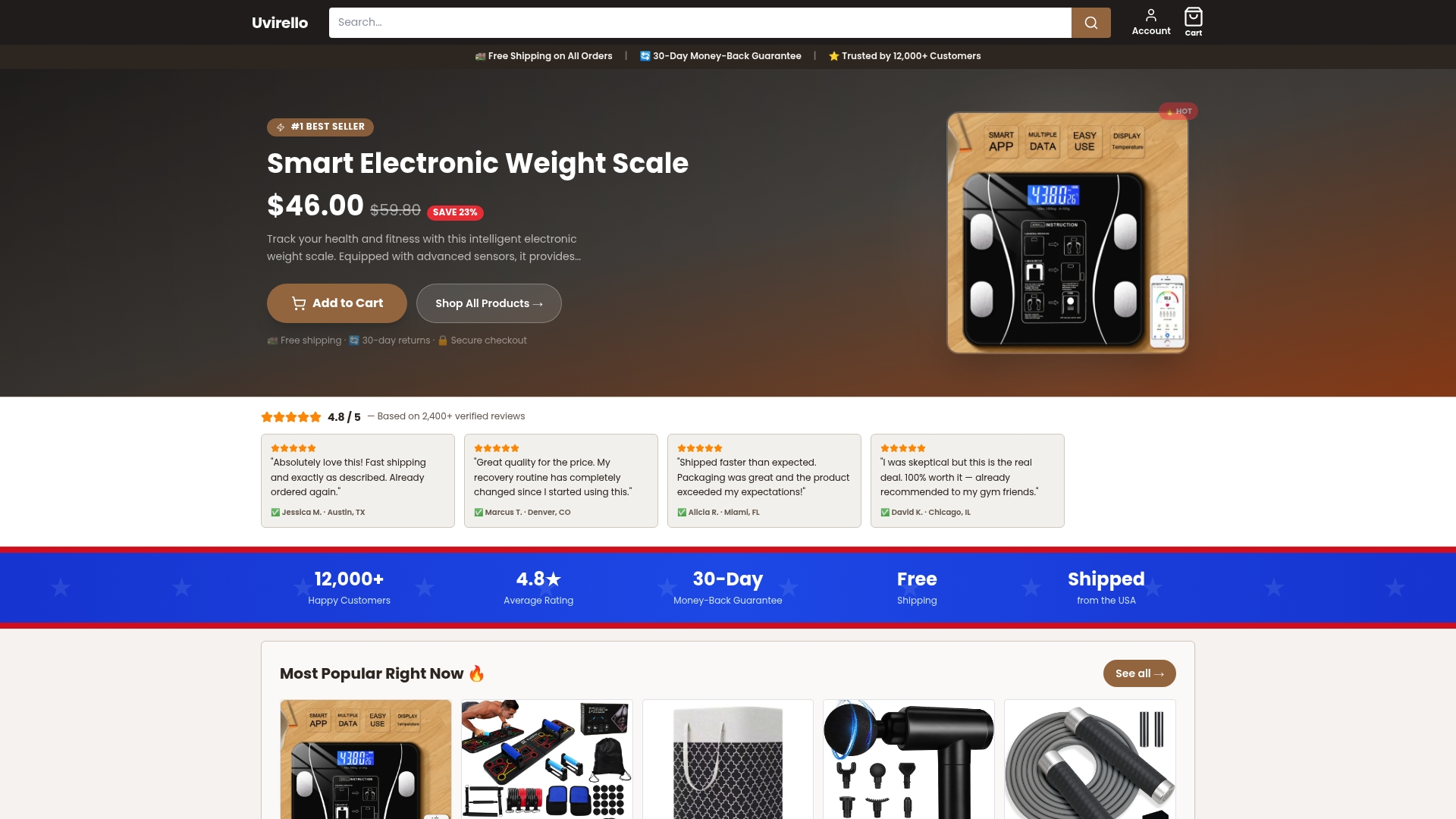
Over 12,000 people have rated the Uvirello scale at 4.8 out of 5 stars, citing the clarity of its readings and the reliability of its data over time. For anyone building a modern wellness tracking routine that includes bone health awareness, the Uvirello scale provides a consistent, accessible starting point. Pair it with periodic clinical DXA scans and a log of your readings to get the most complete picture of your skeletal health. Visit uvirello.com to see the full product details and customer reviews.
FAQ
What does a bone density tracking home device actually measure?
Most home devices measure either bone stiffness via ultrasound or estimated bone mass via bioimpedance. Neither method measures true bone mineral density, which requires DXA technology.
Can a smart scale tell me if I have osteoporosis?
No. Smart scales cannot diagnose osteoporosis because they measure estimated bone mass, not bone mineral density. Only a clinical DXA scan produces the T-score needed for diagnosis.
How often should I use a home bone density measurement device?
Monthly to quarterly readings are sufficient for trend tracking. Meaningful bone density changes occur over months to years, so more frequent testing adds noise rather than useful data.
Are at-home bone density tests accurate enough to act on?
Home devices are accurate enough to flag a potential concern and motivate clinical follow-up. They are not accurate enough to confirm or rule out osteoporosis on their own.
When should I see a doctor after using a home bone health monitor?
See a doctor if your device shows a significant drop in bone mass readings, if you have known risk factors for osteoporosis, or if you have not had a clinical DXA scan in the past two years.