
Data privacy in health tracking is defined as the practice of ensuring individuals maintain control over their personal health data collected by wearable devices and health apps. The industry term for this is "health data confidentiality," and it covers everything from how your step count is stored to who can buy your sleep patterns. The role of data privacy in health tracking has never been more urgent. 60% of people using health wearables express significant concern about unauthorized access, employer misuse, and social stigmatization from data leaks. That number signals a real trust problem, not just a technical one. Understanding how your data moves, who sees it, and what laws actually protect you is the first step toward using health technology on your own terms.
What are the main data privacy concerns with health tracking devices?
Privacy concerns in health tracking go well beyond someone seeing your heart rate. The risks are structural, and they affect nearly every person who wears a fitness tracker or uses a health app.
The most immediate risk is unauthorized data access. Health apps routinely share data with third-party advertisers, data brokers, and analytics firms. Many people grant these permissions without reading the fine print. The result is that sensitive health information, including menstrual cycles, sleep disorders, and chronic condition markers, ends up in commercial databases with no clear limit on how long it stays there or who buys it next.
A less obvious but equally serious risk is re-identification. Raw sensor data from wearables can uniquely identify individuals even after anonymization. High-frequency motion sensors capture movement patterns so specific that researchers have compared them to a biometric fingerprint. Anonymized data is not truly anonymous when the underlying signal is that distinctive.
The risks people face include:
- Unauthorized access: Data breaches expose health records to hackers and identity thieves.
- Employer and insurer misuse: Employers and insurers can potentially use health data to make decisions about coverage or employment.
- Re-identification from sensor data: Wrist sensor data enables re-identification across different activities, creating reputational and financial harm.
- Third-party data sales: Health app companies sell aggregated data to pharmaceutical firms and marketers.
- Social stigmatization: Leaked data about mental health conditions or chronic illness can damage personal and professional relationships.
Pro Tip: Read the data-sharing section of any health app's privacy policy before you grant permissions. Look specifically for language about "third-party partners" and "de-identified data," since those phrases often signal data sales.
The misconception that all health data is federally protected makes these risks worse. Most people assume HIPAA covers their fitness tracker. It does not.
How do current regulations protect or fail to protect health tracking data?
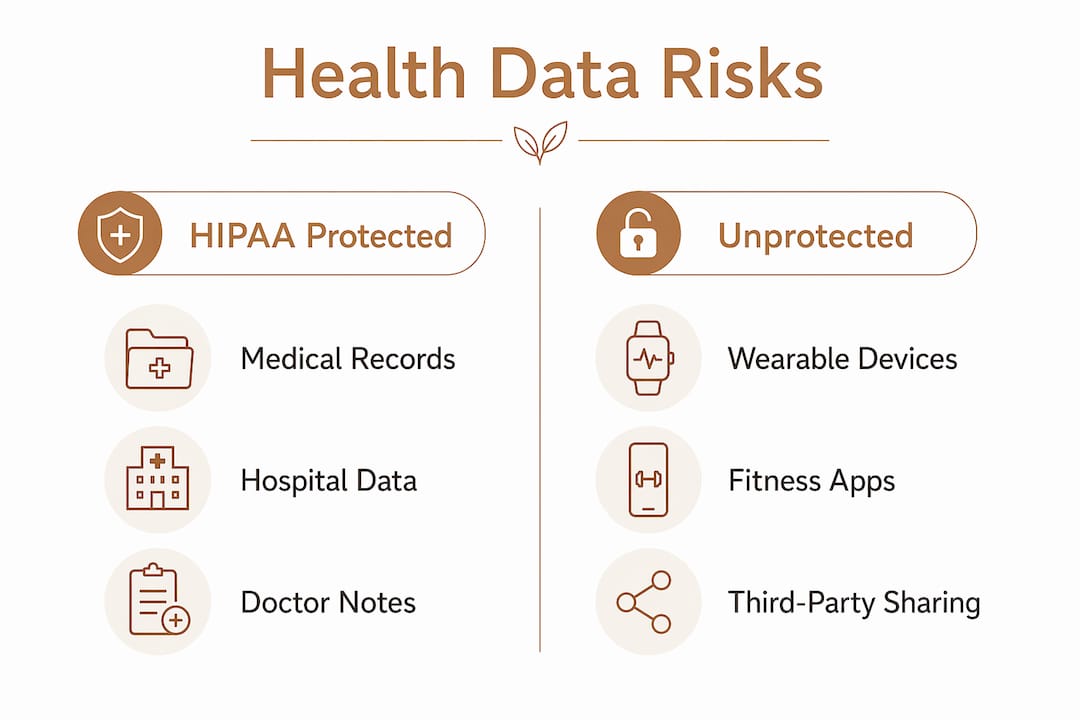
The regulatory gap in health data protection is wide, and most people do not know it exists. HIPAA, the Health Insurance Portability and Accountability Act, applies to covered entities: hospitals, clinics, insurers, and their direct business associates. Most wearable health trackers are not covered entities, which means their data collection falls entirely outside federal protections.
That distinction matters enormously. When your doctor records your blood pressure, HIPAA governs that record. When your fitness tracker records the same reading, no equivalent federal law applies. The company can share, sell, or lose that data with limited legal consequence to you.
| Data type | Collected by | HIPAA protection | Practical risk |
|---|---|---|---|
| Blood pressure reading | Hospital or clinic | Yes | Low |
| Blood pressure reading | Consumer wearable | No | High |
| Sleep patterns | Health app | No | High |
| Heart rate history | Clinical device | Yes | Low |
| Step count and movement | Fitness tracker | No | Moderate to high |
State laws fill some gaps, but unevenly. California's Consumer Privacy Act gives residents rights to access and delete their data. Most other states offer far weaker protections. The absence of a uniform federal framework leaves most Americans exposed to commodification of their health data without meaningful consent. Legal scholars and consumer advocates have called for federal reform, but no comprehensive legislation has passed as of 2026.
Consumer health tech operates under a "buyer beware" model. Manufacturers claim secure data sharing, but people using these devices have little real control over how their data is packaged and sold downstream. The contrast between clinical health data and consumer wearable data is stark. One is tightly regulated. The other is largely a commercial asset.
What technologies are emerging to protect health tracking data?
Technology is catching up to the privacy problem, though deployment at scale remains a challenge. Two approaches stand out as genuinely promising: differential privacy and federated learning.
Differential privacy adds carefully calibrated statistical noise to a dataset before analysis. The result is that researchers can extract population-level insights without exposing any individual's raw data. Federated learning takes a different route. Instead of sending your health data to a central server, the model trains locally on your device and shares only the learned parameters, not the underlying data. Both approaches enable data utility without exposing raw personal data, which is the core trade-off in health data science.
These technologies also address the re-identification problem directly. When raw sensor data never leaves your device, it cannot be reverse-engineered into a biometric fingerprint. The health data life cycle typically involves transmission to third-party apps, insurers, and data brokers. Privacy-preserving architectures interrupt that flow at the source.
Key emerging privacy technologies include:
- Differential privacy: Adds statistical noise to protect individual records while preserving aggregate insights.
- Federated learning: Trains AI models on-device, keeping raw data local and never transmitting it to central servers.
- End-to-end encryption: Protects data in transit and at rest, making interception far less useful to attackers.
- Privacy-preserving AI: Builds health prediction models without requiring access to identifiable personal records.
- Consent management platforms: Give people granular control over which data flows to which third parties.
Transparent metrics and standardized privacy measures are necessary to rebuild trust in health tracking technology. Basic encryption alone is not sufficient. The field needs verifiable standards, not just marketing claims about security.
Pro Tip: When evaluating a health app or device, look for explicit mentions of federated learning or on-device processing in their technical documentation. These are concrete signals that the company is investing in genuine privacy protection, not just compliance theater.
For a deeper look at how these technologies are reshaping the field, the IoT and health tracking space in 2026 offers useful context on where the industry is heading.
How can you protect your privacy while using health tracking devices?
People using health trackers have more control than they realize, but exercising that control requires deliberate action. The default settings on most health apps are not designed with your privacy in mind. They are designed for data collection.
Follow these steps to protect your health data:
- Audit your app permissions. Go into your phone's settings and review exactly what each health app can access. Revoke location, microphone, and contact permissions that are not strictly necessary for the app's core function.
- Read the privacy policy before you sign up. Focus on the sections covering third-party sharing and data retention. If the policy is vague or missing, treat that as a warning sign.
- Exercise your data deletion rights. Many apps are required to delete your data on request, especially in California and the European Union. Submit deletion requests for any app you no longer use actively.
- Avoid unnecessary third-party integrations. Connecting your health app to social platforms or nutrition trackers multiplies the number of companies that can access your data. Each integration is a new risk surface.
- Choose devices with transparent privacy policies. Look for companies that publish clear data-sharing agreements and offer opt-out options for data sales.
- Update your apps regularly. Security patches close vulnerabilities that attackers exploit. Running outdated software is one of the most common causes of data exposure.
User perception of privacy assurance strongly influences willingness to keep using health trackers. People who understand their rights and feel confident in a platform's practices are far more likely to engage consistently with their health data. That engagement produces better health outcomes. Privacy protection and health tracking are not in conflict. They reinforce each other.
Understanding why tracking prevents health neglect is valuable, but only when you trust the system collecting your data. That trust starts with knowing your rights and acting on them.
Key Takeaways
Strong data privacy in health tracking requires regulatory reform, technical safeguards, and informed personal choices working together, because no single layer of protection is sufficient on its own.
| Point | Details |
|---|---|
| HIPAA does not cover most wearables | Consumer fitness trackers fall outside federal protection, leaving data legally exposed to commercial use. |
| Re-identification is a real risk | Raw motion sensor data can identify individuals even after anonymization, creating financial and reputational harm. |
| Emerging tech offers real solutions | Differential privacy and federated learning protect individual data while still enabling health insights. |
| Default settings favor data collection | Auditing app permissions and exercising deletion rights are the most direct ways to protect your information. |
| Trust drives engagement | People who feel confident in a platform's privacy practices use health tracking more consistently and effectively. |
The trust gap is the real health tech problem
The conversation about data privacy in health tracking tends to focus on regulation and technology. Both matter. But the deeper issue is trust, and right now the industry is losing it.
I have watched this space for years, and the pattern is consistent. Companies launch health tracking products with impressive feature lists and vague privacy disclosures. People adopt them enthusiastically. Then a data breach happens, or a journalist reveals that anonymized data was sold to an insurer, and a wave of people delete the app. The technology improves. The trust does not recover at the same pace.
What frustrates me most is that the tools to do this right already exist. Federated learning, differential privacy, and genuine consent management are not theoretical. They are deployed in other industries. The health tech sector has chosen not to prioritize them, largely because data is profitable and regulation has not forced the issue.
The people who get hurt are not abstract data points. They are individuals who shared their sleep patterns, their menstrual cycles, their chronic pain levels, trusting that the information would stay private. When that trust is broken, it does not just damage one company's reputation. It makes people less willing to use health technology at all, which has real consequences for their health.
The solution is not to stop tracking your health. The solution is to demand better from the companies building these tools, support regulatory reform, and stay informed about where your data actually goes. Informed people are harder to exploit.
— Jacob
Uvirello and responsible health tracking
Health tracking works best when you trust the data and the device collecting it.
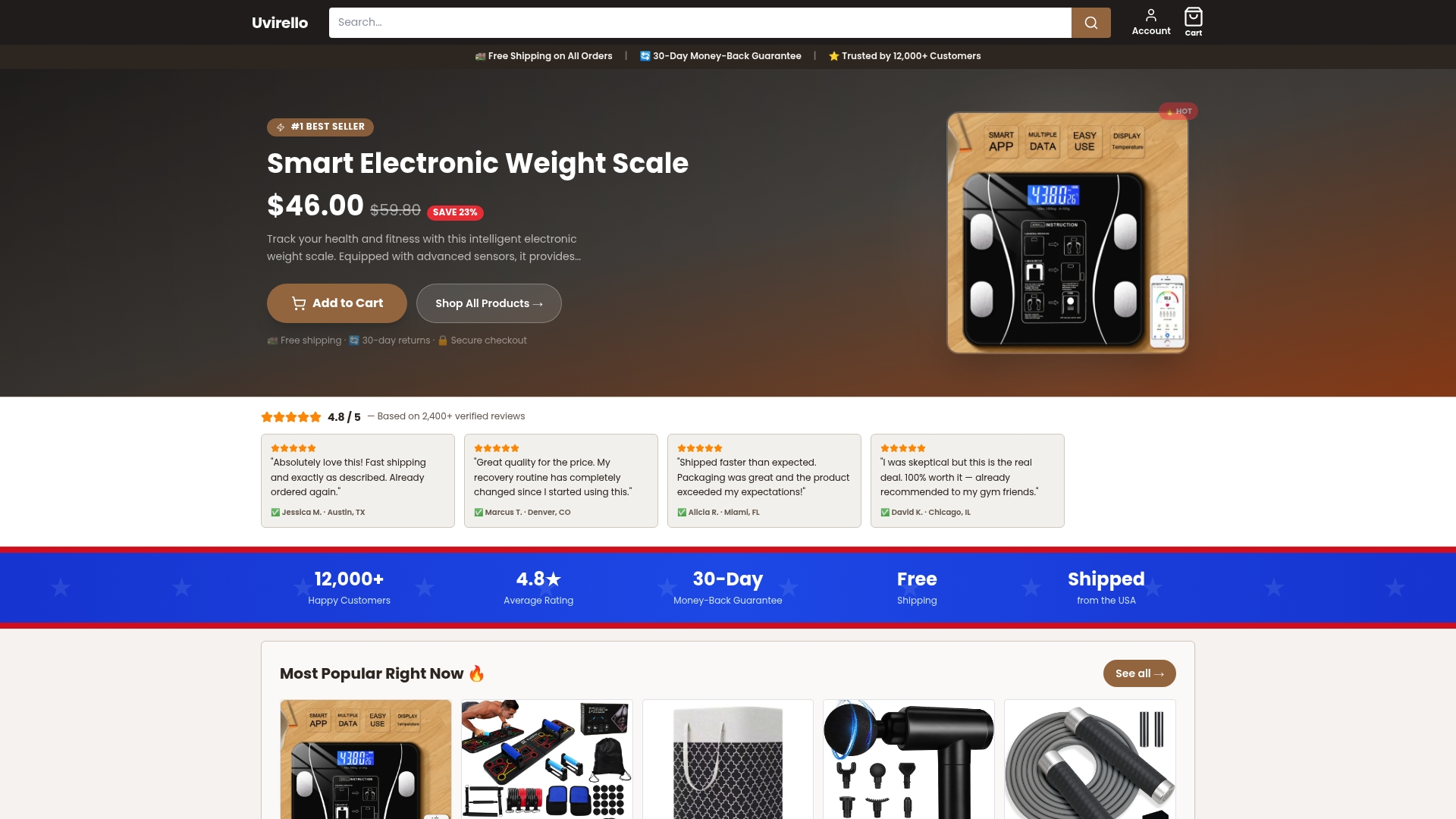
Uvirello's Smart Electronic Weight Scale is built around that principle. With high-precision sensors measuring body fat percentage, BMI, and other body composition metrics, it gives you detailed health data without the opacity that plagues many health apps. Over 12,000 customers have rated Uvirello at 4.8 out of 5, reflecting consistent satisfaction with both accuracy and the overall experience. If you want accurate body composition tracking you can actually rely on, Uvirello is worth a close look. The scale delivers the health insights you need while keeping the experience straightforward and transparent.
FAQ
What is data privacy in health tracking?
Data privacy in health tracking is the practice of controlling who can access, use, and share the personal health data collected by wearable devices and health apps. It covers data security, consent, and your legal rights over that information.
Does HIPAA protect my fitness tracker data?
HIPAA does not cover most consumer fitness trackers. Wearable devices are not classified as covered entities under HIPAA, so their data collection falls outside federal privacy protections.
Can anonymized health data still identify me?
Yes. High-frequency wrist sensor data can be reverse-engineered to identify individuals even after anonymization, a risk researchers describe as a biometric "WristPrint."
What can I do to protect my health data right now?
Audit your app permissions, revoke unnecessary access, submit data deletion requests for apps you no longer use, and choose devices from companies with clear, specific privacy policies.
How does privacy affect whether people keep using health trackers?
Privacy assurance directly influences continued use. People who understand their data rights and trust a platform's practices are significantly more likely to engage consistently with their health tracking tools.