
Longitudinal health data tracking is the systematic collection and analysis of health information from individuals over extended periods to capture biological dynamics and inform clinical decisions. Unlike a single lab result or a one-time physical exam, this approach records how a patient's health evolves across time, revealing patterns no snapshot can show. Tools like wearable devices, electronic health records (EHRs), and multi-omics platforms feed into what researchers now call "scientific wellness," a model that builds personalized health baselines from dense, continuous data streams. For health professionals and researchers, understanding this model is the foundation for better prediction, earlier intervention, and more precise care.
What is the role of longitudinal health data tracking in clinical prediction?
Longitudinal tracking outperforms snapshot analysis because it captures how health metrics change, not just where they stand at a single point. A patient's fasting glucose at one visit tells you little. That same metric tracked monthly over two years tells you whether they are drifting toward diabetes or stabilizing after a lifestyle change.
The clearest evidence comes from predictive modeling research. Time-stamped longitudinal event modeling applied to EHR data from more than 85,000 patients improved prediction of post-acute SARS-CoV-2 sequelae by +18.4% in AUROC and +40.14% in PRAUC compared to methods that ignored temporal order. Those are not marginal gains. They represent the difference between catching a condition early and missing it entirely.

Continuous risk models built on longitudinal data also replace binary diagnostic thresholds. Instead of labeling a patient as "at risk" or "not at risk" based on a single reading, clinicians can track a trajectory and intervene at the inflection point. This shift matters most for chronic diseases like heart failure, type 2 diabetes, and chronic kidney disease, where deterioration is gradual and early signals are subtle.
Multi-domain data integration amplifies this further. Combining genetics, wearable sensor outputs, clinical histories, and microbiome profiles creates a systems-level picture of an individual's biology. Scientific wellness approaches that collect this kind of dense, longitudinal data can detect wellness-to-disease transitions before symptoms appear.
Pro Tip: When building a predictive model on EHR data, account for nonrandom data missingness. Patients who miss appointments are not missing at random. Time-aware modeling methods that treat irregular visit gaps as informative signals consistently outperform those that ignore them.
- Temporal modeling captures health trajectory direction, not just current status.
- Multi-domain integration (genetics, wearables, clinical data) improves risk stratification.
- Continuous risk scores replace binary thresholds for chronic disease monitoring.
- EHR-based prediction improves significantly when temporal context is encoded.
What operational challenges affect longitudinal health data collection?
Operational issues limit longitudinal tracking more than analytical methods do. Researchers and clinicians often focus on the technology and overlook the infrastructure required to keep a cohort intact and a dataset clean over years or decades.
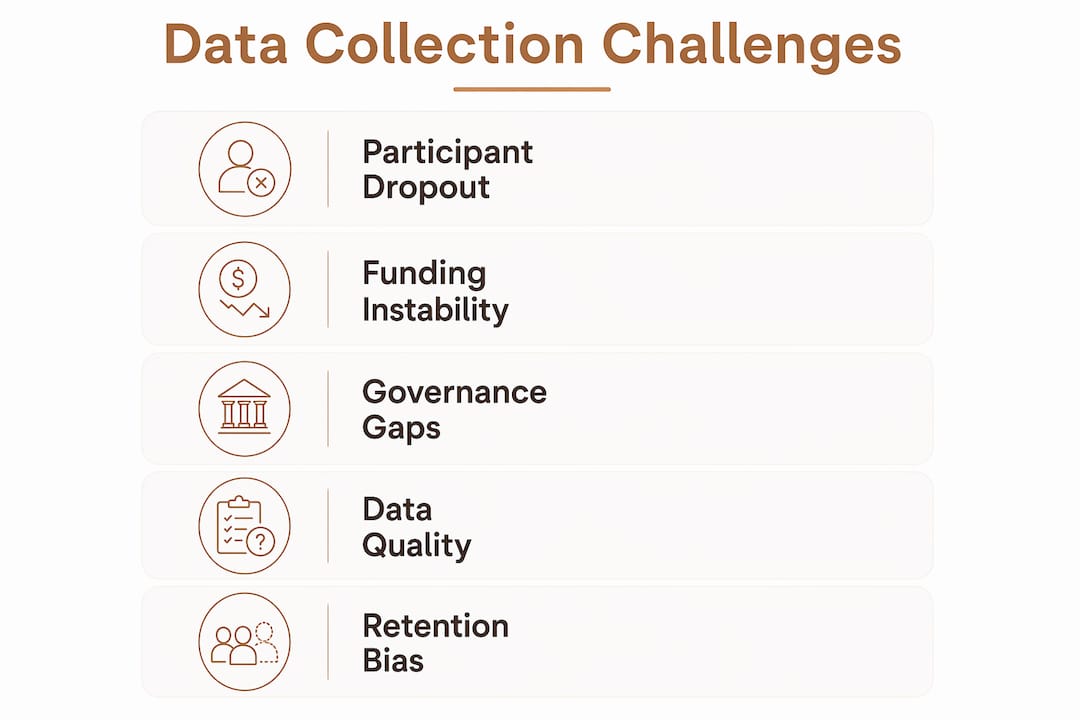
Participant and staff retention is the most critical driver of cohort validity. When participants drop out unevenly, the remaining sample skews toward healthier, more engaged individuals. That bias distorts health trajectory estimates and undermines the study's conclusions. Funding instability and personnel shortages compound the problem by disrupting protocols mid-study.
Governance and privacy constraints add another layer of complexity. De-identification is not a binary state. Researchers must treat it as a spectrum, because re-identification risk increases as datasets grow richer and more granular. Strengthened consent alone does not prevent re-identification in multi-party longitudinal data sharing. Governance must cover the entire data lifecycle, including storage, access controls, and downstream use.
"Governance must address the entire data lifecycle for multi-party longitudinal data sharing, not only the point of collection." — PLOS Digital Health
Regulatory gaps are especially acute in AI-powered wearable monitoring. No current regulations specifically protect older adults using AI-driven health wearables, despite the sensitivity of the continuous physiological data these devices collect. Proposed frameworks call for coordinated action across governments, device manufacturers, and healthcare providers.
- Plan for participant retention from day one. Build active retention workflows into the study protocol before data collection begins.
- Treat de-identification as an ongoing process, not a one-time step at enrollment.
- Implement technical controls and accountability mechanisms across all parties handling the data.
- Align governance policies with regulatory requirements, especially for AI-powered monitoring in vulnerable populations.
- Secure multi-year funding commitments to prevent mid-study disruptions that bias longitudinal estimates.
How does technology enable richer longitudinal health datasets?
Wearable sensors and IoT devices have fundamentally changed what longitudinal data collection looks like. Patients no longer need to visit a clinic for their data to be recorded. Continuous physiological monitoring through devices that track heart rate variability, sleep architecture, activity levels, and blood oxygen saturation generates a real-time health data stream that was impossible to build a decade ago.
Laboratory medicine is undergoing a parallel shift. The field is moving from periodic panel testing toward integrated longitudinal datasets that combine wearable outputs with multi-omics data. This transition supports refined risk stratification and the identification of preclinical biological deviations before they become clinical diagnoses. Frontiers in Medicine documents this paradigm shift as a defining trend in 2026 laboratory practice.
One of the most significant analytic advances is the TLDR (Temporal Learning with Dynamic Representations) method for encoding temporal sequences in EHR data. TLDR treats the timing and order of clinical events as features, not noise. The result is a model that understands that a rising creatinine level three months after a hospitalization carries different predictive weight than the same value recorded at admission.
| Method | Data type | Key advantage |
|---|---|---|
| Atemporal EHR modeling | Static snapshots | Simple to implement |
| TLDR temporal modeling | Time-stamped event sequences | +18.4% AUROC improvement |
| Wearable sensor integration | Continuous physiological streams | Captures between-visit changes |
| Multi-omics longitudinal profiling | Genetics, microbiome, metabolomics | Detects preclinical deviations |
Pro Tip: Precision sensors improve data fidelity at the source. Errors introduced by low-quality hardware compound over time in longitudinal datasets. Investing in high-accuracy sensor technology at the data collection stage reduces downstream cleaning costs and improves model reliability.
What are the practical applications of long-term health monitoring?
The most mature application of longitudinal health data is chronic disease management. Aging populations with conditions like heart failure, COPD, and type 2 diabetes require ongoing monitoring that a quarterly clinic visit cannot provide. Continuous tracking identifies decompensation events earlier, reduces emergency admissions, and supports medication titration based on real-world response rather than trial-and-error.
Long COVID research demonstrates what longitudinal data can reveal that cross-sectional studies cannot. A four-year cohort study of 3,590 individuals used registry-linked secondary-care data and patient-reported outcomes to model symptom trajectories and recovery patterns. That kind of granular, time-resolved data is the only way to distinguish patients who recover within six months from those who follow a prolonged, fluctuating course.
A large consumer digital health cohort tracking more than 20,000 individuals with 39 blood biomarkers alongside fitness metrics like VO2 max and sleep architecture showed sustained improvements in blood biomarkers over time. The finding confirms that personalized, data-driven feedback loops produce measurable biological change. This is the practical argument for longitudinal tracking in preventive medicine.
For research design, longitudinal data also enables cross-study harmonization. When multiple cohorts collect the same variables using the same protocols, their data can be pooled to answer questions no single study has the statistical power to address. That requires upfront investment in standardization, but the payoff in research efficiency is substantial.
- Chronic disease management benefits from continuous monitoring between clinic visits.
- Long COVID trajectory modeling requires multi-year, patient-level longitudinal data.
- Personalized preventive interventions are validated by biomarker response tracking over time.
- Cross-study harmonization multiplies research value when protocols are standardized from the start.
- Precision medicine depends on individual health trajectories, not population averages.
Key takeaways
Longitudinal health data tracking delivers its greatest value when temporal context, multi-domain data integration, and strong governance operate together across the full data lifecycle.
| Point | Details |
|---|---|
| Temporal modeling beats snapshots | Time-aware EHR methods improved post-COVID prediction by over 18% compared to atemporal approaches. |
| Retention drives cohort validity | Uneven dropout biases health trajectory estimates; active retention workflows must be built into study design. |
| Governance covers the full lifecycle | Consent at enrollment is insufficient; technical controls and accountability must extend to all data use stages. |
| Wearables enable continuous capture | IoT sensors collect physiological data between visits, filling the gaps that clinic-based records miss. |
| Harmonization multiplies research value | Standardized protocols across cohorts allow data pooling and increase statistical power for population-level questions. |
What I've learned about making longitudinal data actually work
The research on longitudinal tracking is compelling. The operational reality is harder than most study designs acknowledge. I've seen well-funded cohorts produce biased estimates because retention planning was treated as an afterthought. The science of temporal modeling is advancing fast, but a sophisticated algorithm applied to a dropout-skewed dataset still produces a skewed answer.
The governance conversation also needs to mature. Treating de-identification as a checkbox at enrollment is a mistake that data lifecycle governance research makes clear. Re-identification risk grows as datasets become richer. Multi-party data sharing agreements need technical controls, not just legal language.
What excites me most is the convergence of wearables, multi-omics, and AI-driven analytics. The ability to track how trends in health metrics shift over months and years, rather than reading a single value in isolation, is changing what prevention actually means. The ethical frameworks and regulatory structures need to catch up. But the direction is right.
— Jacob
Uvirello and the foundation of continuous health tracking
Accurate longitudinal health data starts with accurate data at the point of collection. Uvirello's Smart Electronic Weight Scale captures body fat percentage, BMI, and other body composition metrics with high-precision sensors, feeding the kind of consistent, reliable measurements that make long-term tracking meaningful. Over 12,000 patients have rated Uvirello 4.8 out of 5, reflecting the trust that comes from data you can depend on visit after visit. For health professionals building monitoring workflows or researchers designing cohort protocols, reliable baseline data is not optional. Explore Uvirello's approach to see how precision measurement supports the longitudinal health monitoring that clinical and research settings require.
FAQ
What is longitudinal health data tracking?
Longitudinal health data tracking is the repeated collection of health measurements from the same individuals over time to capture biological change and health trajectories. It differs from cross-sectional analysis by recording how health evolves rather than describing a single point in time.
Why does temporal context improve clinical prediction?
Time-aware modeling treats the order and timing of clinical events as meaningful features. Research shows this approach improved prediction of post-acute SARS-CoV-2 sequelae by 18.4% in AUROC compared to methods that ignored temporal sequence.
What are the biggest challenges in longitudinal data collection?
Participant dropout, funding instability, and governance gaps are the primary barriers. Uneven retention biases cohort estimates, while inadequate data lifecycle governance increases re-identification risk in multi-party data sharing environments.
How do wearables contribute to long-term health monitoring?
Wearable sensors capture continuous physiological data, including heart rate variability, sleep architecture, and activity levels, between clinical visits. This fills the observational gaps that clinic-based records cannot address and supports real-time risk monitoring.
What does de-identification mean in longitudinal studies?
De-identification is the removal of direct identifiers from health data, but it is not a permanent guarantee of privacy. As longitudinal datasets grow richer, re-identification risk increases, requiring ongoing technical controls and governance throughout the data lifecycle.