
Health tracking motivates behavior change by creating a direct feedback loop between what you do and what you see, forcing a confrontation between your self-image and your actual habits. This process, known formally as self-monitoring reactivity, is not passive observation. It is an active psychological intervention. Research confirms that people who regularly record their behavior show medium-sized effects on target behaviors, even without external coaching. The Uvirello Smart Electronic Weight Scale builds on this principle by delivering body composition metrics, including body fat percentage and BMI, that make abstract health goals concrete and measurable every single day.
How does health tracking motivate behavior change?
Health tracking works because it closes the gap between perception and reality. Most people dramatically overestimate how active they are and underestimate how much they eat. When a device or scale shows you the actual numbers, that gap becomes impossible to ignore.
The formal term for this process is self-monitoring reactivity. Self-monitoring constitutes its own behavior change technique through psychological reactivity, even without any external coaching or program. That means the act of recording your weight, steps, or sleep is itself the intervention, not just a precursor to one.

This effect is closely related to the Hawthorne effect, the well-documented finding that people change their behavior simply because they know they are being observed. When you are the observer and the observed at the same time, that pressure becomes constant and personal. The result is a self-reinforcing cycle: you track, you see, you adjust.
What does the evidence say about tracking and motivation?
The research on health tracking and behavior change is consistent across age groups and health conditions. Wearable device adopters showed a rate ratio of 1.24 for total activity and 1.36 for physical activity compared to non-adopters. Those numbers mean that simply wearing a device and engaging with its data produces a measurable and sustained increase in movement.
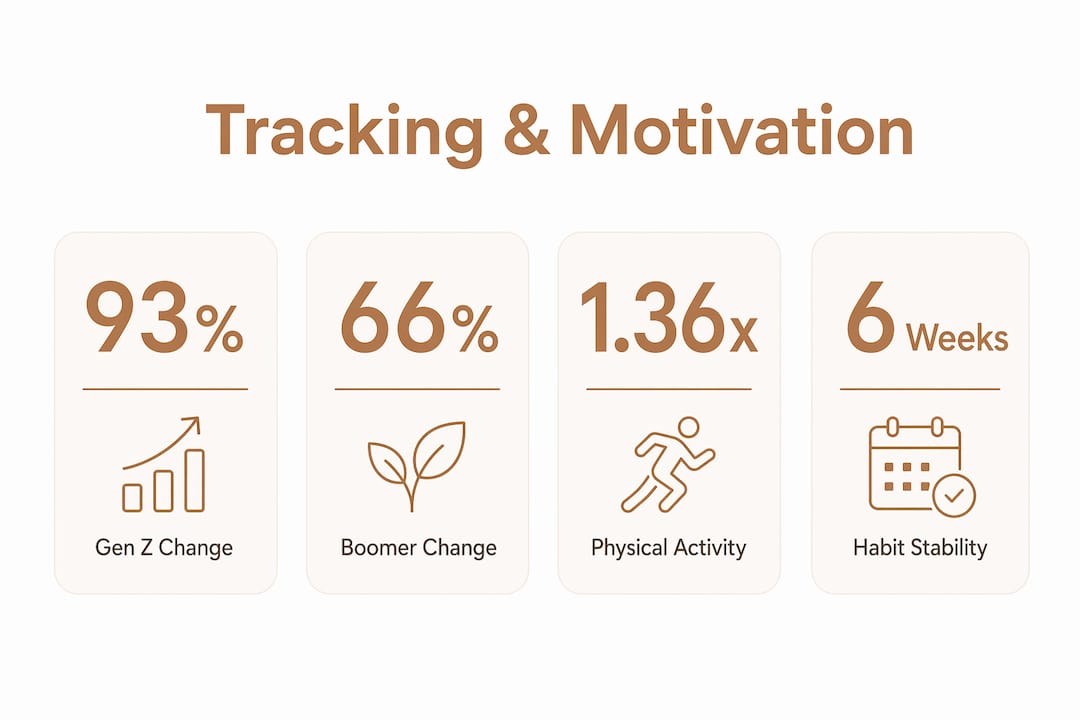
The generational differences are striking. 93% of Gen Z users reported making positive behavior changes based on health tracker data, compared to 66% of baby boomers. That 27-point gap does not mean older adults cannot benefit. It means the interface, framing, and type of feedback matter enormously for different audiences.
Weight loss outcomes follow the same pattern. Adults engaging with AI-integrated health platforms lost weight at a rate of 1.17% per week during active engagement periods, versus 0.44% per week during non-engagement periods. Active engagement nearly tripled the rate of progress. The data is not subtle.
How do psychological mechanisms drive motivation through tracking?
The core mechanism is cognitive confrontation. Tracking reduces the cognitive gap between how you perceive your habits and what you actually do. Researchers call the distorted version "vague habit syndrome," a state where self-reports consistently overestimate compliance with healthy behaviors. When your scale shows a number that contradicts your mental model, your brain has to reconcile the two. That reconciliation is where behavior change begins.
Feedback loops accelerate this process. Immediate feedback, meaning data you see within minutes or hours of a behavior, is far more motivating than delayed feedback. A weekly weigh-in is useful. A daily body composition reading is more powerful because it connects cause and effect while the memory of your choices is still fresh.
"Any system that regularly records behavior becomes an active part of that behavior, directing attention and motivation toward the target outcome."
Pro Tip: Set a consistent time each morning to check your metrics before the day's decisions pile up. Morning data review primes your decision-making for the next 12 hours in a way that evening reviews cannot.
The Hawthorne effect also extends beyond formal tracking sessions. Once you internalize that your behaviors are being measured, you begin making micro-adjustments throughout the day, choosing stairs over elevators, water over soda, without consciously deliberating each time. The tracking system becomes a background coach.
What factors sustain engagement with health tracking over time?
Sustained engagement is where most people struggle, and where the real behavior change either takes root or fades. The key factors are personalization, normalization of setbacks, and habit scheduling.
Personalization matters more than most people realize. Over 76% of consumers want personalized insights and nudges that translate data into measurable action. Generic step-count goals do not hold attention the way targeted feedback tied to your specific metrics does. AI-driven coaching that adjusts recommendations based on your actual trends keeps the feedback relevant and the motivation alive.
Non-linear progress is normal, and treating it as failure is the single biggest reason people quit. Weight loss and behavior change follow a non-linear path. Consistent engagement with tracking data helps people re-trigger progress after lapses rather than abandoning the process entirely. Clinicians and coaches now recommend framing lapses as re-engagement opportunities, not failures.
Several features consistently improve long-term retention:
- Scheduled check-ins: People who schedule dedicated time blocks for habits are over 3 times more likely to maintain them than those who fit habits in sporadically.
- Progress badges and streaks: Gamification elements create short-term reward cycles that bridge the gap between current effort and long-term results.
- Social accountability: Sharing progress with a group or partner adds external observation to the internal feedback loop, doubling the Hawthorne effect.
- Trend visualization: Seeing a 30-day trend line is more motivating than a single day's number because it shows direction, not just position.
Pro Tip: After six weeks of consistent tracking, your perception of your own activity patterns stabilizes significantly. Push through the first six weeks before judging whether a tracking habit is working for you.
How can you use health data to drive real lifestyle changes?
Practical application separates people who track from people who change. The most common mistake is focusing on single data points instead of trends. One bad weigh-in is noise. A two-week upward trend is a signal. Tracking trends rather than isolated readings gives you the context to make decisions that actually move the needle.
Automated logging beats manual logging for one simple reason: friction kills habits. Every extra step between a behavior and its recording is an opportunity to skip the record. Automated body composition tracking, sleep monitoring, and step counting remove that friction entirely. Automated tracking consistently outperforms manual logging for long-term habit maintenance because it requires no willpower to sustain.
Building a complete picture requires integrating multiple data sources. A weight reading alone tells you less than a weight reading combined with sleep quality, activity level, and nutrition data. A holistic tracking system that connects these inputs gives you the full story behind your numbers.
A practical weekly tracking workflow looks like this:
- Daily: Log body composition metrics at the same time each morning, before eating or drinking.
- Every three days: Review activity and sleep trends to spot patterns before they become problems.
- Weekly: Compare this week's averages to last week's averages, not individual days.
- Monthly: Adjust your goals based on trend data, not single readings or emotional reactions.
- Quarterly: Evaluate whether your tracking system still fits your current goals and simplify where possible.
The comparison below shows how trend-based tracking outperforms single-metric tracking across the behaviors that matter most for behavior change:
| Tracking approach | Motivation impact | Decision quality | Burnout risk |
|---|---|---|---|
| Single daily metric | Short-term spikes | Reactive, emotional | Moderate |
| Weekly trend review | Sustained, goal-oriented | Proactive, data-driven | Low |
| Multi-metric integration | Highest, context-rich | Comprehensive | Low with automation |
Streamlining your tracking workflow is not about doing less. It is about removing the steps that consume energy without producing insight.
Key Takeaways
Health tracking motivates behavior change most effectively when it combines consistent self-monitoring, trend-based analysis, and personalized feedback that normalizes non-linear progress.
| Point | Details |
|---|---|
| Self-monitoring is the intervention | Recording behavior changes it, even without coaching or external programs. |
| Engagement nearly triples results | Active tracking users lost weight at 1.17% per week versus 0.44% during non-engagement. |
| Generational response varies | 93% of Gen Z acted on tracker data versus 66% of baby boomers, so personalization matters. |
| Trends beat single readings | Weekly averages drive better decisions than reacting to any single day's number. |
| Scheduling habits triples retention | People who block time for tracking are over 3 times more likely to maintain the habit. |
Why the data confrontation moment is the one most people skip
Most articles about health tracking focus on features, step counts, and calorie goals. The part that actually changes behavior gets far less attention: the moment you see a number that contradicts what you believed about yourself.
I have worked with enough people tracking their health to notice a consistent pattern. The ones who make real progress are not the ones with the most sophisticated apps. They are the ones who sit with an uncomfortable reading and ask "why" instead of dismissing it as a bad day. That moment of honest confrontation is where the psychological work happens.
The vague habit syndrome concept resonates deeply with me because I have seen it play out constantly. People genuinely believe they are eating well and moving enough, right up until the data shows otherwise. The tracking device does not judge. It just reports. And that neutrality is what makes it effective in a way that willpower-based approaches rarely are.
My honest recommendation: do not wait until you have the perfect system. Start with one metric, track it consistently for six weeks, and let the data tell you what to focus on next. The weekly tracking practices that work are almost always simpler than people expect. Complexity is the enemy of consistency.
— Jacob
Uvirello: where body composition data meets daily motivation
Tracking your weight is one thing. Tracking what your weight is made of is another level entirely. Uvirello's Smart Electronic Weight Scale measures body fat percentage, BMI, and other body composition metrics with high-precision sensors, giving you the kind of data that actually explains your progress rather than just reporting a number.
Over 12,000 customers have rated Uvirello at 4.8 out of 5, and the consistent feedback is that the detailed metrics change how people think about their fitness. When you can see body fat trending down even during a week when the scale number barely moved, you stay motivated instead of quitting. Explore the Uvirello Smart Scale and see what your numbers are actually telling you.
FAQ
How does health tracking motivate behavior change?
Health tracking creates a feedback loop between your actions and measurable outcomes, triggering self-monitoring reactivity. Seeing real data confronts the gap between your self-image and actual behavior, which prompts adjustment.
Does tracking really increase physical activity?
Yes. Wearable device adopters showed a rate ratio of 1.36 for physical activity compared to non-adopters, meaning consistent tracking produces a statistically significant and sustained increase in movement.
How long does it take for tracking habits to stabilize?
Research shows that wearing a tracking device consistently for around six weeks stabilizes your perception of daily activity patterns. The first six weeks are the most critical period for building the habit.
Why do younger people respond more to health tracking?
93% of Gen Z users made positive behavior changes based on tracker data, versus 66% of baby boomers. Younger adults are more accustomed to real-time digital feedback and tend to act on data more readily.
What is the best way to avoid tracking burnout?
Automate as much logging as possible, focus on weekly trends rather than daily numbers, and schedule a fixed time for data review. Reducing friction and emotional reactivity to single readings keeps engagement sustainable long-term.