
Automated tracking is the practice of using technology, such as Apple Watch, Fitbit, or Oura Ring, to capture health and fitness data in real time without requiring you to write anything down. Manual logging, the traditional approach of recording workouts, meals, and body metrics by hand or in a spreadsheet, is prone to memory errors, inconsistent timing, and gaps that quietly corrupt your data. The core reason why automated tracking beats manual logging comes down to one fact: your memory is not a reliable instrument. Research on ecological momentary assessment confirms that retrospective recall introduces bias that real-time data capture avoids entirely. Digital health tools like the Dario app have already demonstrated this advantage in clinical settings, and the same principle applies directly to your fitness goals.
Why automated tracking beats manual logging on accuracy

Manual logging fails at the moment you try to remember what happened two hours ago. You reconstruct intensity, duration, and effort from memory, and that reconstruction is almost always wrong. Temporal drift in manual entries causes your data to collapse toward averages, masking the real variability in your performance.
Automated tracking solves this by capturing data at the moment it occurs. A wearable records your heart rate during a run without waiting for you to sit down and estimate it later. That difference in timing is the difference between a data point and a guess.
The accuracy gap is real but also worth understanding clearly. A 2026 PLOS ONE study found that consumer wearables track steps within roughly 10% of research-grade ActiGraph instruments. That level of accuracy is more than sufficient for trend tracking, which is the primary goal for most fitness-focused people.
- Memory bias: Manual entries made hours after activity average out peaks and valleys, hiding the data that matters most.
- Temporal drift: Late logging compresses intensity details into a single number, losing context.
- Passive capture: Wearables record continuously, so gaps from forgetting to log simply do not exist.
- Consistency: Automated systems apply the same measurement method every time, removing day-to-day variation in how you record.
Pro Tip: Treat your wearable data as a trend line, not a precise clinical reading. The value is in the pattern over weeks, not the exact number on any single day.
Which metrics work best with automated tracking vs. manual methods?
Not every health metric benefits equally from automation. Knowing where automated tracking excels, and where it has limits, helps you build a tracking system that actually serves your goals.
| Metric | Automated tracking | Manual logging |
|---|---|---|
| Step count | High accuracy, consistent trend data | Unreliable; easy to forget or miscount |
| Heart rate | Continuous, real-time capture | Impractical to record manually during exercise |
| Sleep staging | Directional trends; not clinical-grade | Nearly impossible to self-report accurately |
| Calorie expenditure | Increasing error at higher intensities | Estimates are rough but can add food context |
| Workout notes and context | Limited; lacks qualitative detail | Strong; you can describe how a session felt |
| Body composition (weight, BMI, body fat) | High accuracy with a quality scale | Accurate only if measured consistently and recorded immediately |
Consumer wearables serve best as directional tools rather than diagnostic instruments. Sleep staging and calorie burn show meaningful error, especially during high-intensity exercise. Step counts and general activity trends, however, are where wearables genuinely outperform anything you could log by hand.
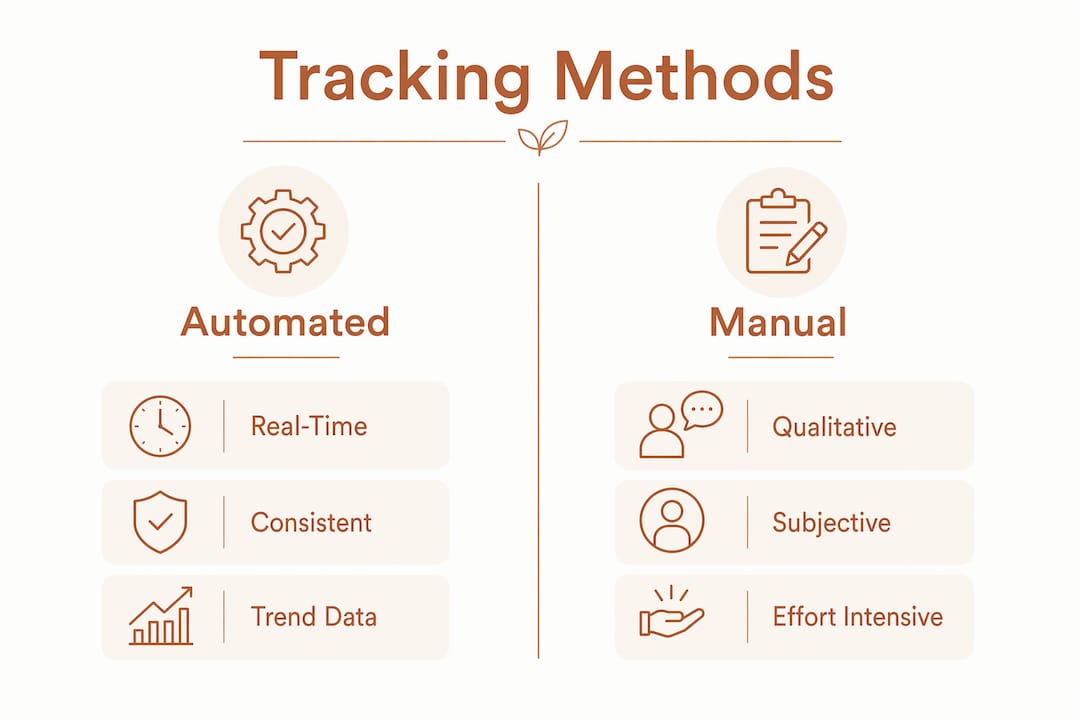
Manual logging still has a role for qualitative context. Notes about how a workout felt, what you ate before a poor performance, or why you skipped a session add meaning that no sensor captures. The strongest tracking systems combine automated data with brief manual notes, not one or the other exclusively.
How automated tracking supports lasting behavior change
Automated tracking reduces the friction between doing something and recording it. That reduction in effort is not a minor convenience. It is the mechanism that keeps people engaged with self-monitoring long enough to change their behavior.
The Dario digital health app for diabetes management demonstrates this clearly. A retrospective JMIR cohort study found that automated logging improved glycemic control and medication adherence among people with type 2 diabetes. The key factor was that users did not have to remember to log. The system captured clinical variables automatically, keeping them inside an active measurement loop.
The same principle applies to fitness. When logging requires no effort, you do it every day. When it requires effort, you do it when you feel motivated, which means you stop during the exact periods when your data would be most revealing.
- Start with one automated metric. Pick step count or resting heart rate. Build the habit of checking it before adding more data streams.
- Review weekly, not daily. Daily numbers fluctuate for reasons outside your control. Weekly averages reveal real trends.
- Share data with your coach or clinician. Automated reports from apps like Dario or Apple Health give professionals context they cannot get from verbal summaries.
- Add a brief manual note after hard sessions. One sentence about perceived effort gives your automated data the context it needs to be useful.
- Set a baseline period. Spend two weeks tracking before making any changes. You need a reference point to measure progress against.
Pro Tip: If you notice a drop in your weekly step average, check your schedule before blaming your fitness. Automated data reveals life patterns, not just exercise patterns.
Is manual logging outdated? The cost-benefit case for automation
Manual logging is not outdated for every situation, but its cost in time and accuracy is higher than most people realize. Every minute spent reconstructing yesterday's workout is a minute spent on imperfect data. Automated time tracking reduces admin workload and the errors that come from manual reconstruction, a finding that applies directly to health data management.
The efficiency case for automation rests on three factors:
- Time savings: A wearable captures 24 hours of data without a single manual entry. Manual logging of the same period takes 10 to 20 minutes and produces less accurate results.
- Error reduction: Automated systems do not misremember, round up, or skip entries on busy days. That consistency produces cleaner data for decision-making.
- Better fitness outcomes: Cleaner data leads to better decisions. If your fitness tracking workflow is built on accurate inputs, your adjustments to training load, sleep, and nutrition are grounded in reality rather than approximation.
The upfront cost of a quality wearable or smart scale is real. The ongoing cost of manual logging, measured in time, errors, and missed insights, is also real. Over a six-month period, the data quality advantage of automation compounds in ways that a notebook cannot match.
Body composition tracking is a clear example. Weighing yourself daily and recording the number manually works, but only if you do it at the same time each day, under the same conditions, and never miss a day. A connected smart scale like the Uvirello Smart Electronic Weight Scale captures weight, BMI, and body fat percentage automatically and syncs the data without any manual step. The precision sensors in connected scales remove the inconsistency that makes manual body composition logs unreliable.
How to transition from manual logging to automated tracking
Switching from manual logging to automated tracking does not require replacing everything at once. A phased approach produces better results and avoids the common mistake of collecting more data than you can actually use.
- Choose devices based on the metrics that matter most to you. If body composition is your focus, start with a smart scale. If activity is the priority, a wrist-worn wearable covers step count, heart rate, and sleep in one device.
- Sync automated data with brief manual context notes. A short note after a hard session, a rest day, or an illness gives your data meaning that sensors cannot provide.
- Use trend data, not single readings. One bad night of sleep data does not mean your sleep is poor. Four consecutive weeks of declining sleep scores does. Tracking trends over time is where automated systems deliver their clearest advantage.
- Check for data gaps regularly. Wearables lose sync, batteries die, and apps update. A weekly review of your data catches gaps before they distort your trend lines.
- Calibrate your expectations by metric. Step counts are reliable. Calorie burn estimates at high intensity are not. Know which numbers to trust and which to treat as rough guides.
Key Takeaways
Automated tracking outperforms manual logging because it captures data in real time, removes memory bias, and keeps you engaged in consistent self-monitoring without adding effort to your day.
| Point | Details |
|---|---|
| Real-time capture removes bias | Automated systems record data as it happens, eliminating the recall errors that corrupt manual logs. |
| Wearables excel at trend tracking | Devices like Apple Watch and Fitbit track steps within ~10% of research-grade accuracy, sufficient for fitness goals. |
| Automation supports behavior change | Reduced logging friction keeps people engaged in self-monitoring long enough to produce real health improvements. |
| Manual notes still add value | Brief qualitative notes after key sessions give automated data the context sensors cannot capture on their own. |
| Body composition needs consistency | A connected smart scale removes the timing and condition variables that make manual weight logs unreliable. |
Automation is a compass, not a ruler
I have watched a lot of people abandon fitness tracking after two or three weeks, and the pattern is almost always the same. They start with a notebook or a spreadsheet, miss a few days, feel behind, and quit. The data was never the problem. The effort required to maintain it was.
What I find consistently true is that automated tracking does not make you more disciplined. It makes discipline less necessary. When your scale syncs automatically and your wearable records your steps without a single tap, the data accumulates whether you think about it or not. That passive accumulation is the real advantage, not the accuracy numbers.
The mistake I see most often is treating automated data as a precise clinical instrument. It is not. A wearable that shows your resting heart rate dropped five beats per minute over three weeks is telling you something real. A wearable that shows you burned exactly 487 calories on a Tuesday run is giving you a useful estimate, not a fact. The people who get the most from automated tracking are the ones who read the trend, not the number.
My honest recommendation is to start with body composition. Weight, BMI, and body fat percentage tracked consistently over time tell a clearer story than almost any other metric. A quality smart scale with automatic sync removes every barrier to consistency. Add a wearable for activity once you have that baseline. Build the data layer before you try to interpret it.
— Jacob
Uvirello and the case for connected health tracking
Accurate body composition data is the foundation of any serious fitness or wellness plan. Uvirello's Smart Electronic Weight Scale captures weight, BMI, and body fat percentage with high-precision sensors, then syncs that data automatically so nothing gets lost or misrecorded.
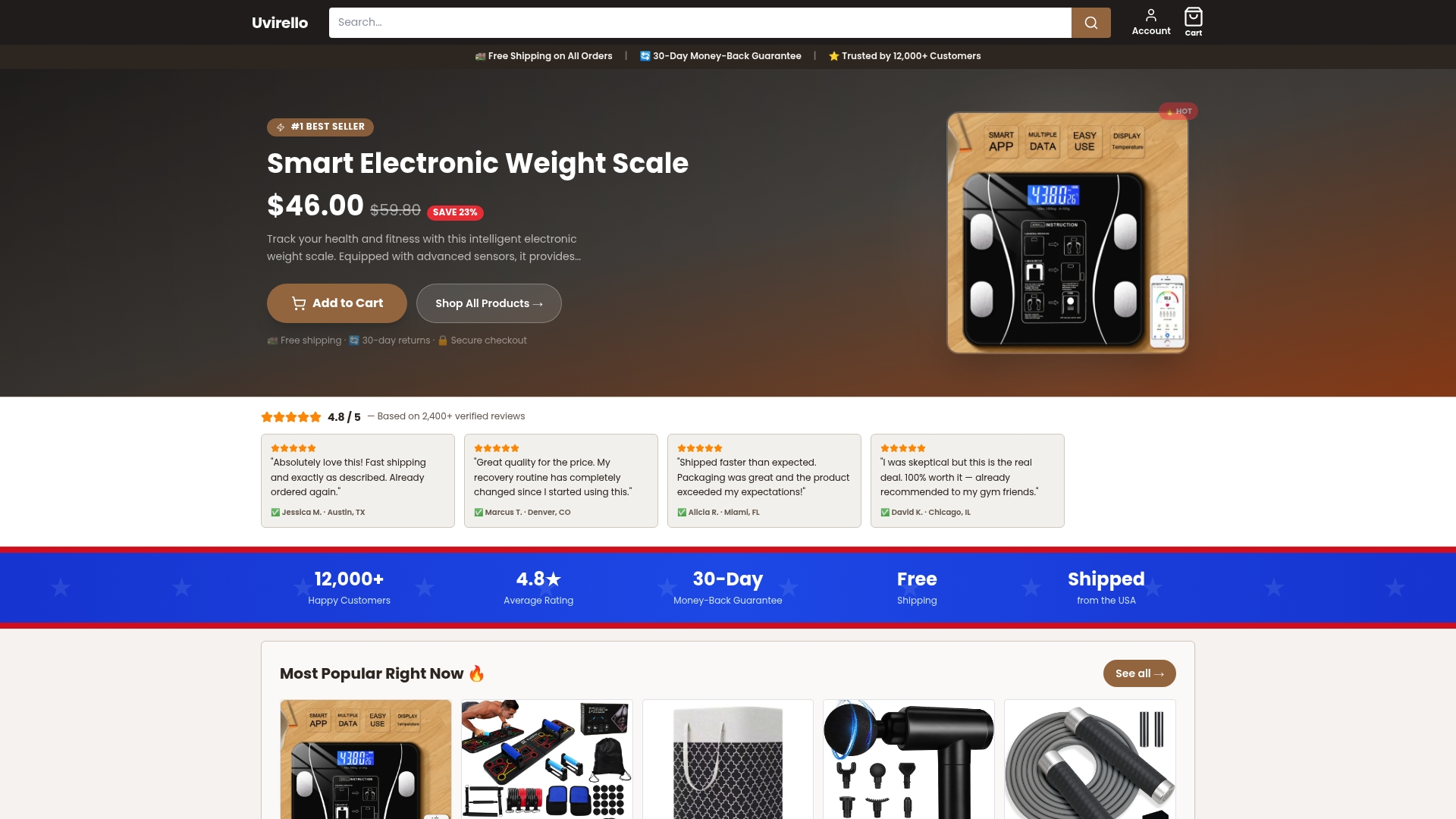
Over 12,000 people have rated the Uvirello scale at 4.8 out of 5, citing the accuracy and ease of use as the primary reasons they kept tracking when previous methods failed them. If you are ready to replace inconsistent manual logs with reliable, automatic body composition data, the Uvirello Smart Scale gives you a starting point you can actually trust.
FAQ
What makes automated tracking more accurate than manual logging?
Automated tracking captures data in real time, removing the memory errors and temporal drift that affect manual entries. Ecological momentary assessment research confirms that retrospective recall introduces significant bias that real-time sampling avoids.
Are consumer wearables accurate enough for fitness tracking?
Yes, for trend tracking. A 2026 PLOS ONE study found that wearables measure step counts within roughly 10% of research-grade instruments, which is sufficient for monitoring fitness progress over time.
Is manual logging ever better than automated tracking?
Manual logging is better for capturing qualitative context, such as how a workout felt or why you skipped a session. The strongest approach combines automated data with brief manual notes for full picture tracking.
How does automated tracking support behavior change?
Automated logging reduces the effort required to self-monitor, which keeps people engaged consistently. The Dario app study showed that automated health logging improved both glycemic control and medication adherence in people with type 2 diabetes.
What is the best metric to start automating first?
Body composition, specifically weight and body fat percentage, is the best starting point. A connected smart scale captures these metrics automatically and consistently, giving you a reliable baseline before adding other data streams.