
Data history is the systematic record of past health and fitness measurements that allows you to track genuine progress, spot real trends, and make decisions grounded in evidence rather than guesswork. A single weigh-in or one-time body fat reading tells you almost nothing on its own. The role of data history in tracking progress is to replace that uncertainty with a clear narrative, one built from weeks and months of consistent measurements. Industry standards now recommend at least 3–6 months of data to reliably identify health trends, and that threshold exists for good reason.
How does data history improve the accuracy of tracking progress?
Progress is a trend line, not a single point. Daily body weight can shift by several pounds due to water retention, sleep quality, or meal timing. Without a record of past readings, you cannot tell whether a number on the scale reflects real change or just normal daily noise. Historical data reduces uncertainty by enabling cumulative learning, improving future health outcome estimates by over 50%. That is not a minor statistical footnote. It means your ability to predict and adjust your health trajectory more than doubles when you track consistently over time.
The concept behind this is sometimes called measurement memory, which is the retrospective structuring of data to reveal genuine trends. Even messy or incomplete records carry value. Aggregated datasets outperform human memory in spotting trends, providing confidence levels that intuition simply cannot match. You might feel like you have been stalling for three weeks, but your data might show a clear downward trend in body fat percentage across two months. The data wins that argument every time.

Understanding why trends beat single readings is the first shift in mindset that separates people who make real progress from those who keep restarting.
Pro Tip: Review your last 30 days of data before making any change to your diet or training plan. A single bad week rarely signals a real problem. A consistent pattern across four weeks does.
Key reasons historical data outperforms isolated measurements:
- It smooths out daily fluctuations caused by hydration, sleep, and stress
- It reveals slow-moving trends that are invisible in short windows
- It gives you a baseline to measure the actual impact of any change you make
- It builds confidence by showing real progress even when motivation dips
What key metrics should you track over time?
Tracking everything is not the goal. Tracking the right things consistently is. For health and fitness, the most useful metrics are body weight, body fat percentage, BMI, and any performance markers tied to your specific goals, such as resting heart rate or workout completion rate. Consistent measurement conditions minimize variance and improve data reliability over time. Consistency matters more than frequency.
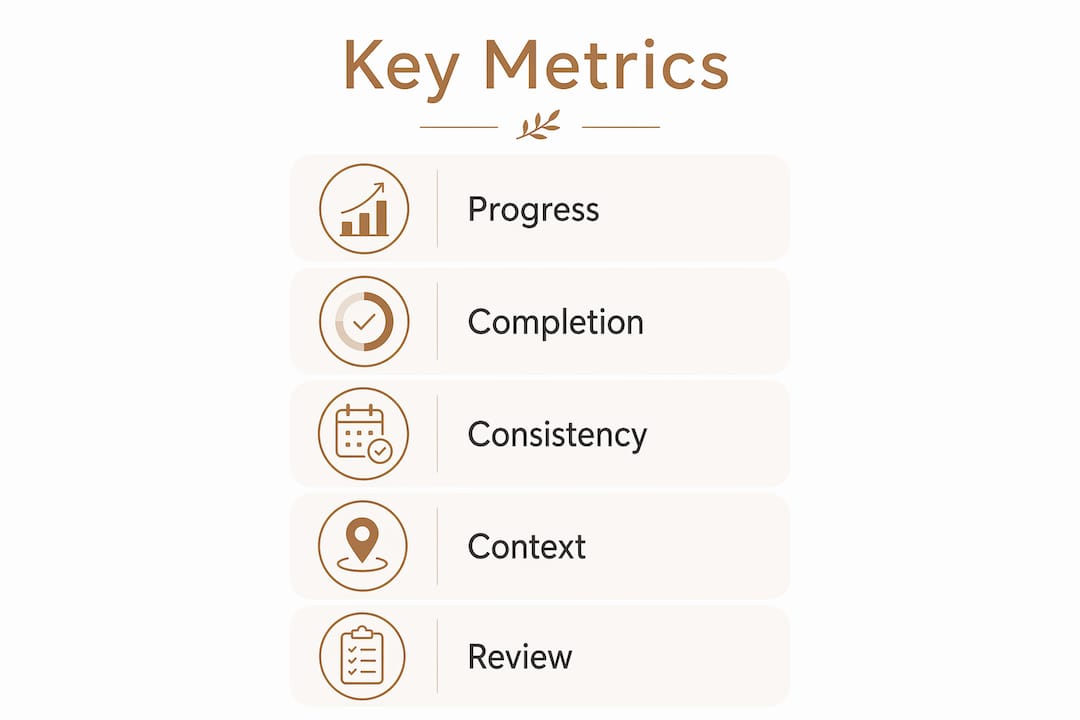
Three metrics borrowed from performance tracking apply directly to personal health goals. Progress completion percentage measures how often you hit your planned workouts or nutrition targets. Time variance tracks whether you are hitting milestones on schedule. Milestone delivery rate shows how reliably you reach the goals you set. Weekly review of these metrics improves execution by 20–30%, which translates directly to better adherence and faster results.
Pro Tip: Weigh yourself and take body composition readings at the same time each day, ideally first thing in the morning after using the bathroom. This single habit removes more variance than any other tracking adjustment.
Best practices for building a reliable data history:
- Log measurements at the same time of day, every time
- Use the same equipment for each measurement session
- Record the conditions around each reading, such as sleep hours or stress level
- Set a fixed weekly review time to assess trends, not individual data points
- Note any changes to your routine, diet, or equipment directly in your log
A structured weekly review routine turns raw numbers into a clear picture of what is working and what needs to change.
Why does context and versioning matter for your data history?
Raw numbers without context are unreliable. Imagine you switched from a basic bathroom scale to a body composition scale that measures body fat percentage. Your readings will look dramatically different, not because your body changed, but because the measurement method changed. Without annotating that change, your historical data becomes misleading. You might interpret a jump in body fat percentage as a setback when it is actually a calibration difference.
This is where the concept of data versioning becomes critical. Software developers version their code so they can trace exactly what changed and when. Your health data deserves the same discipline. Viewing data as a narrative with a consistent semantic layer prevents you from comparing incompatible data points. Old readings taken under different conditions cannot be directly compared to new ones without a note explaining the difference.
Four steps to maintain meaningful data context:
- Annotate equipment changes. When you switch scales, apps, or measurement tools, record the date and note the change in your log.
- Document routine shifts. If you change your measurement time, fasting window, or workout schedule, add a note to your data record.
- Flag anomalies immediately. If a reading looks unusual, note the likely cause, such as illness, travel, or a late meal, before you forget.
- Keep an audit trail. A simple spreadsheet column labeled "notes" is enough. The goal is to preserve the original context of every reading.
Time travel capabilities in data tracking refer to the ability to revisit original measurement conditions and explain unexpected changes. For personal health tracking, this means being able to look back at any point in your history and understand exactly what was happening at that moment.
How can you use historical data to improve your health results?
The real power of historical data analysis is not in the collection. It is in the review. Tracking time variance gives you a 3x higher likelihood of achieving your goals because it forces you to identify bottlenecks early, before they derail your progress entirely. If you consistently miss your Friday workout, your data will show that pattern within a month. Without the record, you might not notice it for six months.
A practical approach to using your data history looks like this:
- Set a monthly review date. Sit down once a month and look at your full data set, not just the last week.
- Identify your trend line. Are your key metrics moving in the right direction over 4–8 weeks? That is the only question that matters.
- Spot your bottlenecks. Where does your progress completion percentage drop? That is where your plan needs adjustment.
- Make one change at a time. Changing multiple variables at once makes it impossible to know what worked. Historical data only helps if you can isolate cause and effect.
- Compare to your baseline. Your starting point is your most important reference. Every review should include a comparison to where you began.
Retrospective data structuring, the practice of going back through older records to find patterns you missed in real time, often reveals hidden cycles. Many people discover they consistently lose progress during high-stress months or gain momentum after specific dietary changes. Building a holistic tracking system that captures multiple metrics at once makes these patterns far easier to spot.
The significance of data records compounds over time. Six months of consistent data is worth more than six months of inconsistent data, but six months of inconsistent data is still worth far more than nothing at all.
Key Takeaways
Historical data is the single most reliable tool for distinguishing real health progress from daily noise, and 3–6 months of consistent records improves outcome estimates by over 50%.
| Point | Details |
|---|---|
| Build a data baseline | Collect at least 3–6 months of consistent measurements before drawing conclusions about your progress. |
| Track trends, not single readings | Daily fluctuations are normal. Real progress only becomes visible across weeks and months of data. |
| Annotate every change | Document equipment swaps, routine shifts, and anomalies to keep your historical data valid and comparable. |
| Review weekly and monthly | Weekly check-ins catch short-term issues. Monthly reviews reveal the trend lines that drive real decisions. |
| Use context to interpret numbers | A number without context is just noise. A number with a note explaining the conditions around it is evidence. |
Why I think most people are tracking health data the wrong way
Most people treat their health data like a scoreboard. They check the number, feel good or bad about it, and move on. That approach wastes the most valuable asset you have, which is your history. I have seen people abandon solid progress plans because one week looked bad, when their own data, had they reviewed it properly, would have shown a clear positive trend across the previous two months.
The shift that changes everything is treating your data as a narrative rather than a verdict. Every reading is a sentence in a longer story. A single bad chapter does not ruin the book. What matters is the direction the story is heading over time.
The annotation habit is the one most people skip, and it is the one that costs them the most. When you switch scales, change your workout schedule, or go through a stressful period, those events explain your data. Without notes, you are left guessing why a number changed. With notes, you have evidence. That evidence is what separates people who make consistent progress from those who keep cycling through the same frustrating plateaus.
Adopt a longitudinal view of your health. Stop asking "What does today's number mean?" and start asking "What does the last three months tell me?" That single question reframes everything.
— Jacob
How Uvirello supports your long-term tracking goals
Building a meaningful data history starts with accurate, consistent measurements at the foundation. Uvirello's Smart Electronic Weight Scale captures body fat percentage, BMI, and other body composition metrics with high-precision sensors, giving you the kind of reliable baseline data that makes historical analysis actually useful.

Over 12,000 people have rated Uvirello at 4.8 out of 5, and the most common feedback centers on the clarity and consistency of the readings over time. That consistency is exactly what a strong data history requires. If you are ready to build a health record you can actually trust and learn from, explore Uvirello's scale and see how it fits into your tracking routine.
FAQ
What is the role of data history in tracking progress?
Data history is a systematic record of past measurements that reveals genuine trends over time. It reduces uncertainty and improves health outcome estimates by over 50% compared to relying on single readings.
How much historical data do you need to see real trends?
Industry standards recommend at least 3–6 months of consistent data to reliably identify health and fitness trends. Shorter windows are too vulnerable to daily fluctuations to be meaningful.
Why does measurement consistency matter more than frequency?
Consistent conditions, such as measuring at the same time each day, remove variance from your data. Inconsistent timing or equipment introduces noise that makes trend analysis unreliable, regardless of how often you measure.
What happens if you change your scale or tracking method?
Changing equipment or methods without annotation breaks your data history. Always record the date and nature of any change so you can account for the difference when reviewing past versus current readings.
Can incomplete data still be useful for tracking progress?
Yes. Even incomplete or messy historical data outperforms human memory for spotting trends. Aggregated records provide confidence levels and pattern visibility that intuition alone cannot replicate.