
Consistent health tracking is the practice of monitoring key health metrics at regular intervals, and research shows it produces measurably better wellness outcomes than sporadic measurement. A 2026 cross-sectional study found that frequent tracking increases the odds of sustained physical activity by 2.4 to 3.5 times. Body composition monitoring, including metrics like body fat percentage and BMI, falls under what clinicians call self-monitoring, a behavioral strategy with strong ties to long-term adherence. The health tracking consistency benefits covered here are grounded in peer-reviewed research and practical experience, giving you a clear picture of why regularity matters more than intensity.
1. Health tracking consistency benefits start with better activity adherence
Consistent tracking is the single strongest predictor of whether you will stick to a physical activity routine. A 2026 cross-sectional study found that frequent trackers showed 2.4 to 3.5 times higher odds of consistent physical activity engagement compared to infrequent trackers. That is not a marginal edge. It is a behavioral multiplier that compounds over weeks and months.
The mechanism is straightforward. Every time you log a metric, you send a small signal to your brain that this behavior matters. Behavioral science calls this a "habit loop," where the act of tracking becomes both the cue and the reward. Over time, the routine becomes automatic rather than effortful.

Consistent timing strengthens this loop further. Tracking at the same point each day, whether morning weigh-ins or evening step counts, reduces the mental friction of deciding when to do it.
Pro Tip: Pick a tracking time that already anchors your day, such as right after brushing your teeth or before your first meal. Attaching tracking to an existing habit cuts the effort of starting from scratch.
2. Data quality improves dramatically with regular entries
Consistent tracking does not just build habits. It produces better data. Research from the Icahn School of Medicine at Mount Sinai shows that tracking at a consistent time yields a 92% data completion rate, compared to 63% when tracking times vary. That 29-percentage-point gap means inconsistent trackers are missing nearly a third of their data.
Missing data skews trends. If you skip tracking on high-stress days or after poor sleep, your dataset systematically underrepresents your worst periods. The result is a falsely optimistic picture of your health.
Tracking trends over time, including heart rate, activity levels, and sleep patterns, gives far more clinically relevant information than any single reading. Johns Hopkins Medicine notes that trend data provides more informative cardiovascular assessments than isolated snapshots.
Pro Tip: Track on boring, uneventful days too. Those baseline readings are what make your trend line meaningful when something unusual does happen.
3. Wearable adoption accelerates consistent behavior change
Wearable devices do more than count steps. A 2026 study published in the Journal of Medical Internet Research found that wearable device adoption associates with a 36% relative increase in physical activity over time. That increase reflects the compounding effect of daily feedback loops that wearables create.
The reason wearables work is rooted in self-determination theory. Consistent data feedback supports three core psychological needs: autonomy, competence, and motivation. When you can see your progress in real numbers, you feel capable and in control. That feeling drives continued engagement.
Devices that track body composition metrics, such as the Uvirello Smart Electronic Weight Scale, extend this principle beyond step counts. Seeing body fat percentage and BMI shift over weeks gives you the kind of trend data that motivates sustained effort.
4. Long-term consistency cuts chronic disease risk significantly
Sustained physical activity, tracked and maintained over years, produces disease prevention outcomes that short bursts of effort cannot match. A 2026 longitudinal cohort study found that consistent physical activity reduces the risk of major chronic diseases by 23%–48% compared to sporadic activity patterns.
The data breaks down by condition:
| Disease | Risk reduction with consistent activity |
|---|---|
| Major chronic diseases (combined) | 23% lower risk |
| Type 2 diabetes | 44% lower risk |
| Cardiovascular disease | 29% lower risk |
These numbers reflect sustained patterns, not peak performance weeks. The body responds to regularity at the metabolic level, improving insulin sensitivity, blood pressure regulation, and inflammatory markers over time.
5. Consistency prevents the metabolic damage of start-stop cycles
Irregular health habits create physiological instability that consistent routines avoid entirely. Start-stop patterns cause blood sugar fluctuations and digestive stress, two markers of metabolic dysfunction that accumulate with repeated cycles of effort and abandonment.
The clinical term for this pattern is "boom-bust cycling." You push hard for two weeks, burn out, stop entirely, then restart from a lower baseline. Each restart costs more effort than the last. Consistent moderate tracking and activity avoids this trap by keeping your baseline stable.
Tracking your metrics daily makes boom-bust cycles visible before they become harmful. When your data shows a sharp spike in intensity followed by a gap in entries, that pattern is a warning sign you can act on.
6. Consistent tracking builds stronger motivation over time
Motivation is not a fixed resource. It grows when you have evidence of progress. Consistent tracking creates that evidence in a format you can see and measure. Fitness trackers that support autonomy and competence through regular feedback reinforce the psychological drivers of long-term behavior change.
The practical result is a shift from willpower-based effort to identity-based habit. You stop thinking "I need to exercise today" and start thinking "I am someone who tracks their health." That identity shift is what separates people who sustain results from those who cycle through short-term programs.
Here are the core motivational advantages of steady tracking:
- You accumulate a visible record of progress that counters discouragement on hard days.
- You identify patterns, such as better sleep after lower-intensity days, that reward continued attention.
- You reduce the cognitive load of health decisions by making tracking automatic rather than deliberate.
- You build self-efficacy, the belief that your actions produce results, which predicts long-term adherence better than motivation alone.
Pro Tip: Review your tracking data weekly, not just daily. Weekly reviews reveal trends that daily check-ins obscure, and they give you a broader sense of progress that sustains motivation through rough patches.
7. The "never miss twice" rule protects your habit streak
Missing a day of tracking does not break a habit. Missing two consecutive days often does. The "never miss twice" rule is a behavioral strategy that treats one missed day as neutral and two missed days as a pattern to interrupt. This distinction matters because perfectionism kills more health habits than laziness does.
When you frame a missed day as a failure, you trigger an all-or-nothing response. When you frame it as a single data point in a long trend, you return to tracking the next day without guilt. The habit survives.
This rule also reduces the anxiety that comes with rigid tracking schedules. You give yourself permission to be human, which paradoxically makes you more consistent over time.
8. Consistent timing matters more than the specific time you choose
The research is clear: any consistent time of day works better than varying your tracking schedule. Evening tracking often shows higher adherence rates in practice, but the key variable is regularity, not the clock position.
This finding removes a common barrier. Many people delay starting a tracking habit because they cannot identify the "right" time. There is no right time. There is only the time you will actually use every day.
Reducing friction is the real goal. If morning tracking requires you to wake up earlier, it will fail. If evening tracking competes with family time, it will fail. The best tracking time is the one that fits your existing routine without requiring willpower to execute.
9. Minimum viable routines outperform high-intensity but inconsistent plans
Clinical observation consistently shows that minimum viable routines prevent injury and attrition better than extreme or erratic tracking regimes. A routine you can sustain through a stressful week, a travel schedule, or a minor illness is worth more than a perfect routine you abandon when life gets complicated.
This principle applies directly to health tracking. A daily two-minute weigh-in and body composition check produces better long-term data than a weekly deep-dive that you skip whenever your schedule shifts. The long-term activity consistency that reduces cancer and cardiovascular risk comes from years of moderate, sustained effort, not months of intense focus followed by gaps.
Build your tracking habit around your worst-case day, not your best-case day. If you can track on a Monday after a bad weekend, you have a habit that will last.
10. Practical strategies to build lasting tracking consistency
Building a consistent tracking habit requires reducing friction at every step. These strategies work across fitness levels and tracking tools:
- Anchor tracking to an existing habit. Pair your daily weigh-in with your morning routine or your evening wind-down. Habit stacking removes the decision of when to track.
- Use reminders without relying on them. Set a phone notification for the first two weeks, then let the habit run on its own. Reminders are training wheels, not permanent fixtures.
- Keep your tracking tool visible. A scale placed in your bathroom, not stored in a closet, gets used. Visibility is a powerful behavioral cue.
- Track the minimum on hard days. On days when a full check-in feels like too much, record just one metric. Partial data beats no data every time.
- Review weekly to stay oriented. Daily numbers fluctuate for reasons unrelated to your habits. Weekly averages show your actual direction.
The difference between entry-level tracking apps and more capable health platforms comes down to how well they support these behaviors. Tools that visualize weekly fitness trends and send contextual reminders make consistency easier to maintain without requiring constant willpower.
Key Takeaways
Consistent health tracking, defined as monitoring key metrics at regular intervals, produces better data, stronger habits, and measurably lower chronic disease risk than sporadic measurement.
| Point | Details |
|---|---|
| Frequency multiplies adherence | Frequent tracking raises the odds of consistent physical activity by 2.4 to 3.5 times. |
| Consistent timing improves data quality | Tracking at the same time daily produces a 92% completion rate versus 63% with variable timing. |
| Long-term consistency cuts disease risk | Sustained activity reduces major chronic disease risk by 23%–48% compared to sporadic patterns. |
| "Never miss twice" protects habits | One missed day is neutral; two consecutive missed days signal a pattern worth interrupting. |
| Minimum viable beats maximum intensity | A routine you sustain through hard weeks produces better outcomes than a perfect plan you abandon. |
Why I think most people track health the wrong way
Most people treat health tracking as a performance review. They check their numbers when they feel good about their habits and avoid the scale when they know the data will disappoint them. That selective approach is exactly backwards.
The value of consistent tracking is not in the good days. It is in the complete picture. I have seen people make their biggest behavioral changes not because their numbers were great, but because they finally had enough consecutive data points to see a pattern they could not ignore. A trend line built from 90 days of honest entries tells you something a single reading never can.
The other mistake I see constantly is chasing intensity over regularity. Someone tracks every metric obsessively for three weeks, burns out, and disappears for two months. Then they restart and repeat the cycle. The data from those three-week sprints is nearly useless for identifying long-term trends. The person who tracks one metric every single day for a year has far more useful information, and far better health outcomes to show for it.
Consistency is not glamorous. It does not make for a compelling before-and-after story. But it is the mechanism behind every meaningful health improvement I have observed. Start small, track every day, and review your trends weekly. The results accumulate in ways that occasional intensity never produces.
— Jacob
Uvirello: built for the habit of daily tracking
Tracking your health consistently requires a tool that makes daily measurement effortless. Uvirello's Smart Electronic Weight Scale delivers body fat percentage, BMI, and other body composition metrics in seconds, giving you the kind of data that builds a meaningful trend line over time.
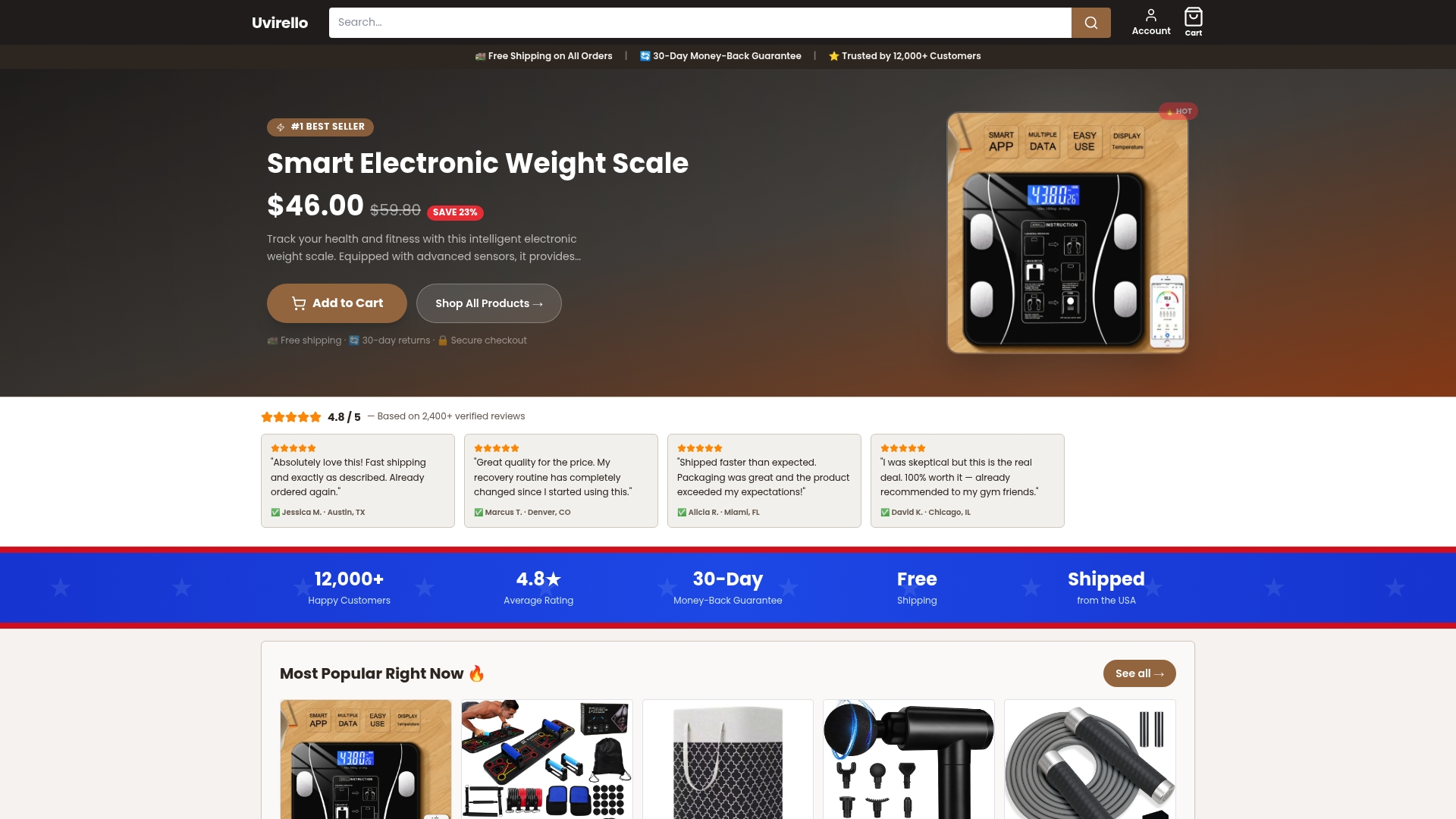
Over 12,000 people have rated Uvirello at 4.8 out of 5 stars, and the feedback centers on one consistent theme: the scale makes daily tracking feel easy rather than burdensome. When tracking is this low-friction, the habit sticks. If you want to put the health consistency advantages covered in this article into practice, Uvirello gives you the foundation to start today and sustain it for the long term. You can also explore how tracking trends beat single readings to get more from every data point you collect.
FAQ
What are the main health tracking consistency benefits?
Consistent health tracking improves physical activity adherence, data quality, and long-term disease prevention. Research shows frequent trackers have 2.4 to 3.5 times higher odds of maintaining regular activity compared to infrequent trackers.
How often should you track your health metrics?
Daily tracking at a consistent time produces the best results. A 92% data completion rate comes from same-time-each-day tracking, compared to 63% with variable timing.
Does consistent tracking actually reduce disease risk?
Yes. Sustained physical activity, supported by consistent tracking, reduces the risk of major chronic diseases by 23%–48% compared to sporadic activity patterns, according to a 2026 longitudinal cohort study.
What should you do if you miss a day of tracking?
Apply the "never miss twice" rule: treat one missed day as neutral and return to tracking the next day. Two consecutive missed days are the threshold that disrupts habit formation.
Is the time of day you track your health important?
The specific time matters less than the consistency of that time. Any fixed daily window works. Evening tracking tends to show higher adherence in practice, but the key is choosing a time you will use every day without exception.