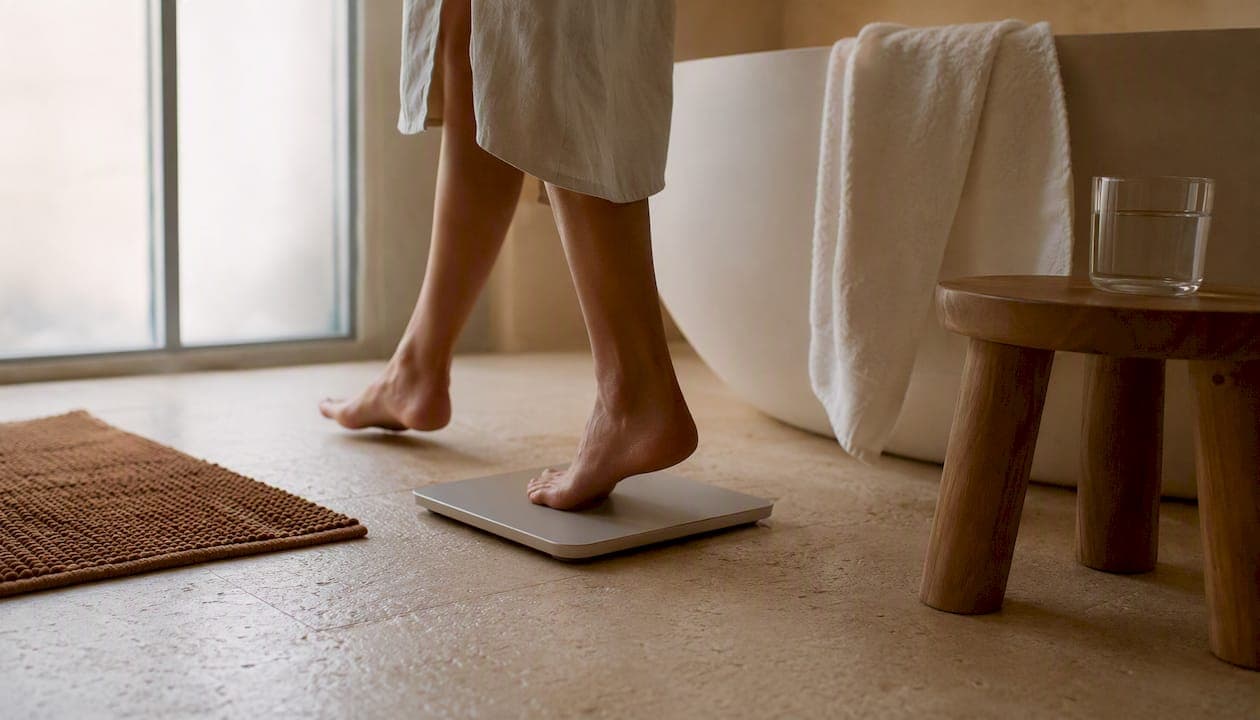
Use your morning weight as your baseline. That's the short answer. Step on the scale after using the bathroom, before eating or drinking anything, and you'll get the most consistent, comparable number your body can give you. According to the Cleveland Clinic, this is the standard recommendation from clinicians for exactly that reason.
Quick dos and don'ts for consistent morning vs evening scale readings:
- Do weigh at the same time every morning, on the same scale, on a hard flat surface
- Do go barefoot and wear minimal or identical clothing each time
- Don't mix morning and evening readings in the same trend line
- Don't judge a single number; judge a week's average
Evening readings are valid data, but only when tracked as their own separate series. A Tuesday morning reading and a Wednesday evening reading are not comparable. Treat them as different measurements of different things.
Table of Contents
- Why does your body weigh less in the morning?
- How much do readings typically shift from morning to evening?
- Your repeatable morning weighing routine
- Daily weigh-ins vs. weekly: which frequency actually works?
- What smart scales add, and where their limits are
- When should you actually worry about a weight change?
- Key Takeaways
- The Uvirello Smart Electronic Weight Scale supports your morning routine
- Useful sources and further reading
Why does your body weigh less in the morning?
Overnight, your body quietly sheds water in ways you don't notice. Every breath you exhale carries water vapor. Skin releases moisture through the night. By the time your alarm goes off, you've lost a meaningful amount of fluid without drinking a drop, and your bladder and gut are empty. That combination produces the day's lowest typical weight.
There's also a glycogen factor worth understanding. Glycogen, the form your body stores carbohydrates in muscle and liver tissue, binds water. Research on body water and glycogen physiology confirms that each gram of glycogen holds roughly 3 grams of water. After an overnight fast, liver glycogen depletes partially to maintain blood sugar. Lose even 50 grams of glycogen and you shed roughly 150 grams of associated water, about a third of a pound, before you've done anything else.
Add the respiratory and skin water loss, the emptied bladder, and the cleared digestive tract, and the morning number reflects your body at its most "deflated" state. That's not a flaw. It's a feature: it's repeatable, and repeatable is what makes a baseline useful.
How much do readings typically shift from morning to evening?
For most adults, the swing between a morning and evening reading runs roughly 1.8–4 pounds (0.8–1.8 kg). Some people see slightly less; others, particularly those with high sodium intake or larger meal volumes, can see more. Body composition, sex, and diet all influence the magnitude. Body composition, sex, and diet all influence the magnitude.

The sources of daily weight variation include food and fluid volume, sodium-driven water retention, glycogen-associated water, bowel contents, and clothing weight, each contributing variably depending on individual factors. |
Peer-reviewed research on weight variability supports using trend-based analysis rather than single readings to detect real change, precisely because these daily sources of noise are so consistent and predictable. Knowing the range is normal is half the battle.
Your repeatable morning weighing routine
Follow this checklist every morning and your readings will be genuinely comparable day to day.
- Wake up and use the bathroom completely before stepping on the scale
- Step on barefoot, on a hard flat surface (tile or hardwood, not carpet)
- Wear minimal clothing or the same light clothing every time
- Stand still and centered on the platform until the reading locks
- Log the number immediately, before you forget it
Consumer Reports specifically flags hard-floor placement as a practical accuracy step, since carpet compresses unevenly under a scale's feet and can skew readings by a pound or more. Keep the scale in one spot and don't move it between weigh-ins. Recalibration after moving is often imperfect.
Pro Tip: Set a phone reminder for the same time each morning, and log your weight in the same app or notebook every day. The habit loop, alarm, bathroom, scale, log, is what makes the data usable. Consistency in the logging tool matters almost as much as consistency in the timing.
Daily weigh-ins vs. weekly: which frequency actually works?
If you can handle seeing daily fluctuations without stress, daily morning weigh-ins paired with a 7-day rolling average give you the clearest signal. If daily checks feel discouraging, pick one consistent morning each week instead. Health.com notes that experts link daily weighing to better weight-control behaviors, but also acknowledge that weekly weighing works well for people who find daily numbers hard on their mental well-being.
The 7-day rolling average is simple. Add your last seven morning readings and divide by seven. Do that every day. The resulting number smooths out the noise from a salty dinner or a hard workout and shows you the actual direction your weight is moving. For example: if your daily readings over a week are 162.4, 163.1, 162.0, 162.8, 161.9, 162.5, and 162.2, the average is 162.4. That's your signal, not any single day.
Pair your numbers with brief notes. A short annotation like "high sodium dinner," "travel day," or "first day of period" turns a confusing spike into an explained data point. This is where a scale data playbook becomes genuinely useful: context transforms raw numbers into something you can act on.
What smart scales add, and where their limits are
Smart scales add trendable body-composition estimates to your daily weigh-in, but they are not clinical-grade measurement devices. Prioritize consistent use and trend lines over any single metric reading.
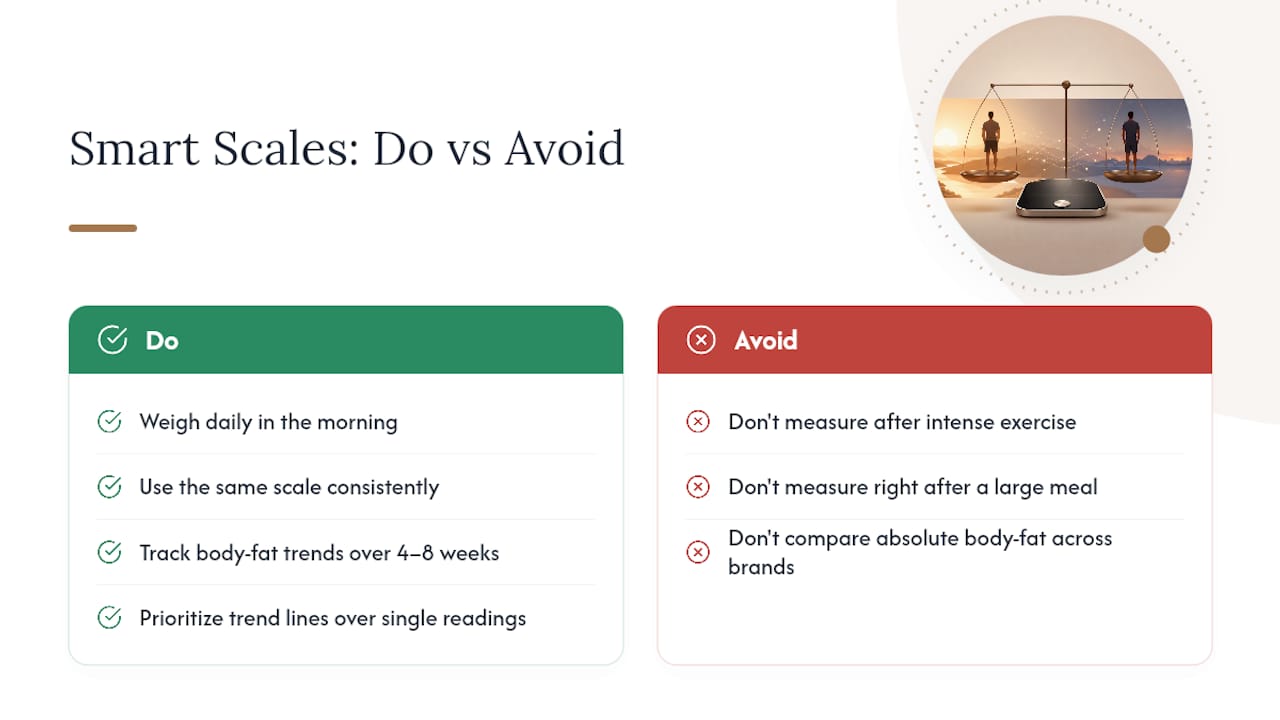
The technology behind body-composition features is bioelectrical impedance analysis (BIA), a method well integrated with modern gym software systems like Fitness Flow. The scale sends a small electrical current through your body and estimates fat mass, lean mass, and other metrics based on how that current travels. The catch: hydration status changes how current flows, and every manufacturer uses a proprietary algorithm to convert impedance into a percentage. Two scales from different brands can show meaningfully different body-fat readings for the same person, as Newsweek's coverage of a viral scale comparison illustrated clearly. The difference wasn't measurement error in the traditional sense; it was two different algorithms producing two different estimates.
That doesn't make the data useless. It makes it device-specific. Track your body-fat percentage trend on the same scale over months and the direction of change is meaningful, even if the absolute number isn't clinically precise.
Pro Tip: Never measure body composition right after intense exercise or a large meal. Both conditions shift hydration and temporarily distort BIA readings. Weigh first thing in the morning, in a fasted, rested state, for the most consistent body-composition estimates your scale can produce.
The Uvirello Smart Electronic Weight Scale uses high-precision sensors and provides body-composition metrics including body fat percentage and BMI alongside daily weight. With over 12,000 customer reviews averaging 4.8 out of 5, it's built for the kind of consistent morning tracking this article describes. Pair it with the daily weigh-in pattern approach and the body-composition trends become genuinely informative over a 4–8 week window.
When should you actually worry about a weight change?
Most daily swings are noise. Only sustained changes across a 2–3 week trend require action.
A few practical rules of thumb:
- If your 7-day rolling average drifts upward for more than two consecutive weeks, that's a real signal worth investigating, not a reason to panic, but worth adjusting diet or activity.
- A sudden unexplained gain of more than 5 lbs in a single week, especially with swelling, breathlessness, or fatigue, warrants a call to your doctor. That pattern can indicate fluid retention from a medical cause.
- Rapid unexplained weight loss over 2–3 weeks, without a change in diet or exercise, is also a reason to check in with a clinician.
Red flags that merit medical review:
- Visible swelling in legs, ankles, or feet (edema)
- Shortness of breath accompanying weight gain
- Unexplained fatigue alongside rapid weight change
- Weight loss of more than 5% of body weight over 6–12 months without intentional effort
For everything else, trust the trend. A single bad reading after a salty dinner is not a setback. It's Tuesday.
Key Takeaways
Morning weight is your most reliable baseline because it's the body's most consistent, repeatable state: fasted, emptied, and deflated of daytime accumulation.
| Point | Details |
|---|---|
| Use morning as your baseline | Weigh after the bathroom, before eating or drinking, for the most consistent daily number. |
| Never mix morning and evening readings | Morning and evening series reflect different physiological states; keep them separate. |
| Expect a typical daily weight swing between morning and evening readings driven by normal physiological changes | The typical swing between a morning and evening reading is roughly 1.8–4 pounds (0.8–1.8 kg), though this range varies based on individual factors. |
| Use a 7-day rolling average | Add seven consecutive morning readings and divide by seven to filter out single-day noise. |
| Uvirello Smart Scale for trend tracking | High-precision sensors and body-composition metrics support the consistent morning-baseline habit. |
The number is just data
The readers who get the most out of daily weighing are the ones who stop treating the scale as a verdict and start treating it as a sensor. A single morning reading tells you almost nothing. Thirty of them, logged consistently, tell you a story. The psychological shift from "what does this number mean about me today" to "what direction is my trend moving this month" is the whole game. Pick a time, commit to four weeks of consistent morning weigh-ins, and you'll have more useful health data than most people collect in a year. The scale doesn't judge. It just measures.
The Uvirello Smart Electronic Weight Scale supports your morning routine
Tracking morning weight consistently is straightforward when your scale makes it effortless. The Uvirello Smart Electronic Weight Scale is built for exactly this: precise daily readings you can trust, body-composition metrics you can trend over time, and a user experience that doesn't get in the way of a 60-second morning habit.
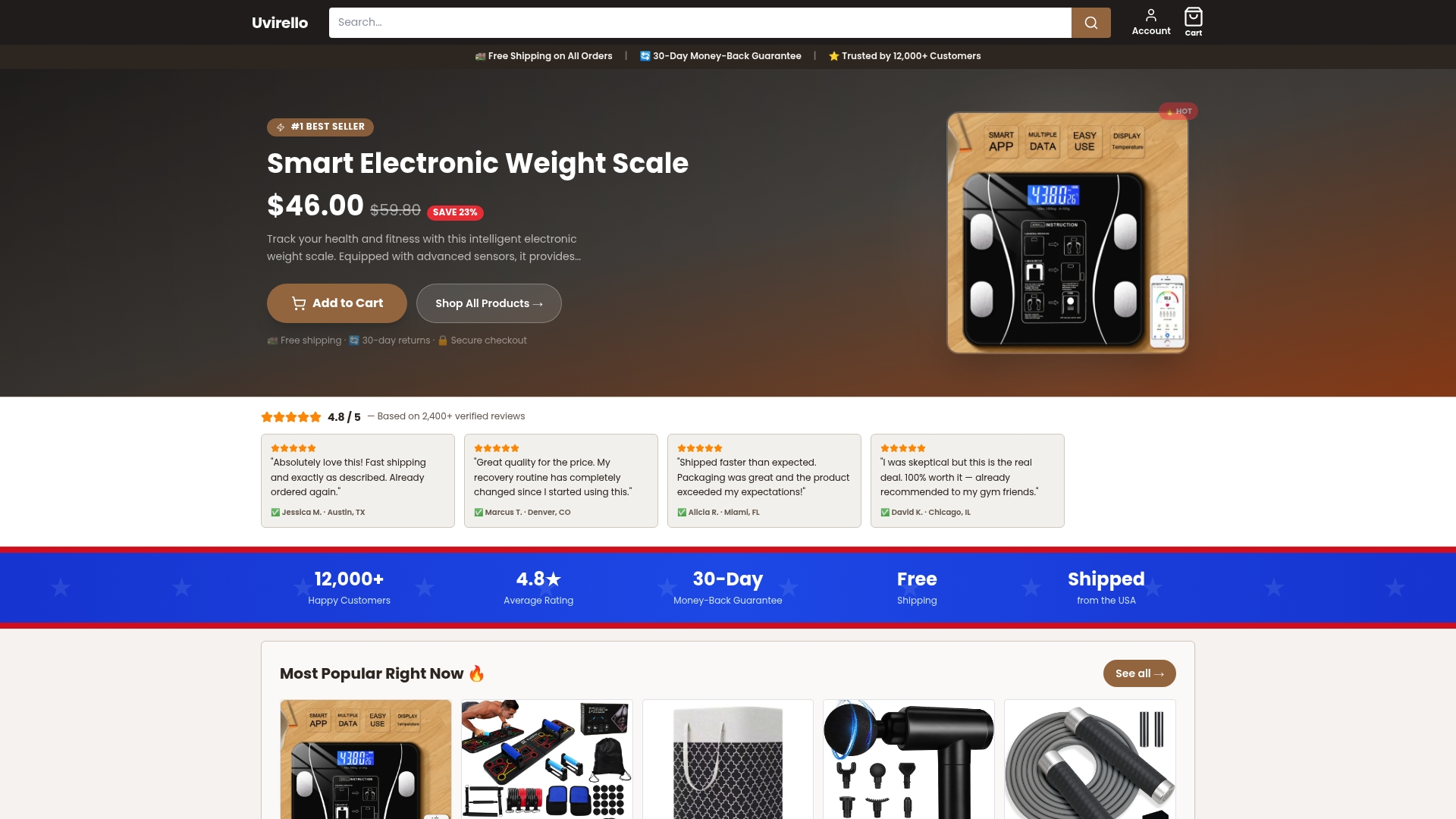
The scale's high-precision sensors capture weight alongside body fat percentage, BMI, and additional composition metrics, all from a single morning step-on. Multi-user profiles mean the whole household can track their own baselines without data mixing. And because BIA accuracy depends on consistency, the same-scale, same-time morning routine this article recommends is exactly how Uvirello is designed to be used.
For fitness enthusiasts using smart scales to support workout planning, the composition trends add another layer of signal alongside weight. Note: the Uvirello scale is a personal health tracking tool, not a diagnostic medical device. For any medical concerns about weight changes, consult a qualified clinician.
Order the Uvirello Smart Electronic Weight Scale and start building a morning baseline worth trusting.
Useful sources and further reading
The claims in this article draw on the following sources. For medical questions about weight changes, consult a physician or registered dietitian.
- The Best Time To Weigh Yourself
- The Best Time to Weigh Yourself for Accurate Results and Better Tracking
- Best Time to Weigh Yourself - Bathroom Scales
- The best time to weigh yourself
- Viral photo shows two scales, same person — viewers stunned
- PubMed article (25521523) on body water/glycogen physiology
- PubMed article (30649648) relevant to weight variability
The scale is one data point. Energy levels, how your clothes fit, and lab work from your doctor all belong in the picture too.