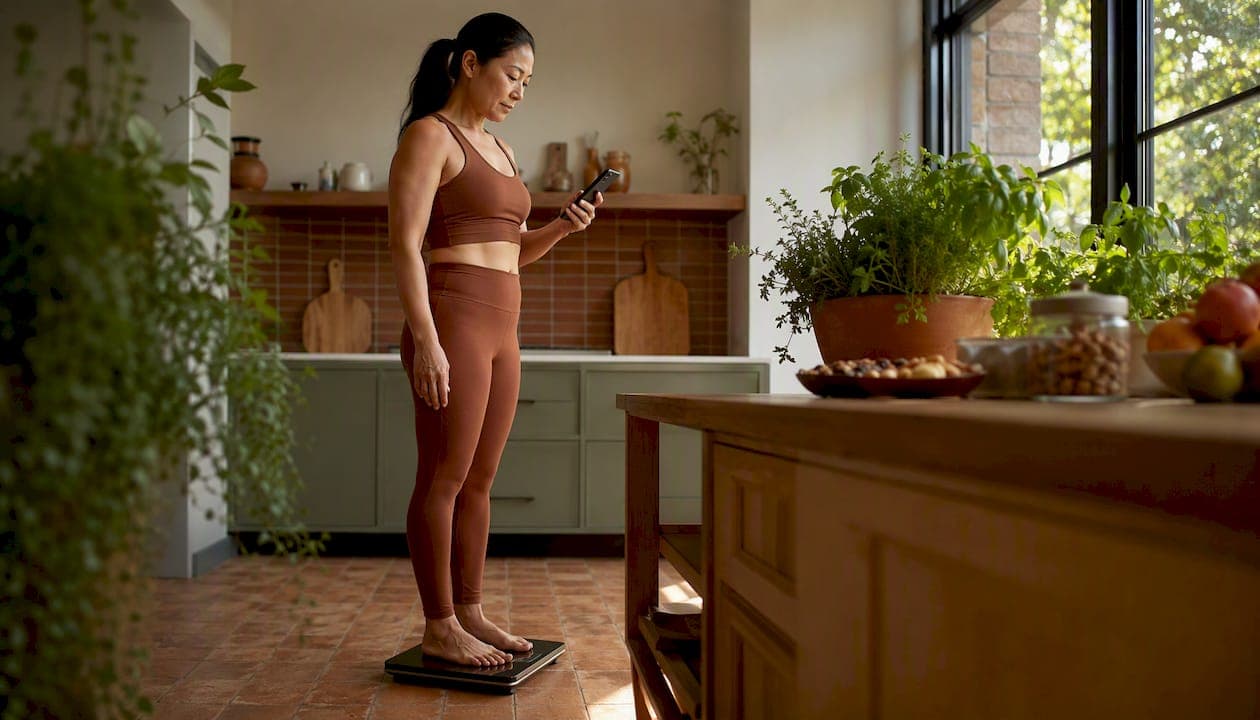
AI turns raw weight and bioelectrical impedance readings into personalized guidance by estimating lean mass, refining your basal metabolic rate, detecting trends, and recommending nutrition and recovery adjustments. A smart electronic weight scale like the Uvirello isn't just measuring you. It's building a model of you.
Here's what that looks like in practice:
- Personalized calorie target calculated from lean body mass using the Katch-McArdle formula, not a generic height-weight estimate
- Fat-to-muscle trend alerts that flag compositional shifts even when the scale number stays flat
- Plateau detection that cross-references body-fat trends with training data to suggest a calorie adjustment or deload week
- Recovery suggestions triggered when poor sleep or elevated resting heart rate coincides with rising fatigue signals
Consumer BIA measures body fat with some error compared to clinical DEXA scans. That gap matters less than most people think, because AI doesn't rely on any single reading. It relies on your trend.
Pro Tip: Measure at the same time every morning, post-void, before eating or drinking. Consistent conditions give the AI reliable input, and reliable input produces meaningful trends.
Table of Contents
- How does a smart scale measure body composition, and where does AI improve it?
- What accuracy should you expect, and why do trends matter more than single readings?
- What concrete AI-powered insights will you actually see?
- How do you apply AI-generated insights to your training and nutrition?
- What are the privacy trade-offs and limits of consumer AI?
- What should you look for in an AI-enabled smart scale?
- Key Takeaways
- What home fitness users should actually expect from AI-enabled scales
- Uvirello: a smart scale built around the insights you'll actually use
How does a smart scale measure body composition, and where does AI improve it?
Consumer smart scales use bioelectrical impedance analysis (BIA): a low-level electrical current (typically around 50 kHz, 500 μA) passes through the body via footpad electrodes. Impedance varies with fat-free mass and body water, and the scale converts that signal into an estimated body composition.
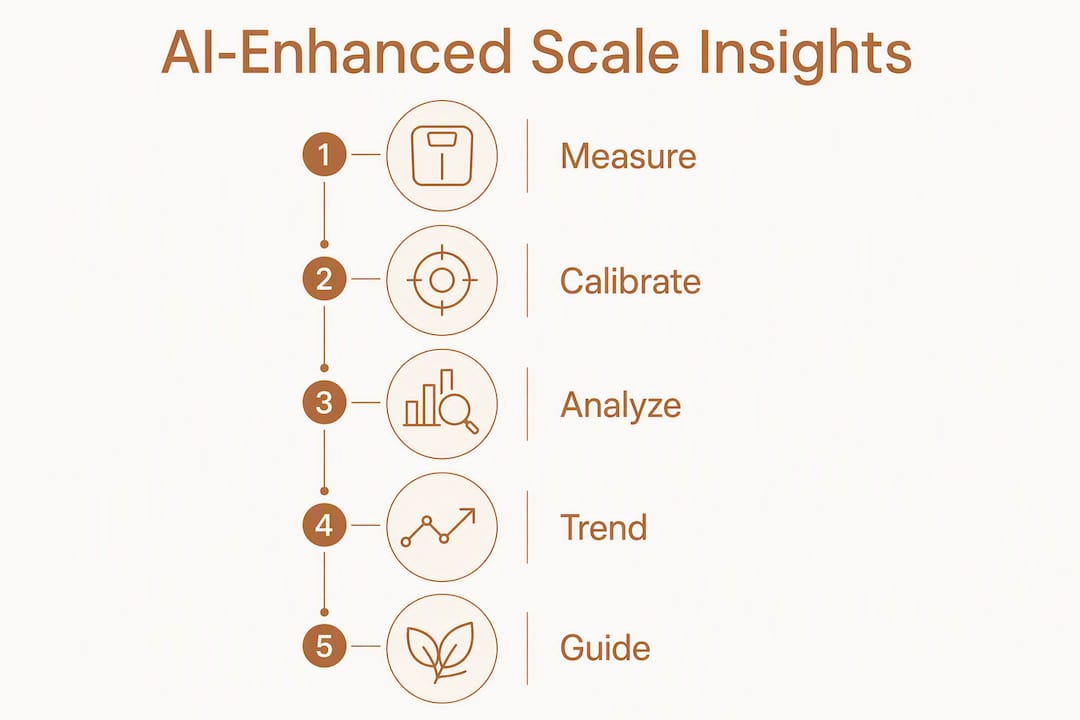
That raw reading is where AI steps in. Instead of applying a one-size formula, the algorithm feeds your measured lean body mass (LBM) into the Katch-McArdle equation to produce a BMR that reflects your actual muscle mass rather than just your height and weight. A 160-pound person with 130 lbs of lean mass has a meaningfully different metabolic rate than someone at the same weight with 115 lbs of lean mass. The AI catches that difference; a standard BMI calculator doesn't.
Beyond BMR, AI adds three more layers:
- Algorithmic smoothing to reduce day-to-day noise from hydration and measurement timing
- Model personalization using your historical readings and demographic profile to improve estimate accuracy over time
- Cross-sensor synthesis when you connect a wearable or manually log waist measurements, sleep, or activity data
That last point is where the real value of AI in home monitoring shows up: correlating body-composition trends with training intensity and recovery so the system can recommend preventive changes before plateaus or burnout set in.
What accuracy should you expect, and why do trends matter more than single readings?
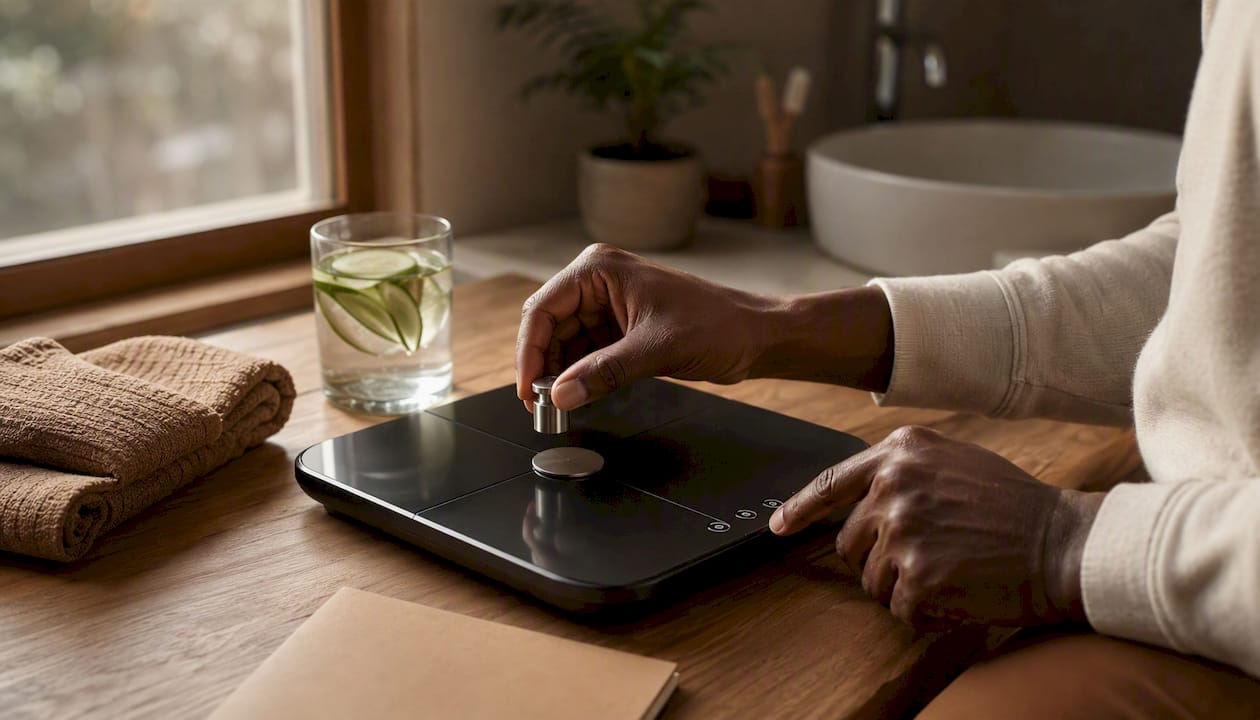
Consumer-grade BIA can be off versus clinical standards, but trends are reliable enough for home fitness decisions. The ±3–5 percentage point error range versus DEXA is the honest benchmark. DXA itself carries roughly 1.5% precision error under controlled conditions, so even the gold standard isn't perfect.
What creates daily noise on your scale:
- Hydration shifts (the biggest factor): changes in body water can move a body-fat reading by roughly 2–4 percentage points on typical consumer devices
- Recent exercise and inflammation, which temporarily alter fluid distribution
- Food, alcohol, and sodium intake in the hours before measurement
- Time of day, since body water redistributes during sleep and activity
Different vendors also calibrate BIA algorithms against different population databases, so absolute numbers can vary across brands. The practical fix is consistent personal protocol and focusing on multi-week trends rather than any single reading.
Pro Tip: Use weekly averages, not daily numbers. A 4-week trend showing body fat down 0.8% and lean mass up 0.5% is a real signal. A single-day spike of 1.2% is almost always hydration.
AI reduces apparent error through smoothing, population-aware model tuning, and cross-sensor correlation. When a spike in body weight coincides with a poor sleep score, the algorithm can flag it as likely water retention rather than fat gain. That context is something a standalone scale reading can never provide. Tracking trends consistently is what separates useful data from noise.
What concrete AI-powered insights will you actually see?
AI turns trends into human actions. These are the outputs a well-integrated smart scale delivers:
- Personalized daily calorie target refined from your current LBM and recent trend data, updated as your composition shifts
- Plateau alert comparing your body-fat trend to strength logs and suggesting a calorie adjustment or a deload week
- Recovery-aware plan changes when poor sleep or elevated resting HR coincides with rising fatigue signals
- Hydration alerts flagging when body-water shifts are making body-fat readings unreliable that day
- Photo-based progress timelines on platforms that integrate visual analysis alongside scale data, adding a richer compositional picture
Here's the kind of language a well-tuned AI might surface:
That's the difference between data and guidance. The number alone tells you nothing. The trend plus context tells you exactly what to adjust.
One underappreciated benefit: AI can highlight compositional wins like fat percentage dropping while lean mass holds steady, even when the scale weight is flat. For anyone who has ever felt discouraged by a stalled number, seeing that fat-to-muscle shift is often what keeps them consistent.
How do you apply AI-generated insights to your training and nutrition?
Follow the AI's trend-based guidance in short test blocks of 2–4 weeks while keeping measurement conditions consistent, then validate by outcome. Small, time-bound adjustments are easier to evaluate than sweeping changes.
A practical cycle to run each month:
-
Confirm your morning measurement protocol — same time, same conditions, every day
-
Review the AI's weekly trend summary at the end of each week, not daily readings
-
Implement one small, time-bound adjustment: calorie +/−150 kcal, one deload week, or a higher protein target
-
Recheck your 2–4 week trend data to see whether the change moved the needle
-
Iterate based on what the trend shows, not how you feel on any given day
For realistic timelines: body fat percentage shifts typically become measurable over 4–12 weeks; strength gains show up in 2–6 weeks. Expecting weekly body-fat changes will frustrate you. Expecting a 6-week trend to tell a clear story is reasonable.
Turning scale data into a workout plan works best when you treat each adjustment as a hypothesis, not a verdict. If the AI suggests a calorie increase and your body-fat trend doesn't respond in 3 weeks, that's useful data too.
Seek professional input when you see large unexplained changes, any medical symptoms, or when the AI recommends aggressive calorie cuts below your estimated BMR.
What are the privacy trade-offs and limits of consumer AI?
AI insights depend on cloud processing and cross-sensor data, which improves personalization but raises real data-handling choices. Before connecting your scale to any app ecosystem, it's worth knowing what you're agreeing to.
Key considerations:
- Data storage location: some platforms process on-device; most send data to cloud servers for model training and personalization
- Encryption: look for TLS in transit and AES-256 at rest as baseline standards
- Account connection permissions: third-party integrations (Apple Health, Google Fit, Fitbit) expand AI capability but also expand data sharing
- Third-party sharing policies: check whether your data is used to train shared models or sold to partners
- Firmware and app update cadence: keeping device firmware and app software current maintains algorithm accuracy and device compatibility
AI-generated body composition insights are consumer wellness guidance, not clinical diagnosis. Any clinically significant finding — unexplained weight loss, unusual body-fat shifts, or metabolic symptoms — warrants a conversation with a healthcare professional, not an app adjustment.
Algorithmic bias is a real limit. BIA calibration databases are often built on specific population samples, which means absolute estimates can be less accurate for some age groups, ethnicities, or body types. Machine learning-based equations are actively being developed to improve generalizability across diverse populations, but consumer devices haven't fully closed that gap. Consistent personal protocol and multi-week trend focus mitigate the issue without eliminating it.
What should you look for in an AI-enabled smart scale?
Prioritize sensor precision, algorithm transparency, app integration, and multi-metric synthesis. Here's the practical checklist:
- High-precision sensors with validated BIA (multi-frequency preferred for better accuracy)
- Reliable multi-user profile handling so each person's history stays separate and personalized
- Integration with major health apps and wearables (Apple Health, Google Fit, Garmin Connect)
- Transparent privacy policy with clear data-retention and sharing terms
- Regular firmware and algorithm updates to keep personalization models current
The Uvirello Smart Electronic Weight Scale checks these boxes for home users. With high-precision sensors, body composition metrics including body fat percentage and BMI, and a user-friendly app experience, it's built for the fitness enthusiast who wants more than a number. Over 12,000 customers rate it 4.8 out of 5 — a trust signal that reflects consistent real-world performance, not just spec-sheet promises. Reviewed and recommended by Jacob, wellness technology writer at Uvirello.
How this guide's claims were formed
Claims throughout this guide draw on peer-reviewed research on consumer BIA, published accuracy comparisons between BIA and DEXA, and industry reporting on AI-model behavior in consumer wellness devices. The empirical anchors used consistently are the consumer BIA ±3–5 percentage point error range versus clinical standards, the typical BIA electrical specifications (50 kHz, 500 μA), and the trend-based measurement approach.
This guide provides consumer wellness information, not medical advice. Consult a healthcare professional for any clinical concerns or before making significant changes to your diet or training based on body composition data.
Key Takeaways
AI-enabled smart scales deliver their real value through trend synthesis, not single readings — consistent measurement protocol and multi-week averages are what make personalized insights accurate and actionable.
| Point | Details |
|---|---|
| Measure consistently | Same time, same conditions daily; the AI's accuracy depends entirely on reliable input. |
| Trust trends, not single readings | Consumer BIA carries ±3–5 percentage points of error versus DEXA; weekly averages are the reliable signal. |
| Treat AI suggestions as experiments | Run each calorie or training adjustment for 2–4 weeks, then evaluate the trend before changing course. |
| Prioritize integration and privacy | Choose a scale with app compatibility, transparent data policies, and regular firmware updates. |
| Uvirello for home users | Rated 4.8/5 by 12,000+ customers, with high-precision sensors and AI-driven body composition insights. |
What home fitness users should actually expect from AI-enabled scales
Most people buy a smart scale expecting it to tell them something they don't already know. What they get instead is a mirror that shows them patterns they were too close to see. That's not a disappointment. That's the actual value.
The fitness enthusiasts who get the most from AI-driven scales are the ones who stop reacting to daily numbers and start reading monthly stories. The AI isn't smarter than a coach. But it's available at 6 AM, it never forgets your history, and it doesn't care if you had a bad week. It just shows you the trend.
What's coming next is genuinely interesting: as more users opt into cross-device data sharing, AI models will learn individual-specific responses — how your body reacts to a calorie surplus, how your lean mass responds to a deload. That level of personalization isn't fully here yet for most consumer devices, but the trajectory is clear.
Uvirello: a smart scale built around the insights you'll actually use
If you've read this far, you already understand what separates a useful smart scale from a glorified bathroom gadget: sensor quality, AI that synthesizes multiple data points, and an app that translates trends into clear next steps.
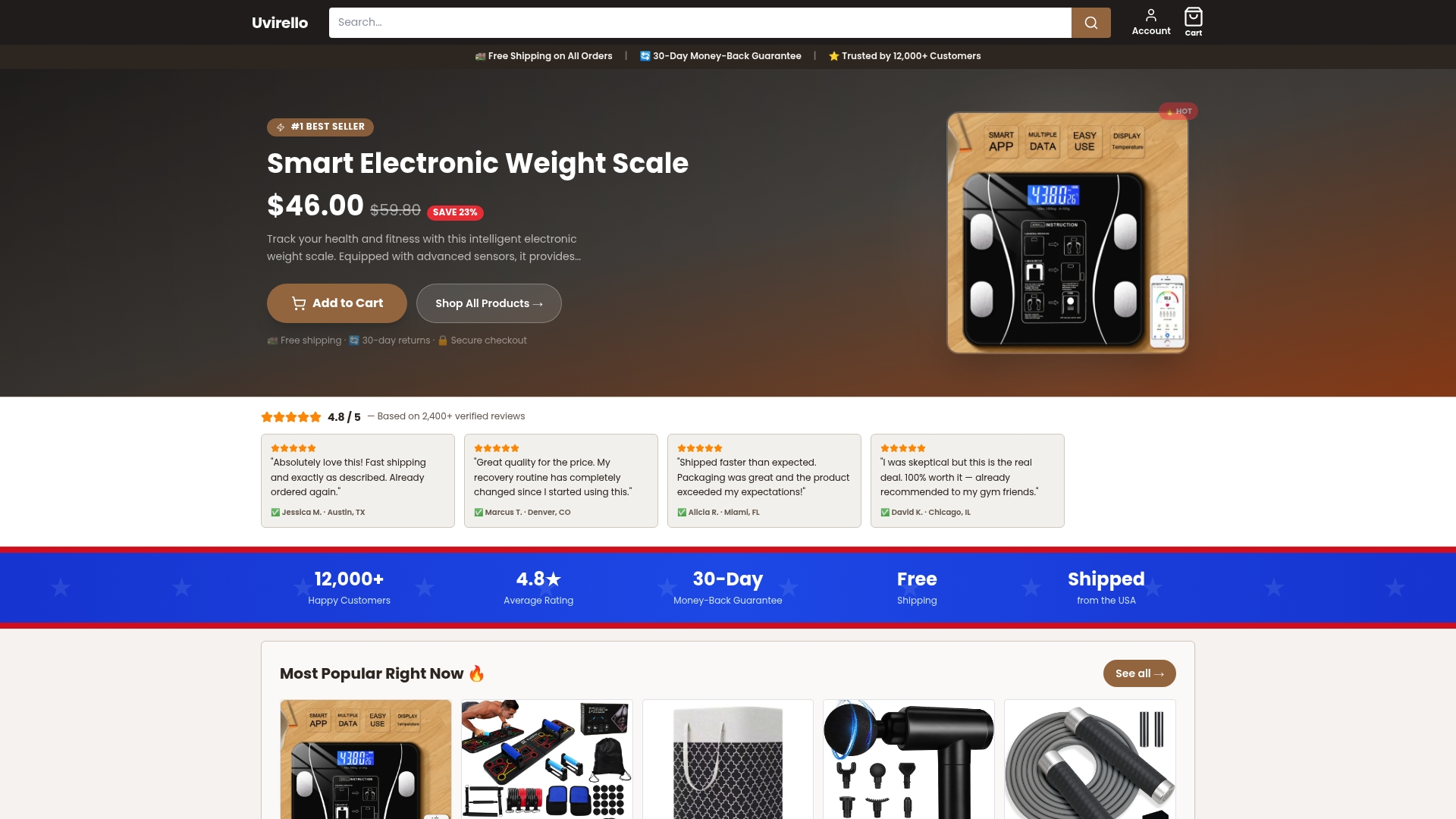
The Uvirello Smart Electronic Weight Scale delivers exactly that. High-precision sensors, body composition metrics including body fat percentage and BMI, and an experience designed for home fitness users who want real guidance, not just a number. More than 12,000 customers rate it 4.8 out of 5. You can pair it with an AI fitness planner to turn your weekly trend data directly into an updated workout plan.
Visit uvirello.com to see full specs and place your order.
Selected sources and further reading
| Source | What it covers |
|---|---|
| Wearable Wellness Guide — Smart Scales | Consumer BIA accuracy vs. DEXA; longitudinal trend reliability |
| Metabolic Age Calculator — How Smart Scales Calculate BMR | BIA electrical specs; Katch-McArdle formula for BMR estimation |
| Athlete Data Health — Body Recomposition AI Coach | AI synthesis of scale, training, and recovery data; deload and plateau detection |
| Body Muscle Matters — How Smart Scales Work | Hydration as primary BIA confounder; vendor calibration differences |
| Annivercary — Body Composition Monitoring Benefits | Motivational impact of compositional tracking; adherence research |
| Appliances Labs — AI for Personalized Wellness | Device compatibility, encryption, and firmware update guidance |
| PLOS Digital Health — ML-Based Body Composition Equations | Machine learning approaches to improving BIA accuracy across diverse populations |