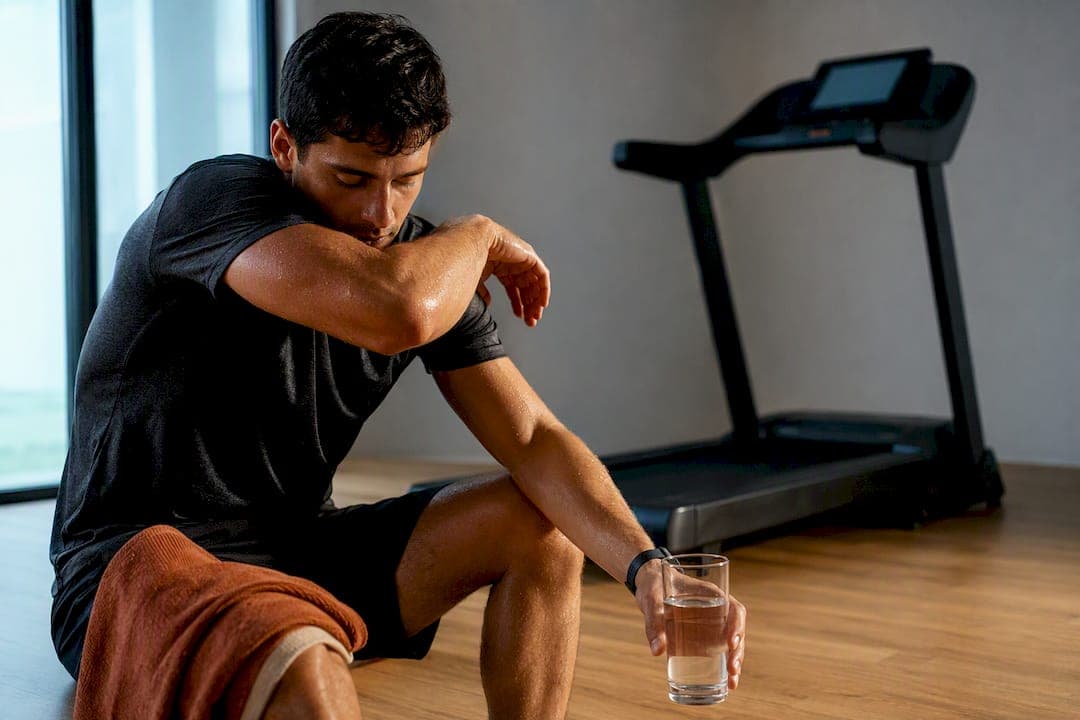
No, sweating is not fat loss. It's mostly water and electrolytes leaving your body to cool you down, not fat being burned off. The Cleveland Clinic confirms sweat output has no direct relationship to calorie burn, and physiology research backs that up. What follows breaks down where fat actually goes when you lose it, why the scale bounces around so much day to day, and how to track progress that's real.
TL;DR:
- Sweating mainly results from water and electrolyte loss for cooling, not fat burning, and scale drops from dehydration are quickly reversed with rehydration.
- Fat exits the body primarily through breathing as carbon dioxide, not sweat, making sweat output an unreliable indicator of fat loss.
- Daily weight fluctuations often stem from carbohydrate, sodium, hormonal, and inflammation changes, so weekly trend tracking is more accurate.
- Measuring body-fat percentage, waist circumference, strength, and clothing fit over weeks provides a more reliable assessment of fat loss than daily scale readings.
- Engaging in excessive heat or sweat-inducing tactics can impair workout performance and pose health risks without accelerating fat loss.
Table of Contents
- Sweat Loss vs Fat Loss: Why They Get Confused
- How Fat Actually Leaves Your Body
- Why the Scale Bounces Around So Much
- How to Actually Tell Fat Loss From Water Loss
- Why Chasing Sweat Can Backfire
- The Real Takeaway on Sweat and Fat
- What Actually Matters Here
- Sources
Sweat Loss vs Fat Loss: Why They Get Confused
Step off a treadmill drenched and step on a scale, and the number drops. It feels like proof. It isn't. That drop is water leaving through your skin, and your body will pull it right back the moment you rehydrate.
Sweat comes from eccrine glands scattered across your skin, most densely on your palms, soles, and forehead. When your core temperature rises, whether from exercise, humidity, or a sauna, your nervous system triggers these glands to release fluid onto the skin's surface. As that fluid evaporates, it pulls heat away from your body. It's a cooling system, not a fat-burning one.
What's actually in sweat matters here. Fat isn't part of the mix in any meaningful quantity. You cannot sweat out fat any more than you can sweat out muscle.
Sweat rate varies wildly between people, and that variation has nothing to do with how much fat someone is burning. Several factors drive the difference:
- Genetics: Some people are born with more active sweat glands or a lower sweating threshold.
- Fitness level: Trained athletes often start sweating sooner and more heavily than untrained people doing the same workout.
- Heat acclimation: Spend two weeks in a hot climate and your body adapts, sweating earlier and more efficiently to keep you cooler.
- Body size: Larger bodies generate more metabolic heat during activity, which means more cooling demand.
- Environment and clothing: Humidity blocks evaporation, and heavy or non-breathable fabric traps heat close to the skin.
That last point about trained athletes deserves a second look, because it's where the sweat myth gets its power. Someone who exercises regularly develops more efficient thermoregulation, meaning their body starts cooling itself sooner and with less delay than someone who is deconditioned. A seasoned runner drenched in sweat 10 minutes into a jog isn't burning more fat than a beginner who barely breaks a sweat during the same jog. They're just better calibrated at releasing heat. Sweat volume tracks thermoregulatory efficiency and environmental conditions, not the size of your calorie deficit.
How Fat Actually Leaves Your Body
Fat loss happens through a chemical pathway with almost nothing to do with heat or perspiration. When your body needs energy and doesn't get enough from food, it breaks down stored triglycerides in fat cells into free fatty acids and glycerol. Those fatty acids travel through your bloodstream to tissues that need fuel, where a process called beta-oxidation breaks them down further, ultimately producing carbon dioxide and water.
That carbon dioxide doesn't just disappear. You breathe it out.
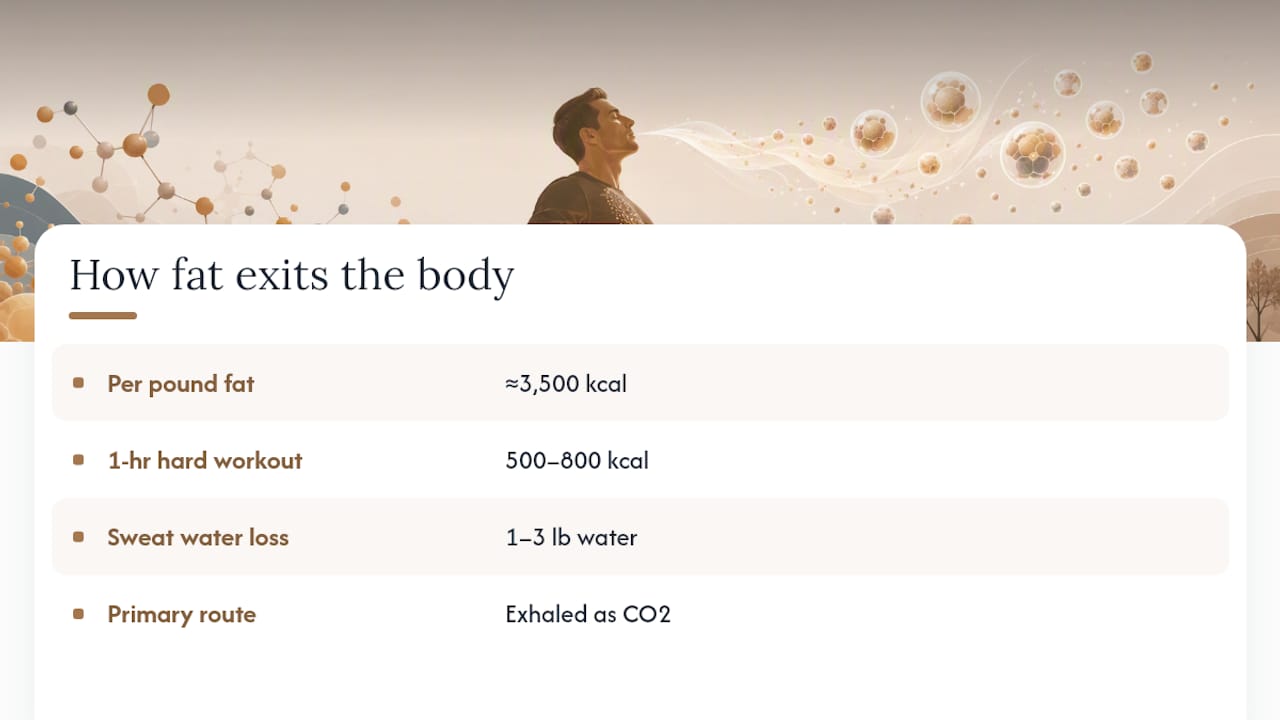
Most of the fat mass you lose when you lose weight is converted to carbon dioxide and exhaled through your lungs. Only a smaller fraction leaves the body as water, through urine, sweat, and other fluids.
That finding, detailed in an analysis published by The Conversation, reframes the whole conversation. You lose fat mainly by breathing it out, not sweating it out. The lungs, not the skin, are the primary exit route.
The math on a single workout puts the sweat myth to rest. Losing one pound of fat requires burning through roughly 3,500 stored calories beyond what you eat. A hard hour-long workout might burn 500 to 800 calories, heat and sweat included. Even a brutal, soaking session can't come close to torching a pound of actual fat tissue in one sitting. What you lose in an hour of heavy sweating is water weight, usually one to three pounds, and it comes back as soon as you drink and eat normally.
Heat production during exercise is a byproduct of muscle contraction and metabolic activity, not a driver of fat oxidation. Cranking up the room temperature or wearing a plastic sauna suit doesn't accelerate the beta-oxidation process described above. A physiology review published on PMC found that heat exposure alone doesn't meaningfully increase fat oxidation compared with doing the same physical work in a cooler environment. Sweating harder in a hot room doesn't mean your body is digging deeper into fat stores. It usually just means you're working against your own thermoregulation.
Why the Scale Bounces Around So Much
Your body weight can shift by several pounds in a single day, and almost none of that swing is fat. Understanding what's actually moving helps you stop overreacting to normal noise.
Carbohydrate intake is one of the biggest levers. Every gram of glycogen your muscles and liver store binds water, causing fluctuations in weight due to water retention. Eat a high-carb meal after a few low-carb days, and your glycogen stores refill, pulling water in right along with them. This is exactly what produces the keto whoosh effect people notice when reintroducing carbs after a strict low-carb stretch: a sudden, temporary weight jump that has nothing to do with fat gain. It's also why keto water weight drops so fast in the first week of the diet. Cutting carbs drains glycogen, and the water bound to it goes with it.
A few other everyday factors move the scale just as much:
- Sodium intake: A salty meal can cause temporary water retention, leading to noticeable but transient weight fluctuations.
- Menstrual cycle: Hormonal shifts before menstruation commonly cause temporary water retention, sometimes noticeable on the scale.
- Exercise-induced inflammation: New or intense training causes microscopic muscle damage, and the resulting inflammation draws fluid into the muscle tissue as part of repair. This is the muscle soreness water retention that surprises people who gain weight after a hard workout, right when they expected to see a loss.
- Sleep and stress: Poor sleep and elevated cortisol can both nudge water retention up temporarily.
Given all that noise, a weighing protocol matters more than the scale itself. Weigh yourself at the same time each morning, ideally right after using the bathroom and before eating or drinking anything. Wear minimal clothing, since even a robe adds inconsistent weight. Skip the day-after-salty-dinner panic weigh-in, and instead look at a rolling weekly average. One data point tells you almost nothing. Seven data points across a week start to tell you something real.
How to Actually Tell Fat Loss From Water Loss
The fix for scale confusion isn't a better scale reading habit alone, it's shifting what you measure and how often you look at it. Daily weight is noisy by nature. Trends over two to four weeks cut through that noise and show you what's actually happening to your body.
A few metrics matter more than the number you see each morning:
- Body-fat percentage, tracked weekly or biweekly, shows whether you're actually losing fat mass or just shedding water and glycogen.
- Waist and hip circumference, measured with a tape at the same spot each time, often shifts before the scale does.
- Strength and performance in the gym, since maintaining or improving your lifts while eating less is a strong sign you're preserving muscle while losing fat.
- How your clothes fit, which is a surprisingly reliable low-tech indicator of body composition change.
- Progress photos, taken in consistent lighting and poses every couple of weeks, catch changes the mirror misses day to day.
A smart scale earns its place here specifically because it gives you body-fat percentage alongside weight, rather than one number in isolation. The key is using it correctly. Weigh yourself under the same conditions each time, morning, post void, similar hydration state, and treat any single reading as one data point in a longer trend rather than a verdict. A one percent jump in body fat overnight is almost certainly hydration or measurement variance, not real fat gain. Uvirello's Smart Electronic Weight Scale is built around this exact use case: high-precision sensors capture body-fat percentage and BMI alongside weight, and its companion tracking makes weekly trends easy to see instead of guessing from memory. Over 12,000 customers have rated it 4.8 out of 5, and the feedback consistently points to the trend data, not the single-day number, as what actually changed how people trained and ate.
Pro Tip: Log your weigh-ins in the same app or notebook every time, and look at the trend line only once a week. Checking daily numbers against each other is like judging a stock by its price one minute after the market opens.
An app-connected scale that logs every session automatically removes the memory problem, since you're not relying on scribbled numbers to spot a pattern. If you want a deeper look at why the composition number matters more than total weight, this breakdown of body composition versus scale weight walks through the reasoning in more detail.
There are limits to what any home tool should try to solve. If your weight changes rapidly and unexpectedly, more than a few pounds in a couple of days with no clear dietary or training explanation, or if you notice swelling, dizziness, or unusual fatigue alongside it, that's a conversation for a doctor, not a spreadsheet. Rapid, unexplained weight shifts can signal issues unrelated to fat or water balance at all.
Why Chasing Sweat Can Backfire
Treating sweat as a fat-loss goal doesn't just fail to work. It actively works against you in a few specific ways.
Heat stress makes you worse at the thing that actually burns calories: exercising hard. When your core temperature climbs too high, your body redirects blood flow toward the skin to help with cooling, pulling it away from working muscles. That drop in muscle blood flow reduces power output and endurance, meaning you do less actual work; the same PMC physiology review referenced earlier ties overheating directly to reduced exercise performance. Sweating buckets in a hot room might feel productive, but you're likely burning fewer total calories than you would in a cooler environment where you could push harder for longer.
The health risks scale up from there. Heavy sweating without adequate fluid and electrolyte replacement leads to dehydration, which shows up as headaches, dizziness, and reduced coordination. Go too far the other direction, chugging plain water without replacing sodium after a long, heavy-sweat session, and you risk hyponatremia, a dangerous drop in blood sodium that can cause confusion and, in severe cases, seizures.
Sauna suits, plastic wraps, and topical "sweat boosting" creams all trade on the same false promise. They increase local heat and sweat output, and every pound they help you shed comes back within a day of normal eating and drinking. None of them touch actual fat tissue.
A few habits keep sweat-heavy training safe without chasing an outcome it can't deliver:
- Rehydrate with water and electrolytes during and after any session lasting longer than an hour.
- Skip sauna suits and extreme heat gimmicks aimed at "melting fat," since the mechanism doesn't exist.
- For long or intense sweat sessions, replace sodium along with water rather than water alone.
- Track how you feel, not just how much you sweat. Dizziness or unusual fatigue means back off, not push harder.
Getting rehydration right matters as much as getting the training right, and a smart water bottle that tracks intake can help close the gap between how much fluid you think you're replacing and how much you actually are.
The Real Takeaway on Sweat and Fat
Sweating cools you down. It doesn't burn fat, and it never did. If you take one thing from this: stop treating a soaked shirt as proof of progress. Track body-fat percentage and measurements over weeks, not the number after one workout. Prioritize hydration and training that builds or preserves muscle instead of chasing heat for its own sake. And if your weight swings in ways that don't match your diet or training, talk to a doctor rather than guessing.
What Actually Matters Here
The sweat myth survives because it feels true in the moment. Nothing reinforces a belief like immediate feedback, and a lighter number on the scale right after a hard workout is about as immediate as feedback gets. The problem is that the feedback is measuring the wrong thing entirely.
Where I think most advice on this topic falls short is in what it asks people to do instead. Plenty of articles will tell you "sweat isn't fat, track body composition," and then leave you with a vague nudge to "monitor your progress." That's not specific enough to change behavior. The actual fix is boring and mechanical: weigh yourself under the same conditions, log body-fat percentage weekly, and only trust a trend line built from several weeks of data. One good scale used consistently beats three good habits used inconsistently.
I'd also push back on how much attention hydration gimmicks get relative to the thing that actually works, which is a sustained calorie deficit paired with resistance training to protect muscle. Muscle is what keeps your metabolism from tanking as you lose weight, and no amount of sweating protects it. Prioritize that first, and let the scale's job stay small: showing you a trend, not a verdict.
— Jacob
This article is general information, not a substitute for advice from a qualified doctor. Consult a qualified healthcare professional about your own circumstances before acting on anything here.
Sources
- Does sweating burn calories? — Cleveland Clinic
- Where does fat actually go when you lose weight? — The Conversation
- What is water weight and should you be trying to lose it? — Houston Methodist
- Physiology review on exercise, heat, and metabolism — PMC