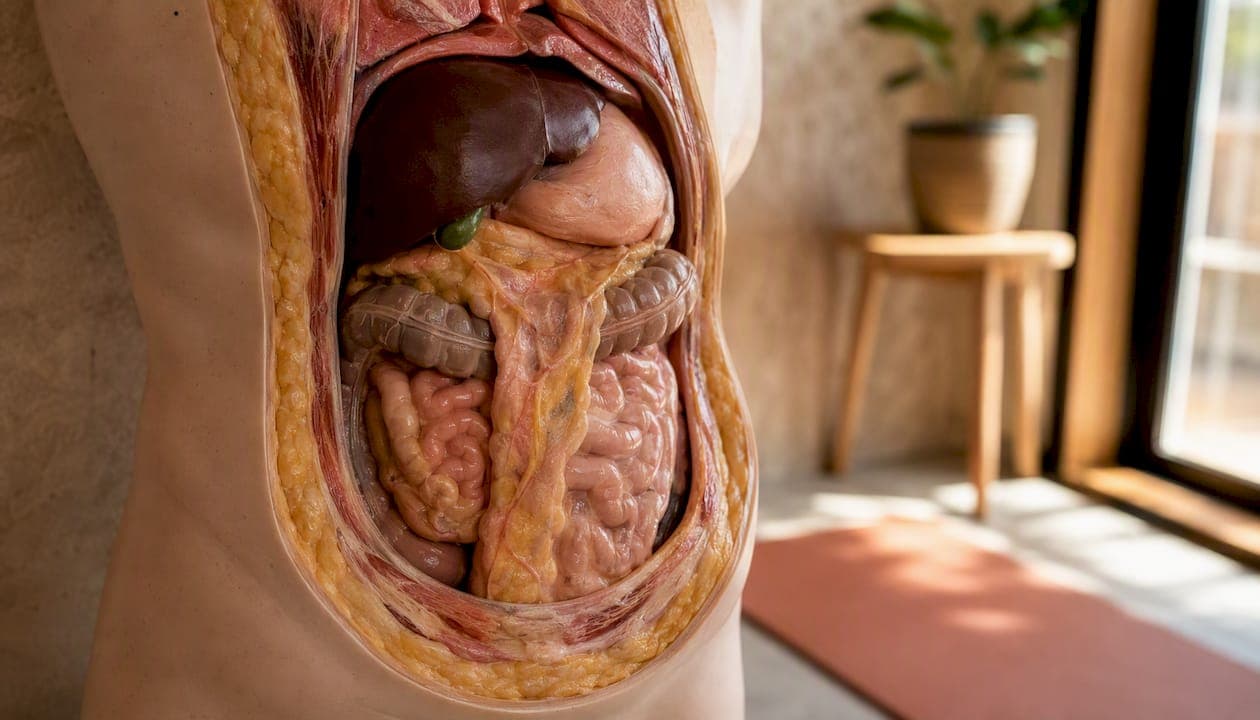
Subcutaneous fat sits just under your skin, pinchable and mostly harmless. Visceral fat packs in around your liver, pancreas, and intestines, and excess amounts of it carry far greater cardiometabolic risk. For most people, about 90% of total body fat is subcutaneous and roughly 10% is visceral, yet that smaller share does disproportionate damage when it builds up. The upside: visceral fat often responds to lifestyle changes faster than subcutaneous fat does, with measurable shrinkage sometimes showing up within two to three months.
- Subcutaneous fat: stored under the skin, mostly stable, some protective function
- Visceral fat: stored around internal organs, metabolically active, higher disease risk in excess
- Visceral fat tends to drop first once diet, exercise, and sleep improve
Key Takeaways
Excess visceral fat drives far more disease risk than subcutaneous fat, but it also responds faster to lifestyle changes, often within two to three months.
| Point | Details |
|---|---|
| Location determines risk | Visceral fat surrounds organs and drains into the liver; subcutaneous fat sits under the skin and poses far less risk. |
| Visceral fat responds fastest | Meaningful visceral fat reduction can appear within two to three months of consistent diet and exercise changes. |
| BIA has real limits | Smart-scale visceral estimates correlate only moderately with CT/MRI, so treat them as trend indicators, not diagnoses. |
| Waist measurement matters | Track waist circumference at a consistent point and time to catch abdominal fat changes early. |
| Uvirello supports trend tracking | The Uvirello Smart Electronic Weight Scale offers precision body-composition tracking to pair with waist measures and labs. |
This article is general information, not a substitute for advice from a qualified doctor. Consult a qualified healthcare professional about your own circumstances before acting on anything here.
Table of Contents
- Visceral vs Subcutaneous Fat: Where Each One Lives in Your Body
- Which Type of Fat Poses the Bigger Health Risk
- What Drives Excess Fat in Each Depot
- How to Measure Visceral Fat Without Guessing
- A Realistic Plan for Reducing Both Fat Types
- Tracking Visceral Fat Progress at Home
- Why Subcutaneous Fat Isn't Something to Fear
- A Word on Chasing the Right Number
- Track Your Progress Without Guessing
- Sources
Visceral vs Subcutaneous Fat: Where Each One Lives in Your Body
The two fat types aren't just in different places. They behave like entirely different tissues.
Subcutaneous fat forms the soft layer you can grab at your waist, thighs, or upper arms. It's stored in pockets throughout the body and acts largely as an energy reserve and insulator. Visceral fat wraps around organs deep in the abdominal cavity, including a fatty apron called the omentum that drapes over the intestines. You can't pinch it, and you often can't tell how much you have just by looking, since a person with a flat stomach can still carry a concerning amount internally.
The biological differences go deeper than location. Visceral fat cells pump out more pro-inflammatory cytokines and precursors to angiotensin, a hormone pathway that raises blood pressure. Subcutaneous fat, particularly in the hips and thighs, seems to work more like a buffer, soaking up excess lipids before they spill into the bloodstream and organs. That buffering capacity is one reason two people with the same BMI can have wildly different metabolic profiles.
- Visceral fat drains directly into the liver through the portal vein, delivering fatty acids and inflammatory signals right where they can disrupt insulin function.
- Subcutaneous fat drains more locally and doesn't have that direct pipeline to the liver.
- Because visceral tissue is more metabolically active, it responds faster to hormonal signals, for better and worse.
Visceral fat by the numbers: Only about one in ten pounds of body fat sits in the visceral depot for a typical person, yet that fraction accounts for most of the fat related disease risk tied to obesity. Size isn't the issue. Location and behavior are.
Which Type of Fat Poses the Bigger Health Risk
Visceral fat is the one that shows up in your labs before it shows up on the scale. Excess visceral fat is linked to type 2 diabetes, cardiovascular disease, stroke, and non-alcoholic fatty liver disease, and the epidemiological evidence behind those links is some of the strongest in metabolic research.
The mechanisms explain why. Visceral adipose tissue releases inflammatory cytokines that interfere with insulin signaling, which is part of why abdominal obesity tracks so closely with insulin resistance. That same inflammatory activity contributes to blood vessel damage over time, raising cardiovascular risk independent of total body weight. And because visceral fat sits so close to the liver, the constant flow of fatty acids into that organ contributes to fat accumulation there too, setting the stage for fatty liver disease even in people who aren't overweight by BMI standards.
None of this means visceral fat is inherently bad. Everyone carries some, and a healthy amount cushions organs and provides quick-access energy.
Visceral fat serves real functional purposes and only becomes a problem once it exceeds a healthy range for your body. The goal isn't zero visceral fat. It's keeping it within bounds.
- Type 2 diabetes risk climbs with visceral fat independent of overall weight.
- Cardiovascular disease and stroke risk both correlate more strongly with abdominal fat than with subcutaneous fat elsewhere.
- Fatty liver disease shows a direct relationship with visceral fat volume in multiple studies.
What Drives Excess Fat in Each Depot
Some of this is within your control. Some of it isn't, and knowing the difference keeps you from blaming yourself for genetics.
On the modifiable side, a sustained calorie surplus is the primary driver of fat gain overall, but where that fat lands depend heavily on activity level, sleep, and stress. Sedentary time correlates strongly with visceral accumulation specifically, and smoking promotes abdominal fat deposition, which is one more reason quitting pays off metabolically. Chronic poor sleep and elevated stress both push the body toward storing fat viscerally rather than subcutaneously, a pattern tied to cortisol behavior covered below.
- Modifiable: calorie surplus, inactivity, smoking, poor sleep, chronic stress
- Non-modifiable: age, sex, genetics, menopausal status
- Population differences: some ethnic groups show a stronger tendency toward visceral accumulation at a given BMI, which is one reason BMI alone is a weak individual risk predictor
Genetics influence where your body prefers to store fat in the first place, and that preference shifts with age. Men tend to accumulate visceral fat more readily even at a healthy weight, a pattern often called an "apple" shape. Women typically store more fat subcutaneously in the hips and thighs before menopause, then shift toward more visceral storage afterward as estrogen declines. That hormonal transition is one of the most consistent findings in body composition research and explains why waist size often creeps up around midlife even without weight gain.
How to Measure Visceral Fat Without Guessing
You can't eyeball this one reliably, and the tools available range from precise but expensive to convenient but rough.
- CT and MRI scans remain the gold standard for visceral fat measurement, giving direct volumetric readings of fat around your organs. They're accurate but impractical for routine home tracking, and they're typically reserved for research or specific clinical situations.
- Waist circumference and waist-to-height ratio are the best practical proxies available outside imaging. These measures predict future health issues better than BMI alone, since BMI can't distinguish where fat is stored.
- Bioelectrical impedance analysis (BIA), the technology behind most smart scales, estimates visceral fat using electrical signals, but validation studies show correlation coefficients with CT only in the range of roughly R=0.387 to 0.636, with sensitivity and specificity that vary by device and body type. Treat BIA numbers as directional, not diagnostic.
For consistency, measure your waist at the same anatomical point (the narrowest point of your torso or just above your navel) first thing in the morning before eating. Combining a waist measurement with a BIA trend line gives a far more reliable picture than relying on either alone.
A Realistic Plan for Reducing Both Fat Types
Start with the levers that move both depots, because there isn't a separate diet for visceral fat versus subcutaneous fat. There's just consistency applied over time.
A sustained caloric deficit remains the foundation. Pair it with regular aerobic exercise, which several studies point to as particularly effective at shrinking visceral fat, and resistance training, which preserves lean mass while you lose fat overall. Diet and exercise together reduce visceral fat more reliably than either alone, and quitting smoking removes one of the clearer drivers of abdominal fat storage. Sleep and stress management matter more than most people assume, since both influence cortisol, and chronically elevated cortisol pushes fat storage toward the visceral depot specifically.

For people who qualify medically, clinical-level interventions exist beyond lifestyle change. GLP-1 receptor agonists and bariatric surgery can produce substantial reductions in visceral and total fat in appropriate candidates, but both require medical evaluation, supervision, and follow-up. These aren't first-line options for someone who simply wants to trim their waistline. They're tools for specific clinical situations.
Here's the timeline worth knowing: visceral fat often shows measurable reduction within two to three months of consistent lifestyle changes, because it's more metabolically active than subcutaneous fat. Subcutaneous fat tends to respond more slowly, often taking longer to show visible change even when you're doing everything right. That mismatch is why your waistband might loosen before the mirror shows much difference.
- Track waist circumference weekly, same time and method each time.
- Pair that with periodic lipid panels and fasting glucose if you have risk factors.
- Watch body-composition trends over months, not days, since single readings bounce around with hydration and food intake.
Pro Tip: Don't judge progress by a single body-composition reading. Log your waist measurement and scale trend every week for eight weeks before drawing any conclusion about whether visceral fat is actually changing.
Tracking Visceral Fat Progress at Home
A smart scale won't replace a CT scan, but it fills a gap imaging can't. Weekly morning scale readings combined with waist circumference and periodic labs give a more complete picture of visceral fat trends than any single device alone. Uvirello's scale uses high-precision sensors to track body fat percentage, BMI, and other composition metrics over time, and it has earned a 4.8 out of 5 average across more than 12,000 customer reviews.
- Take a baseline reading, then recheck weekly under the same conditions.
- Log the trend for several months rather than reacting to daily swings.
- If your waist measurement climbs alongside abnormal lipid or glucose labs, that's the signal to see a clinician.
A single scale reading tells you almost nothing on its own. The trend line across weeks and months is where the useful information actually lives.
Understanding scale outputs helps here. Uvirello's guide on interpreting body composition metrics walks through what each number actually reflects, and this piece on why trends beat single readings explains the reasoning behind a weekly check-in habit rather than a daily obsession.
Why Subcutaneous Fat Isn't Something to Fear
Subcutaneous fat gets lumped in with visceral fat in casual conversation, but treating them as equally risky misses a real distinction. Some subcutaneous depots, particularly around the hips and thighs, function as a relatively safe storage site that absorbs excess lipids before they end up circulating and causing harm elsewhere.

This gluteofemoral fat has been linked in research to more favorable metabolic profiles compared to abdominal fat at similar total body fat levels. It also provides mechanical cushioning for joints, insulation against cold, and a hormone-buffering role, since fat tissue produces leptin and other signals involved in appetite regulation and reproductive health. Women's typically higher subcutaneous fat percentage, especially before menopause, is part of why premenopausal women often show better metabolic markers than men at similar body fat percentages.
None of this means unlimited subcutaneous fat is harmless. At very high volumes it still contributes to joint stress, mobility limits, and skin issues, and it can eventually spill over into visceral storage once its buffering capacity is exceeded. But in moderate amounts, subcutaneous fat is doing a job your body actually needs done, not just sitting there as dead weight. That's a meaningfully different story from the inflammatory, organ-adjacent fat this article spends most of its time warning about.
A Word on Chasing the Right Number
Steady, boring progress beats obsessing over one scale reading. Trends over months tell you more than any single number. If a specific figure worries you, ask a clinician about labs, not just the scale.
— Jacob
Track Your Progress Without Guessing
Waist tape measures and CT scans each tell part of the story, but most people need something they'll actually use every week. That's where the Uvirello Smart Electronic Weight Scale fits: high-precision sensors that track body fat percentage, BMI, and composition trends over time, paired with a simple interface that doesn't require a clinical background to read.
It won't replace an MRI, and it shouldn't. Think of it as the weekly checkpoint that sits between your waist tape measure and your doctor's office visit, flagging the direction things are moving so you know when a real risk marker like chronic disease risk factors is worth a clinical follow-up. Readers who also want to pair device data with daily habit tracking might find this guide to habit tracking useful for building the weekly routine around it. Over 12,000 customers have rated the scale 4.8 out of 5, and most describe the same thing: it makes the weekly check-in easy enough to actually stick with. If you're ready to start tracking your own trend line, you can order the Uvirello scale directly and get your first baseline reading this week.
Sources
- What Is Visceral Fat & How To Get Rid of It — WebMD
- Agreement between BIA and CT for visceral fat assessment — PMC
- Adipose tissue distribution in metabolic disease — Frontiers (2026)