
Health data is defined as any measurable biological or behavioral metric, from body weight and BMI to sleep quality and stress levels, that informs decisions about physical and mental performance. The role of health data in productivity is no longer a wellness side note. The McKinsey Health Institute estimates that improving global health outcomes could generate 288 million additional full-time equivalent work-years by 2050, adding $12.5 trillion to global GDP. That figure reframes health data from a personal concern into a core driver of economic output. Whether you track your own metrics or manage a workforce, understanding how health information connects to performance is the first step toward using it well.
What is the role of health data in productivity?
Health data improves productivity by closing the gap between how people feel and how they actually perform. Without data, most professionals rely on subjective cues: fatigue, stress, or a vague sense of being "off." With data, those cues become measurable signals tied to specific behaviors.
Physical activity, sleep duration, resting heart rate, and body composition are the four metrics most consistently linked to cognitive output. Research confirms that health awareness improves work performance by giving people a concrete feedback loop. When you know your sleep dropped below seven hours three nights in a row, you can connect that directly to slower decision-making or reduced focus the next day.

Body composition data adds another layer. Tracking body fat percentage and BMI over time reveals whether diet and exercise habits are actually working, not just whether they feel like they are. This distinction matters for professionals who need sustained cognitive energy, not just short-term motivation.
Pro Tip: Track at least three metrics simultaneously, such as weight, sleep, and step count, for two weeks before drawing conclusions. Single-metric tracking produces misleading patterns.
The connection between physical health and mental output is well established. Holistic health tracking consistently outperforms single-metric monitoring because the body's systems interact. A drop in body weight without a corresponding improvement in body fat percentage, for example, may signal muscle loss rather than fat reduction. That distinction changes the right response entirely.
Key individual benefits of consistent health data tracking include:
- Cognitive clarity: Stable blood glucose and adequate sleep directly support working memory and concentration.
- Energy management: Tracking physical activity patterns reveals peak performance windows during the day.
- Stress detection: Resting heart rate variability is a reliable early indicator of accumulated stress before it becomes burnout.
- Behavioral accountability: Seeing data trends over time makes it harder to rationalize poor habits.
How does health data analytics improve organizational productivity?
Organizations that treat employee health as an investable asset, rather than a cost center, consistently outperform those that do not. The problem is that most workplace wellness programs generate fragmented reports focused on insurance costs rather than integrated productivity metrics. Employers struggle to connect health data to business performance when the data lives in silos.
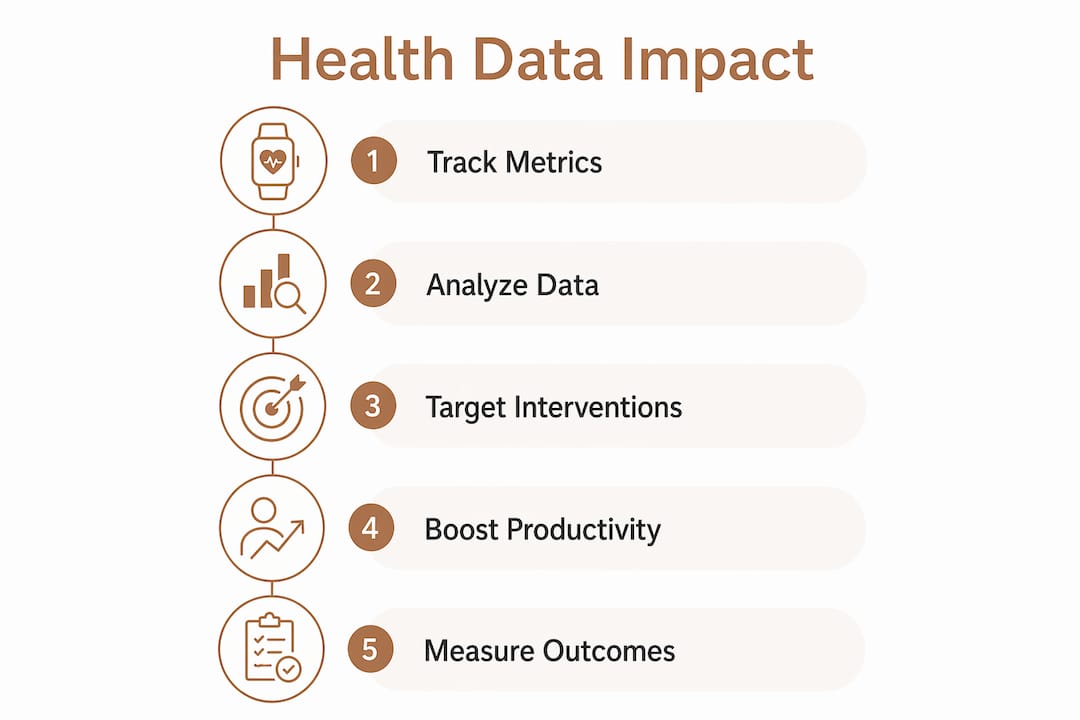
The fix is a centralized health dashboard, sometimes called a "health cockpit," that links clinical metrics to workforce outcomes like absenteeism rates, output per employee, and retention. When leadership can see that a spike in reported stress scores precedes a drop in project completion rates, the case for intervention becomes financial, not philosophical.
Workplace health interventions that measure both health and business outcomes improve productivity, participation, and retention. Measuring only health outcomes lets executives dismiss wellness programs as "soft." Measuring both makes the ROI undeniable.
Four organizational steps that convert health data into measurable productivity gains:
- Integrate data sources. Connect health program data with HR systems to correlate wellness metrics with absenteeism, turnover, and output.
- Set baseline benchmarks. Measure workforce health metrics before launching any intervention so you can calculate actual change.
- Segment by role. A sedentary desk worker and a field technician face different health risks. Targeted programs outperform one-size-fits-all approaches.
- Report in business language. Present health data outcomes as cost per productive hour, not just clinical improvement scores.
"Health data can transform employee health from a cost to an investable asset." — HealthNEXT
The UK's National Health Service demonstrated this principle at scale. A single patient record saves NHS doctors 500,000 hours annually and reduces medication errors, delivering £20 million in annual savings and a 2.8% NHS productivity increase. The lesson for any organization is clear: unified data eliminates redundant work and frees skilled people to do higher-value tasks.
What technology advances are driving health data productivity gains?
The biggest barrier to using health data effectively has never been data volume. It has been data accessibility. Most health datasets require technical staff to query, clean, and interpret them before anyone else can act. That bottleneck adds days to decisions that should take minutes.
AI-powered natural language interfaces solve this directly. AI-powered query tools reduced medical billing rule generation time from 45 minutes to 2 minutes and opportunity analysis from 6 hours to 6 minutes. That is a 60x speed improvement. The implication is that non-technical staff can now ask questions of health data directly, without waiting for an analytics team to build a report.
Natural language AI interfaces empower non-technical staff to query clinical data, reducing reliance on analytics personnel and shifting data roles from gatekeepers to collaborators. This democratization of data access is one of the most underrated productivity gains in health analytics.
| Technology | Productivity impact | Key benefit |
|---|---|---|
| AI natural language querying | 60x faster rule generation | Non-technical staff access data directly |
| Automated data normalization | Days to hours on project timelines | Eliminates manual pipeline management |
| Centralized health dashboards | Unified workforce health view | Links clinical metrics to business outcomes |
| Ambient AI documentation | Reduced clinician admin burden | More time per patient, less paperwork |
Pro Tip: Before adopting any health data platform, audit your team's current workflow maturity. Technology accelerates good processes and amplifies broken ones.
Automating clinical data ingestion cuts project timelines from days to hours, enabling faster collaboration and decision-making. The key insight here is that automation's value comes from normalizing chaotic data formats, not just increasing data volume. Clean, structured data is what makes fast decisions possible.
What challenges come with using health data for productivity?
Health data does not automatically improve productivity. The gains depend heavily on the infrastructure and workflows already in place. Productivity gains from health IT increase substantially only in organizations with high technological maturity and information-intensive workflows. A team that still manages schedules on spreadsheets will not benefit from a sophisticated health analytics platform.
Several specific pitfalls reduce the impact of health data programs:
- Data latency: Outdated health metrics lead to delayed interventions. Real-time or near-real-time data feeds are necessary for timely decisions.
- Volume versus quality confusion: Reducing documentation burden improves productivity without increasing patient or task volume. More data entry does not equal more productivity.
- Siloed reporting: Health data that never reaches decision-makers produces no change. Integration with business reporting systems is non-negotiable.
- Ignoring systemic burnout factors: Health data can flag burnout risk, but the data alone does not fix workload problems. Targeted intervention must follow the signal.
The distinction between documentation burden reduction and actual workload increase is critical. AI tools that reduce administrative tasks free professionals to do higher-quality work, not just more work. That difference determines whether a health data program prevents burnout or accelerates it.
Workflow maturity also affects how quickly an organization can act on health signals. A team with clear escalation paths and decision authority can respond to a spike in stress indicators within days. A team without those structures will sit on the data indefinitely.
Key Takeaways
Health data drives productivity when it is specific, integrated, and acted upon at both the individual and organizational level.
| Point | Details |
|---|---|
| Health data has economic scale | Improving global health could add $12.5 trillion to GDP and 288 million work-years by 2050. |
| Individual tracking requires multiple metrics | Tracking weight, sleep, and activity together reveals patterns that single metrics miss. |
| Organizations need integrated dashboards | Linking health metrics to business outcomes converts wellness programs from costs to assets. |
| AI removes the data access bottleneck | Natural language querying cuts analysis time by up to 60x, enabling faster decisions. |
| Infrastructure readiness determines ROI | Health IT delivers gains only in organizations with mature workflows and data systems. |
What I've learned from watching health data change how people work
Most professionals I've observed treat health tracking as a personal habit, separate from their work performance. That separation is the mistake. The moment you connect your sleep data to your output on a given day, or your body composition trend to your energy levels across a quarter, the data stops being abstract. It becomes a management tool for your own performance.
The same logic applies at the organizational level, but the stakes are higher. I've seen companies invest in wellness platforms and see no measurable change because the data never reached the people with authority to act on it. The technology was fine. The workflow was broken.
What I find most promising in 2026 is the shift toward IoT-enabled personal health tracking. Devices that capture body composition, activity, and recovery data continuously are closing the gap between what professionals know about their health and what they can actually do about it. The professionals who will outperform their peers are not necessarily the ones working longer hours. They are the ones using health data to protect and direct their cognitive capacity.
The uncomfortable truth is that most productivity problems are health problems in disguise. Chronic fatigue, poor concentration, and low motivation are not character flaws. They are measurable, addressable health states. The data exists to identify them. The only question is whether you use it.
— Jacob
How Uvirello supports your health data practice
Tracking body composition consistently is the foundation of any data-driven health strategy. The Uvirello Smart Electronic Weight Scale delivers body fat percentage, BMI, and weight data through high-precision sensors, giving you the metrics that matter most for connecting physical health to daily performance.
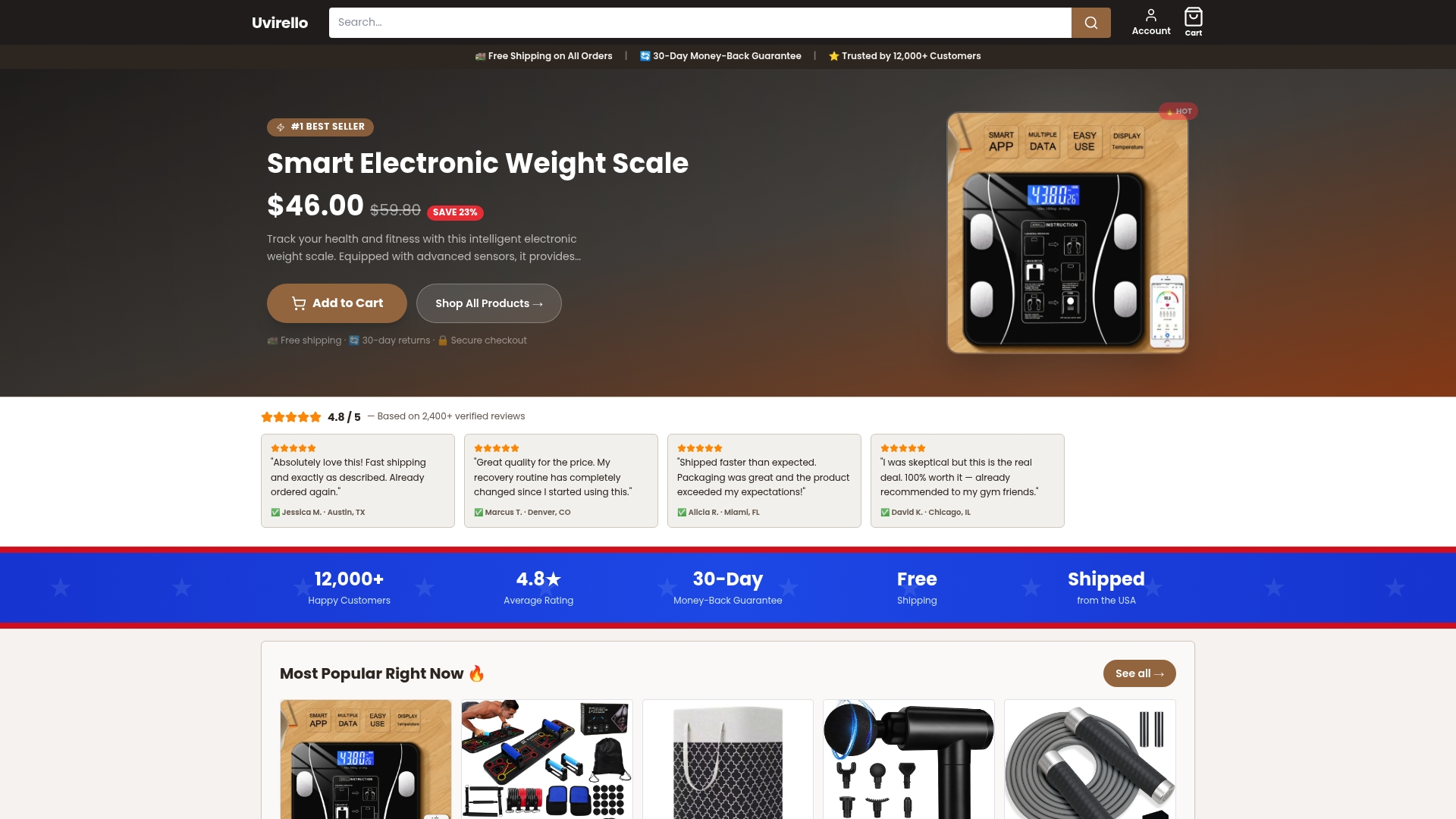
Over 12,000 people have rated Uvirello 4.8 out of 5 stars, reporting real improvements in their fitness routines and health awareness. For professionals who want to move beyond guesswork and build a desk job fitness routine grounded in accurate data, Uvirello provides the measurement foundation that makes progress visible and sustainable.
FAQ
What is health data in the context of productivity?
Health data refers to measurable biological and behavioral metrics, such as BMI, body fat percentage, sleep duration, and activity levels, that directly influence cognitive and physical work performance.
How does health data analytics improve workforce efficiency?
Integrating health metrics with business outcomes like absenteeism and retention allows organizations to target interventions precisely, converting wellness spending from a cost into a measurable productivity investment.
What health metrics matter most for individual work performance?
Sleep duration, physical activity, body composition, and stress indicators are the four metrics most consistently linked to cognitive output and sustained energy throughout the workday.
Does health IT always improve productivity?
No. Research shows that productivity gains from health IT increase substantially only in organizations with high technological maturity and information-intensive workflows. Infrastructure readiness determines the outcome.
How can AI improve health data productivity?
AI-powered natural language tools reduce analysis time by up to 60x, enabling non-technical staff to query health data directly and act on findings without waiting for analytics support.