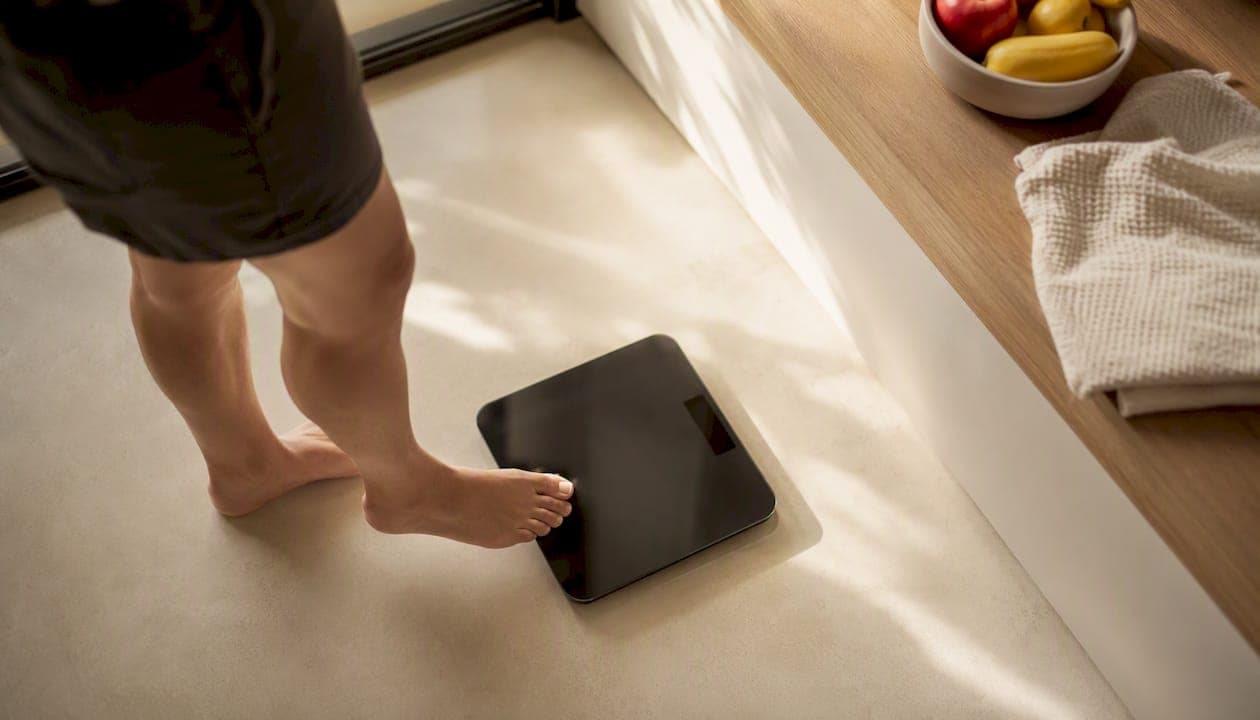
The most reliable way to weigh yourself consistently for accurate results is simple: step on the same scale, at the same time each morning, right after you use the bathroom and before you eat or drink anything, wearing minimal or identical clothing, on a hard level floor. That single routine strips out most of the noise that makes bathroom-scale numbers feel random, and it turns your data into something you can actually trust week to week.
Lock in these five things and the rest takes care of itself:
- Time: first thing in the morning, before coffee or breakfast
- Bathroom: after voiding, not before
- Clothing: the same each time (or none)
- Surface: a hard, level floor, same spot
- Log: write down the date, time, and number every time
None of this is about getting one flawless reading. It's about making every reading comparable to the last one, so a week of numbers tells you something a single number never could.
Key Takeaways
Accurate weight tracking comes down to identical conditions every time, not a single flawless reading, paired with a 7-day rolling average to reveal real trends.
| Point | Details |
|---|---|
| Weigh at the same time | Morning, after using the bathroom, before eating or drinking gives the most consistent baseline. |
| Standardize every condition | Same scale, same floor spot, same or minimal clothing each time you step on. |
| Track averages, not days | A 7-day rolling average smooths out 1 to 4 pound daily swings from water and food. |
| Maintain your scale | Check zero, batteries, and level placement regularly to catch drift early. |
| Use Uvirello for automated consistency | Its high-precision sensors and auto-sync remove manual logging friction from your daily routine. |
Table of Contents
- Why Weighing Consistently Beats Chasing One "Accurate" Number
- Best Time of Day and How Often to Weigh Yourself
- How to Weigh Yourself: The Exact Steps Every Time
- Reading Trends Instead of Daily Noise
- Scale Care, Calibration, and the Limits of Home Scales
- When to Rethink How Often You're Weighing
- Your Printable Daily Weigh-In Checklist
- Why Simple Beats Perfect
- A Scale Built for This Exact Routine
- Frequently Asked Questions
- Sources
Why Weighing Consistently Beats Chasing One "Accurate" Number
Your body weight moves throughout the day for reasons that have nothing to do with fat loss or gain. Water retention, undigested food, sodium intake, and even the clothes on your back can swing the scale by 1 to 4 pounds (0.5 to 2 kg) in a single day. That range dwarfs the actual week-to-week change most people are trying to track, which is exactly why a single "precise" reading is often misleading.
Consistency solves this a different way: it doesn't eliminate the noise, it standardizes it. If you weigh under the same conditions every time, the swings become predictable background static instead of a source of daily panic.
Pro Tip: Stop reacting to any single number. Look at your weight only after you have a week of data, and judge the week, not the day.
Best Time of Day and How Often to Weigh Yourself
Morning, post-void, pre-food is the gold standard. Your body is closest to a stable baseline before you've eaten, had anything to drink, or moved around enough to shift fluid levels. Consumer Reports and the Cleveland Clinic both point to this window as the one that gives the most repeatable reading.
Frequency is more personal. Consider:
- Daily + 7-day average: the most data, best for spotting trends early, but requires emotional distance from daily swings
- 2 to 3 times a week: a solid middle ground, still enough data to average out noise without a daily ritual
- Weekly: simplest and lowest stress, but slower to reveal a trend shift
Pro Tip: If a bad number can ruin your morning, weigh less often. If missing a day makes you anxious, daily with an average is probably better for you.
How to Weigh Yourself: The Exact Steps Every Time
Getting an accurate bathroom scale reading isn't complicated, but skipping a step is how people end up comparing numbers that were never comparable in the first place.
Before you step on:
- Place the scale on a hard, level floor, not carpet
- Confirm the batteries aren't low, since a weak battery is a common cause of erratic readings
- Clear the area so you have room to stand still and centered
While weighing:
- Go after using the bathroom, before eating or drinking
- Wear the same clothing each time, or none, especially if you're using a body-fat mode, which needs bare feet to read the electrical signal properly
- Stand centered on the platform, feet flat, and hold still until the number stabilizes
- Take a reading, then take a second one if the first looks off
After weighing:
- Log the date, time, and weight immediately, before you forget
- Add a one-word context tag if something unusual applies: late meal, travel, or a cycle day
Pro Tip: If two readings taken back to back differ by more than about 0.5 pounds (0.2 kg), take a third and average the two closest numbers. That small step alone catches most one-off measurement errors.
Reading Trends Instead of Daily Noise
A single day's number tells you almost nothing on its own. A rolling 7-day average tells you a lot. Add up your last seven daily weigh-ins and divide by seven, and the water retention, sodium spikes, and digestive variation mostly cancel out, leaving a number that actually reflects direction.
Say your daily weights for a week are 181, 179.5, 182, 180, 178.5, 181.5, and 179. The average lands around 180.2, a far steadier signal than any single day in that range.
As a rule of thumb, treat any single-day change under about 2 pounds (1 kg) as noise, not signal. Only start adjusting your habits when the weekly average moves consistently in one direction for 2 to 4 weeks straight. That's the point where you're looking at an actual trend rather than a fluctuation.
- One high or low day: ignore it
- Weekly average shifting for 2+ weeks: pay attention
- Weekly average flat for a month: time to reassess habits, not the scale
Scale Care, Calibration, and the Limits of Home Scales
A scale that isn't level, isn't zeroed, or is running on dying batteries will quietly sabotage every reading you take, no matter how disciplined your routine is. NIST's guidance on weighing operations points out that drafts, uneven surfaces, and thermal shifts all introduce error, which is exactly why lab technicians warm up equipment and control their environment before trusting a measurement. Home scales are less sensitive than lab balances, but the same principles apply on a smaller scale, literally.
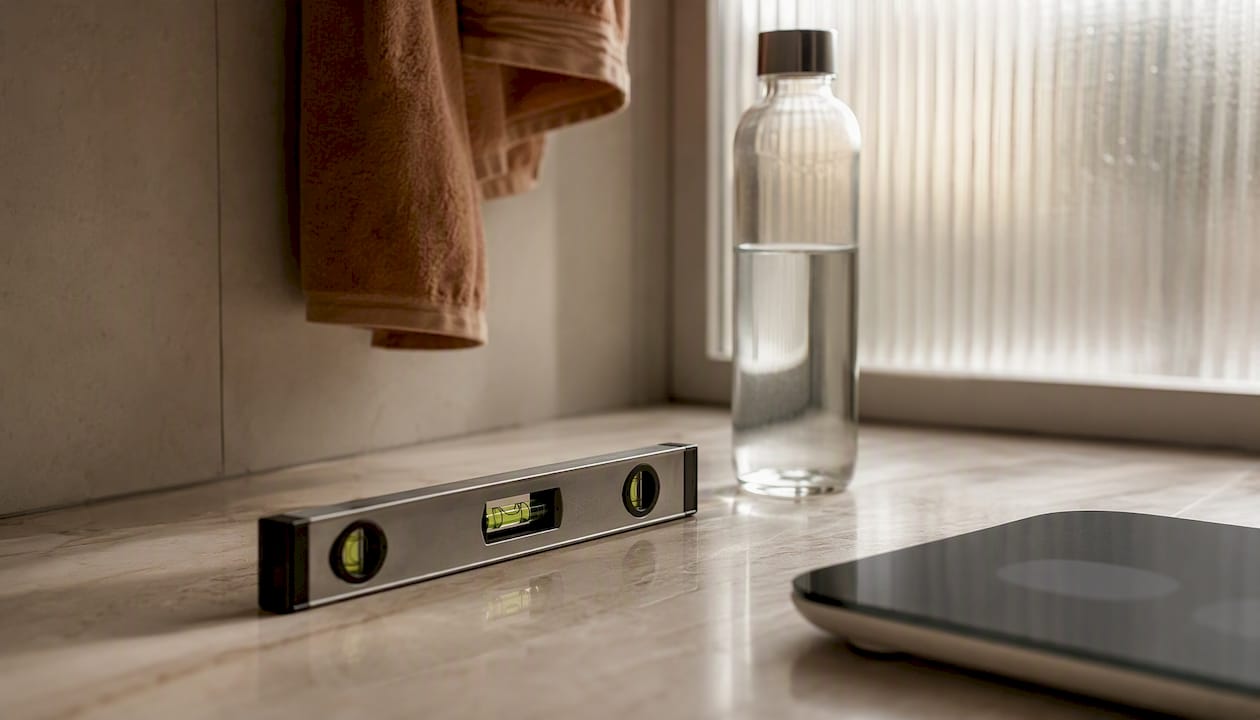
Analytical balance guidance from CASRAI recommends checking repeatability by weighing the same object twice and comparing results, a trick that works just as well for bathroom scales.
| Check | What to do | Action if it fails |
|---|---|---|
| Zero/tare | Confirm scale reads 0.0 before stepping on | Reset or replace batteries |
| Batteries | Swap if display is dim or flickering | Replace with fresh batteries |
| Level | Use a level or check by eye on flat tile/wood | Move to a flatter spot |
| Placement | Same spot, same surface every time | Standardize location permanently |
| Comparison | Test against a known weight or trusted scale | Replace scale if drift persists |
Pro Tip: Weigh yourself twice in a row without stepping off. If the numbers match within a few tenths of a pound, your scale is reading reliably that day.
When to Rethink How Often You're Weighing
Frequent weigh-ins help most people, but not everyone. Watch for warning signs: your mood swinging based on the number, skipping meals or social plans to "make weight" before you step on, or feeling compelled to weigh multiple times a day out of anxiety rather than curiosity.
- Dreading or obsessing over the daily number
- Weighing multiple times a day "just to check"
- Letting the scale dictate your food intake for the day
- A personal history of disordered eating
If any of this sounds familiar, that's a signal to change your approach, not push through it. Switching to weekly weigh-ins, focusing on non-scale metrics like waist measurements or strength gains, or doing blind weigh-ins with a clinician can all restore a healthier relationship with the number. If you suspect an eating disorder, a conversation with a doctor or a call to the National Eating Disorders Association helpline is worth more than any tracking method.
Your Printable Daily Weigh-In Checklist
Keep this list somewhere you'll actually see it, taped near the scale or saved as a phone note.
- ⬜ Same time, first thing in the morning
- ⬜ After using the bathroom
- ⬜ Before eating or drinking
- ⬜ Same clothing (or none)
- ⬜ Same scale, same spot, hard level floor
- ⬜ Stand centered, still, until the number settles
- ⬜ Log date, time, weight, and a context tag if needed
- ⬜ Ignore the single number, check your 7-day average weekly
Pro Tip: Stack this habit onto something you already do daily, like brushing your teeth. A routine that piggybacks on an existing habit survives far longer than one relying on willpower alone.
Why Simple Beats Perfect
People obsess over getting one perfect reading and miss the bigger point: a slightly imperfect routine, followed the same way every day, beats a technically precise reading taken under different conditions each time. The scale isn't the goal. The trend line is.
What tends to separate people who stick with tracking from those who quit in frustration isn't discipline, it's whether they built a routine simple enough to survive a bad morning. Consistency wins over precision almost every time.
A Scale Built for This Exact Routine
Following a morning routine is only half the battle. The other half is not losing your data to inconsistent logging, forgotten notebooks, or a scale that reads differently depending on where you place it. That's where the Uvirello Smart Electronic Weight Scale earns its keep: it's built around the same principle this entire article rests on, standardized, repeatable readings you can actually trust over time.
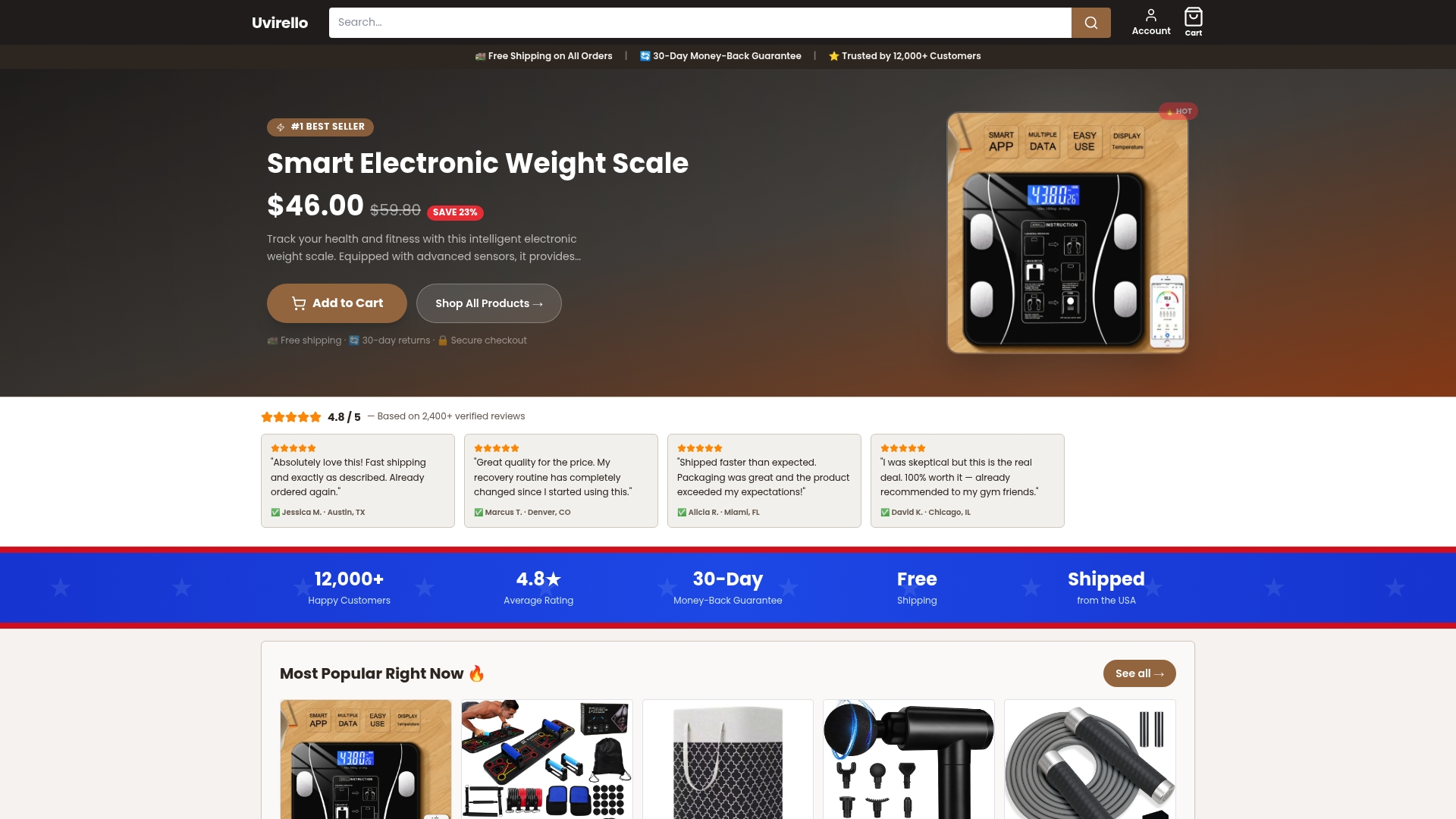
High-precision sensors keep your readings stable from one morning to the next, and body composition metrics like body fat percentage and BMI give you context beyond a single number on the display. Automatic syncing to a connected app removes the biggest failure point in any tracking routine: forgetting to log the number before you walk away.
This scale fits you if:
- You want body composition data alongside weight, not just a single figure
- You'd rather your readings sync automatically than rely on manual logging
- You're building a long-term weekly average habit and want a scale that stays consistent over months of use
Over 12,000 customers have rated it 4.8 out of 5, and many report that automated tracking is what finally made their weekly averages stick. If you're ready to remove the guesswork from your morning routine, check out the Smart Electronic Weight Scale and start logging your first weigh-in tomorrow morning.
Frequently Asked Questions
Does weighing myself at a different time of day ruin my data? Not ruin, but it does reduce comparability. Weight naturally shifts by a few pounds across the day from food and fluid intake, so switching times makes it harder to isolate a real trend from normal daily variation.
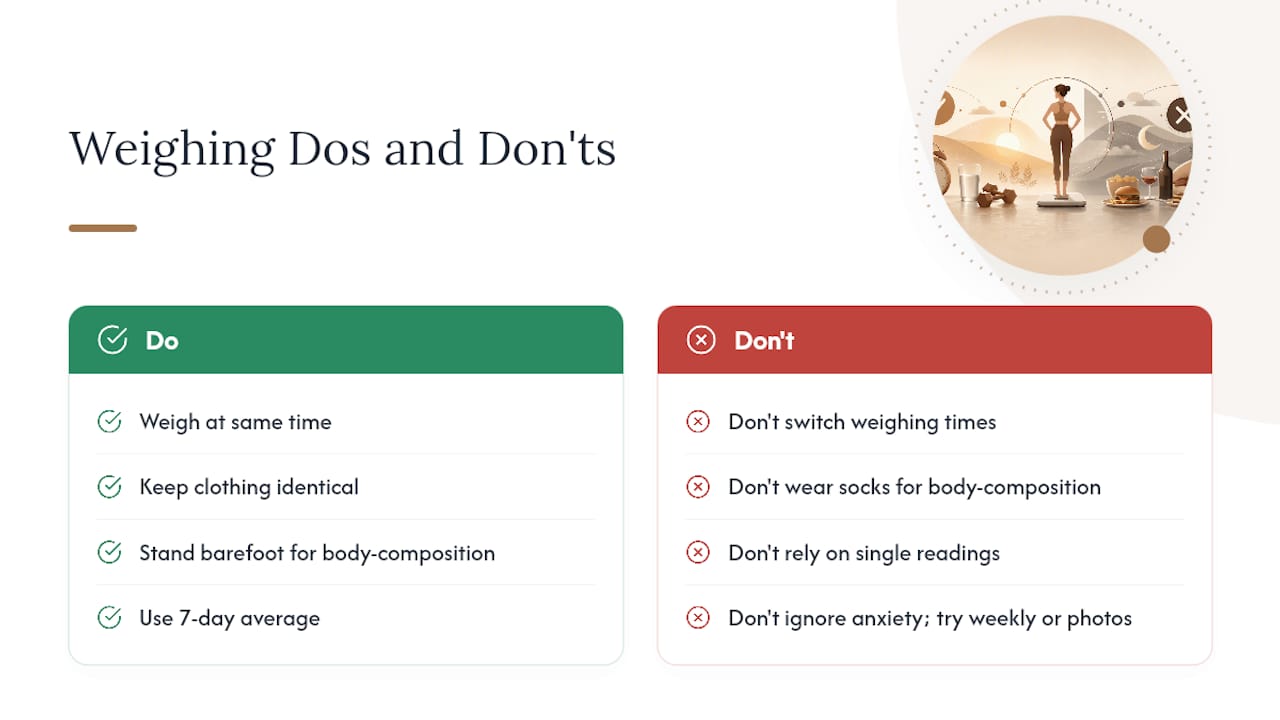
Should I weigh in with clothes on or off? Whichever you choose, keep it identical every time. If you're using a body-fat or body-composition mode, stand barefoot, since these modes read a small electrical signal through your feet that clothing and socks can interfere with.
Is daily weighing bad for my mental health? For some people, yes. If daily numbers cause anxiety, mood swings, or compulsive checking, switch to weekly weigh-ins or non-scale metrics like waist measurements and progress photos instead.
How do I know if my scale is accurate? Check that it reads zero before you step on, sits on a hard level floor, and has fresh batteries. Weighing twice in a row and comparing the two numbers is a quick, practical repeatability check.
What's a normal daily weight fluctuation? Typically 1 to 4 pounds (0.5 to 2 kg), driven by water, sodium, and food volume rather than actual fat change. That's exactly why a 7-day average matters more than any single reading.
This article is general information, not a substitute for advice from a qualified doctor. Consult a qualified healthcare professional about your own circumstances before acting on anything here.
Sources
- What to Know About Weighing Yourself — WebMD
- GMP 10 — Understanding factors affecting weighing operations — NIST
- Analytical balance calibration and weighing technique — CASRAI
- The best time to weigh yourself — Consumer Reports
- When is the best time to weigh yourself? — Cleveland Clinic