
Short, routine health checks are one of the most underused tools in a fitness professional's kit. When you step on a smart scale under consistent conditions and log what you see, you are not just weighing yourself. You are generating objective trend data that clinicians and trainers can actually use. The Agency for Healthcare Research and Quality frames health assessments as tools for aligning clinician and patient priorities and driving targeted behavior change, not as diagnostic endpoints on their own. That framing matters. A quick check done right turns a vague concern into a specific, trackable signal. The Uvirello Smart Electronic Weight Scale is built around exactly that idea: give you the body-composition data you need in under two minutes, every time.
Table of Contents
- What a quick health check actually looks like for smart-scale users
- Why clinicians and trainers rely on short, repeatable checks
- What quick checks actually change: outcomes and early detection
- How to run quick checks reliably: a simple protocol
- Using the Uvirello Smart Electronic Weight Scale for professional-grade checks
- When a quick check should send you to a clinician
- Key Takeaways
- The case for building this into your routine
- The Uvirello Smart Electronic Weight Scale makes this protocol simple
- Selected sources and further reading
What a quick health check actually looks like for smart-scale users
A quick health check is not a full physical. It is a two-minute, repeatable snapshot of your body's measurable state, taken under controlled conditions. Routine health checks typically include physical measurements, blood pressure, cholesterol, and BMI, with additions based on personal history.
For smart-scale users, the core metrics are:
- Body weight (total mass, tracked over time)
- Body fat percentage (the ratio that matters more than weight alone)
- Muscle mass (lean tissue, the metric most sensitive to training response)
- Hydration/impedance (a proxy for fluid balance and recovery state)
- Derived ratios (muscle-to-fat balance, which flags composition shifts even when weight holds steady)
Optional vitals that pair well with a scale check include resting heart rate and, when available, a spot blood pressure reading. Neither replaces a clinical panel, but both add context to composition data.
What a check is not: a diagnostic battery. One reading tells you almost nothing. The value lives in the pattern across readings, not in any single number.

| Check type | Time required | What it captures | Clinical value |
|---|---|---|---|
| Smart-scale body composition | 1–2 minutes | Weight, fat %, muscle, hydration | Trend detection, behavior feedback |
| Resting heart rate | — | Cardiovascular recovery state | Training load and stress signal |
| Spot blood pressure | 2–3 minutes | Vascular pressure | Early hypertension flag |
| Full clinical panel | — | Biomarkers, labs, vitals | Diagnosis, treatment decisions |
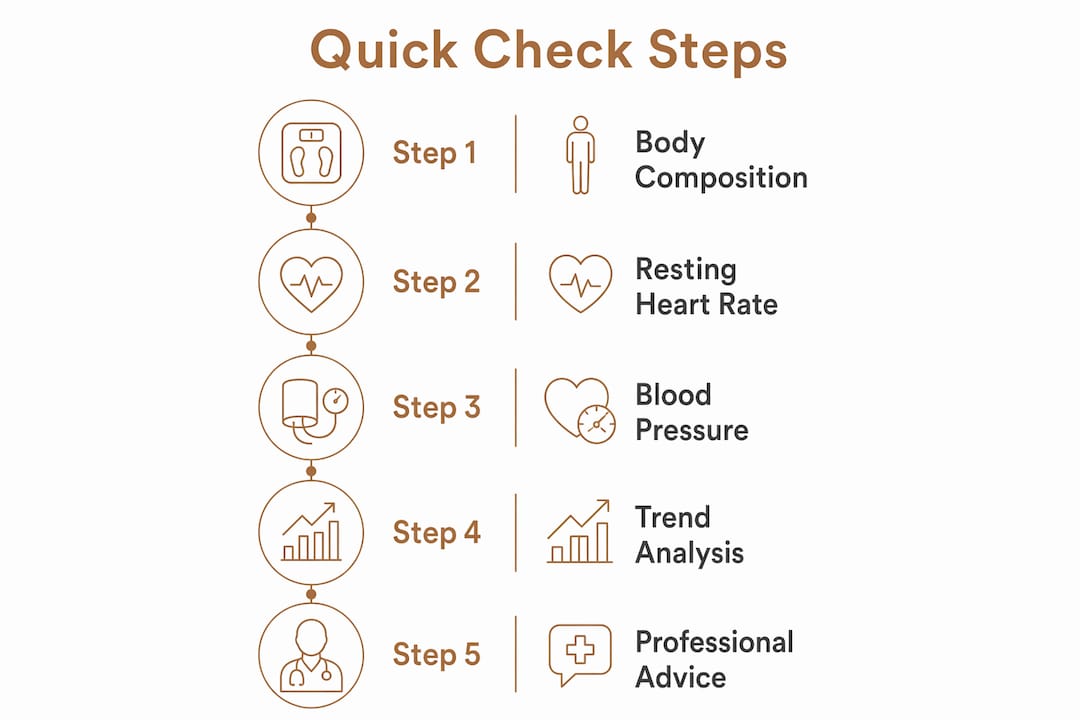
Why clinicians and trainers rely on short, repeatable checks
The AHRQ's position is clear: health assessments engage patients and support evidence-based advice rather than serving as standalone diagnoses. A trainer reviewing three weeks of body-fat readings can see whether a nutrition change is working. A clinician seeing a sustained weight trend has a concrete starting point for a conversation about metabolic risk.
"Health assessments are catalysts for conversation: objective data turns vague worries into prioritized, actionable goals between clinician and patient." — AHRQ
Quick checks also let professionals measure response to interventions. If a client's muscle mass drops two weeks into a caloric deficit, that is a signal to adjust protein intake before the loss compounds. Without the data, that adjustment happens by feel, weeks late. The role of health data in productivity is well-documented: professionals who track consistently make faster, more confident decisions about their own health.
Pro Tip: Set one fixed check-in day per week. Use that reading for decisions. Ignore the other days unless you are tracking acute hydration. Reacting to daily noise is the fastest way to lose confidence in your data.
What quick checks actually change: outcomes and early detection
The evidence on general health checks is nuanced. A systematic review found no clear reduction in overall mortality from broad, untargeted health checks. The key word is untargeted. Checks focused on modifiable risk factors, such as body composition, blood pressure, and fasting glucose, consistently show value in behavior change and early detection.
"Workplace screenings detect conditions that are easily treatable when found early — the window for controlled management is widest before symptoms appear." — CheckAtWork
Structured preventive assessments in primary care show significantly higher detection rates for lipid disorders, impaired fasting glucose, and thyroid conditions compared with standard care. Those are exactly the conditions that show up silently, over months, in body-composition data before they produce symptoms.
A practical example: a fitness-focused professional notices a 4% body-fat increase over six weeks with no change in training or diet. That trend, documented and timestamped, gives a clinician a concrete reason to order a thyroid panel and fasting lipids. Without the trend data, the appointment starts from zero. Wearables and smart scales gain clinical value when combined with periodic lab-based biomarkers they cannot measure on their own.
How to run quick checks reliably: a simple protocol
Weekly checks, done under consistent conditions, capture trends far better than daily measurements taken at random times. Here is the protocol:
- Timing: First thing in the morning, after using the bathroom, before eating or drinking.
- Clothing: Minimal or none. Consistent clothing matters more than the specific choice.
- Scale placement: Hard, flat floor. No carpet. Same spot every time.
- Pre-check behavior: No intense exercise in the prior 12 hours. No heavy meals the night before.
- Recording: Log the reading immediately. A note app or the scale's paired app both work.
Frequency by goal:
- Maintenance: Once per week is enough.
- Active training phase: Two to three times per week to catch composition shifts early.
- Acute hydration tracking: Daily, but treat those readings as a single-variable signal, not a full check.
Pro Tip: Interpret trends using a 7–14 day moving average, not individual readings. A single high reading after a salty dinner is noise. Three consecutive elevated readings in the same direction are a signal worth acting on. The difference between trends and single readings is where most people lose the thread.
Using the Uvirello Smart Electronic Weight Scale for professional-grade checks
A calibrated smart scale that measures multi-compartment body composition and timestamps every reading is the practical tool that makes this protocol work. The features that matter for professional use:
- Sensor precision: High-precision bioelectrical impedance sensors that produce consistent readings across sessions
- Consistent algorithms: Same calculation method every time, so trends reflect real change, not measurement drift
- Data export and cloud history: Readings stored and accessible for clinician review or trainer analysis
- Multi-user profiles: Separate trend lines for each person in a household
- Trend visualization: At-a-glance graphs that show direction, not just today's number
The Uvirello Smart Electronic Weight Scale covers all of these. The scale has been used by many customers and has received very positive average ratings. Users consistently report meaningful improvements in how they track and respond to their fitness data. For anyone running the weekly protocol above, the scale's cloud history and body-composition breakdown make the difference between data you can act on and numbers you forget by Tuesday.
| Feature | Why it matters for quick checks |
|---|---|
| Multi-compartment composition | Separates fat, muscle, and hydration so you track the right signal |
| Timestamped cloud history | Lets clinicians and trainers review trends, not just today's reading |
| Multi-user profiles | Keeps each person's trend line clean and separate |
| Consistent algorithm | Removes measurement drift as a variable |
When a quick check should send you to a clinician
Not every trend needs a doctor's visit. But some do. Watch for these triggers:
- Sustained body-weight change of more than 5% in one month with no corresponding program change
- Repeated elevated resting heart rate over several consecutive days without a training explanation
- Abrupt composition shifts (fat up, muscle down simultaneously) inconsistent with your current nutrition and training
- Repeated high home blood pressure readings across multiple sessions
Context triggers matter too. New symptoms, a family history of metabolic disease, extended high-stress periods, or recent medication changes all lower the threshold for earlier follow-up.
When a trigger appears:
- Take three repeat measurements under strict protocol conditions over 48–72 hours.
- Document the trend with dates and readings.
- Schedule targeted clinical screening: lipid panel, fasting glucose, thyroid function, and blood pressure confirmation.
- Bring your trend export to the appointment. A clinician who sees six weeks of data makes a faster, better decision than one starting from a single in-office reading.
Johns Hopkins Medicine notes that people who track consistently and attend routine screenings are more likely to receive an early diagnosis, which directly improves outcomes.
Key Takeaways
Consistent, trend-focused quick checks are the most practical tool professionals have for staying ahead of modifiable health risks before they become clinical problems.
| Point | Details |
|---|---|
| Track trends, not daily readings | Use a 7–14 day window; single readings are noise, sustained direction is signal. |
| Consistent conditions are non-negotiable | Same time, same clothing, same surface every check — variation in protocol creates false trends. |
| Pair scale data with periodic labs | Smart scales cannot measure internal biomarkers; combine trend data with annual lipid, glucose, and thyroid panels. |
| Know your escalation triggers | A sustained 5%+ weight shift or repeated abnormal vitals warrants clinical follow-up, not just more readings. |
| Uvirello Smart Electronic Weight Scale | Covers the full protocol: multi-compartment composition, timestamped cloud history, and multi-user profiles. |
The case for building this into your routine
Most fitness-minded professionals already know they should track their health more consistently. The gap is not motivation. It is a reliable system that produces data worth acting on. Quick checks work when they are tied to a simple protocol, interpreted as trends rather than daily verdicts, and connected to periodic clinical testing for the biomarkers a scale cannot reach. The 12,000+ people using the Uvirello Smart Electronic Weight Scale and rating it 4.8 out of 5 are not doing anything complicated. They step on the scale at the same time each week, review the trend, and bring that data to their trainer or clinician when something shifts. That is the whole system. Bring your trend report to your next clinical visit and let the data do the talking.
The Uvirello Smart Electronic Weight Scale makes this protocol simple
Precision body-composition tracking does not require a clinical setting. The Uvirello Smart Electronic Weight Scale gives you high-precision sensor readings across weight, body fat percentage, muscle mass, and hydration, stored automatically in cloud history so your trend data is always ready for review. Whether you are tracking a training phase or preparing for a clinical conversation, the scale's multi-user profiles and consistent algorithms mean your data is clean, timestamped, and exportable.
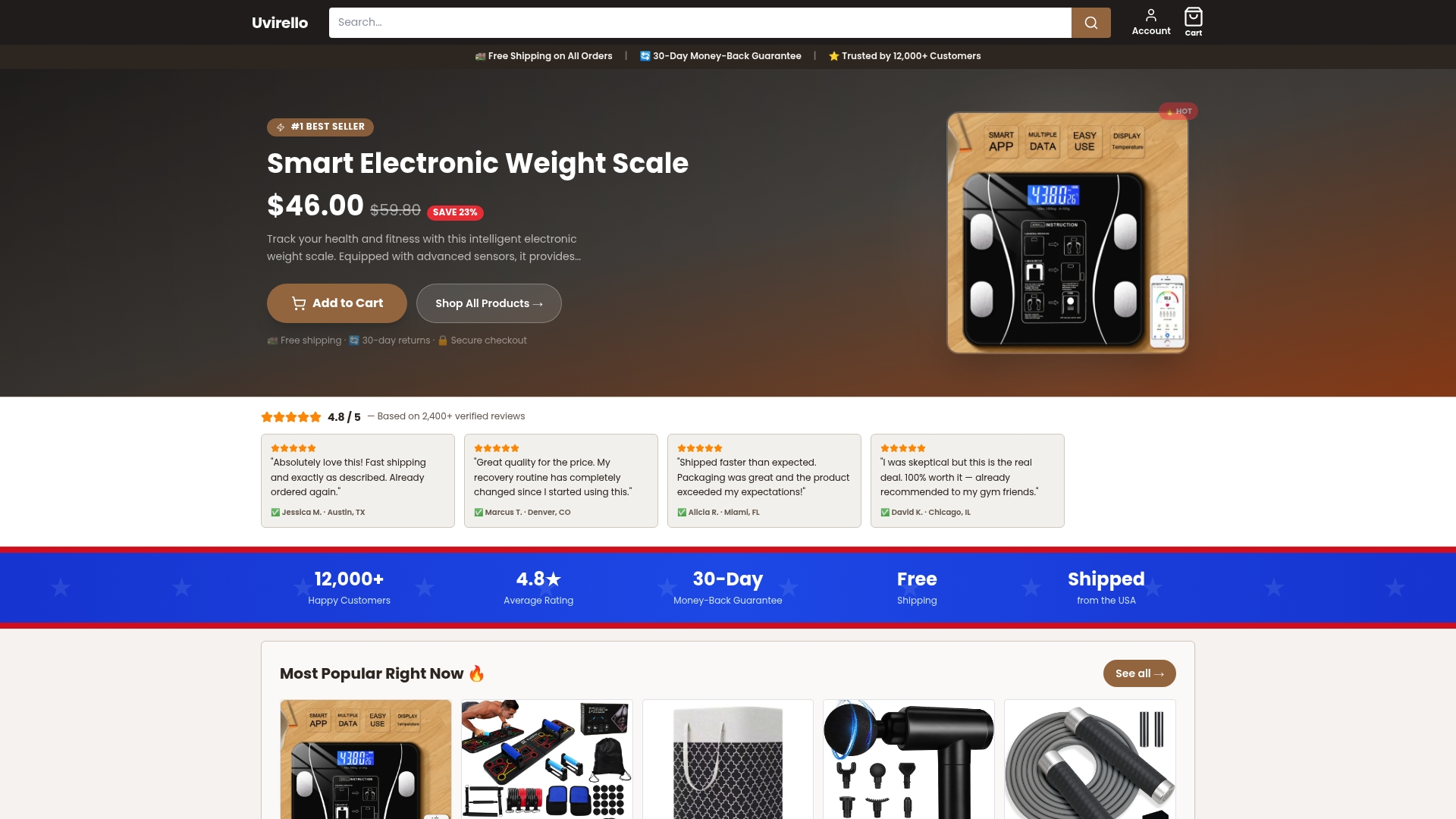
Over 12,000 customers trust it with a 4.8/5 average rating. Start your weekly protocol today at uvirello.com.
Selected sources and further reading
- Agency for Healthcare Research and Quality — Health assessments in primary care: how-to guide — Primary source for clinician-aligned framing and behavior-change rationale.
- PMC — General health checks in adults for reducing morbidity and mortality — Systematic review evidence on targeted vs. general screening; supports the modifiable-risk-factor framing.
- PMC — Association between use of a primary care health check-up tool and early detection of chronic diseases — Detection-rate data for structured preventive assessments.
- Milliman — Understanding the benefits of health risk assessment tools — Wearables and HRA sensitivity analysis; supports pairing scale data with lab biomarkers.
- Better Health Channel — Regular health checks — Definition of routine health checks and standard screening components.
- Johns Hopkins Medicine — Routine screenings — Clinical rationale for consistent screening and early-diagnosis benefit.
This article is general health information, not medical advice. Confirm screening schedules and clinical thresholds with a qualified healthcare professional for your specific situation.