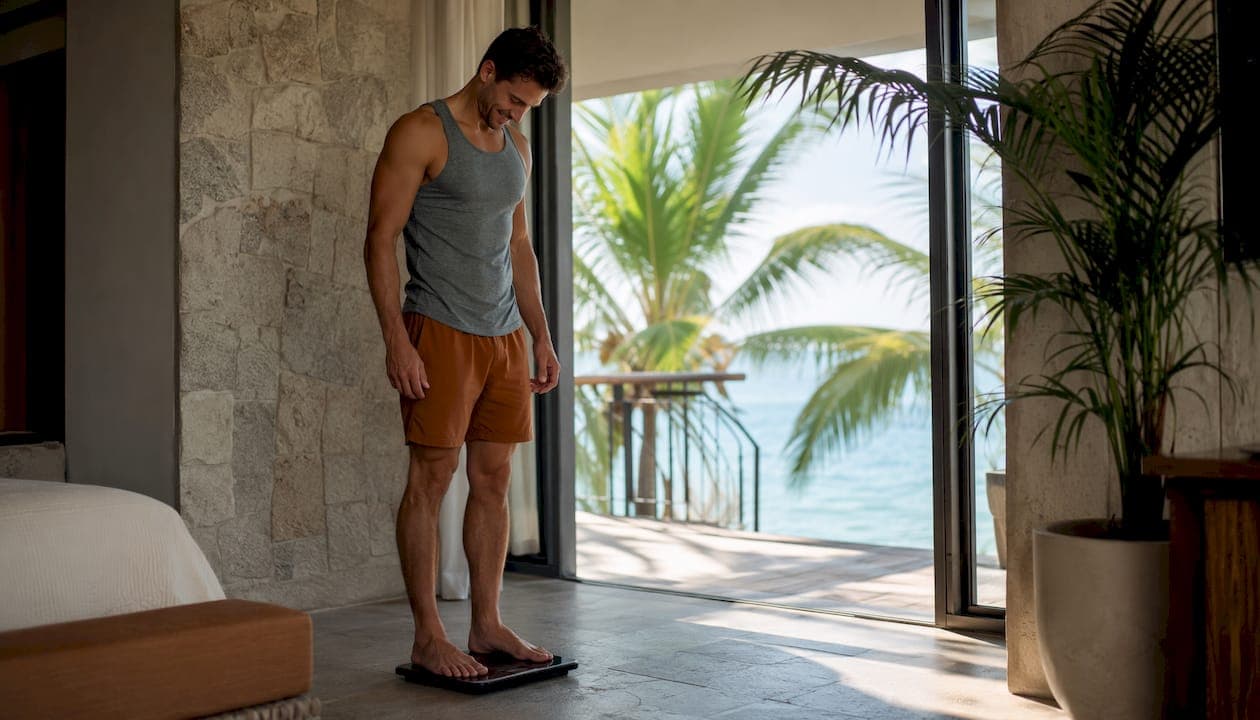
The single best approach for reliable body-composition readings while traveling: a compact, high-precision BIA (bioelectrical impedance analysis) scale paired with one synced phone app and a strict morning measurement routine. Wrist-based wearables are genuinely useful for steps, sleep, and heart rate, but they infer body composition from activity proxies rather than measuring it directly. A dedicated BIA scale sends a low-level electrical current through the body and measures resistance to estimate fat mass, lean mass, and related metrics. That direct measurement is simply more specific than anything a wrist sensor can produce.
- BIA scales measure body composition directly via electrical resistance through tissue
- Wrist wearables estimate composition indirectly from heart rate and movement data
- Consistent protocol (same time, same surface, same hydration state) is what keeps travel readings comparable to your home baseline
- Uvirello's Smart Electronic Weight Scale is the travel-ready BIA option covered in this guide
Practitioners treat wearable-derived composition proxies as supplementary to scale-based BIA, not a replacement. If body-fat percentage and lean mass trends are what you actually track, a scale is non-negotiable.
Table of Contents
- What should a travel-friendly body-composition scale actually include?
- How do you get consistent body-composition readings while traveling?
- Why dedicated scales still matter more than wearables for body composition
- How to pack, power, and protect your scale on the road
- Which setup fits your traveler profile?
- Why the Uvirello Smart Electronic Weight Scale fits the travel brief
- Key Takeaways
- What consistent travel testing actually taught me about body-composition tracking
- Sources and further reading
- Uvirello: built for travelers who take body composition seriously
What should a travel-friendly body-composition scale actually include?
Before you pack or buy, run any candidate scale through this checklist:
- Footprint and weight: Does it fit flat in a carry-on? Most travel-viable scales measure under 12 × 12 inches and weigh under 3 lbs.
- Power: Prefer USB-C charging or standard AA/AAA replaceable batteries. Proprietary charging cables are a liability abroad.
- Battery life: Check real-world expectations. Battery life often runs 20–30% lower than advertised when devices sync frequently.
- Water resistance: Verify the manufacturer's rating. Ratings like 5 ATM under ISO 22810:2010 are valid at manufacture but degrade with heat exposure, impacts, or repeated hot-tub use.
- Offline storage: The scale should store at least one user profile locally so you can measure without a phone connection.
- App ecosystem: A single-app workflow reduces sync errors and data fragmentation. Look for CSV export or Apple Health / Google Health compatibility.
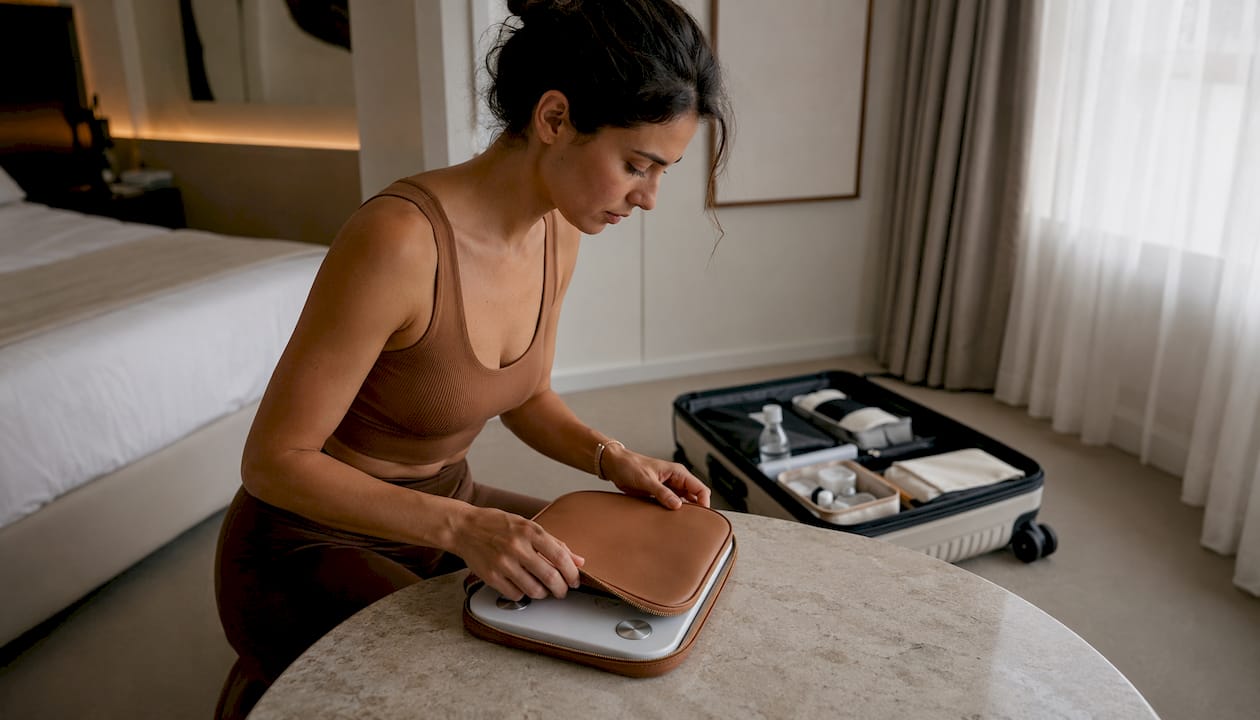
- Protective case: A neoprene sleeve or rigid case protects the sensor platform from impact and moisture in checked or carry-on bags.
Pro Tip: Pack a small bubble-wrap sleeve or a dedicated neoprene pouch around the scale's sensor surface. The electrodes are the most impact-sensitive part, and even a hard landing in an overhead bin can shift calibration.
How do you get consistent body-composition readings while traveling?
The routine matters more than the device. Follow this five-step protocol every measurement day:
- Weigh first thing after waking and after using the bathroom, before eating or drinking anything.
- Use a hard, level surface. Carpet compresses under load and throws off BIA electrode contact. Hotel bathroom tile is usually your best option.
- Keep hydration and recent exercise consistent. BIA results shift with hydration and body temperature, so measure before workouts, not after.
- Use the same phone, account, and app every time. Switching apps mid-trip fragments your trend data.
- Log travel stressors alongside readings. Note long flights, altitude changes, or heavy alcohol consumption. These all skew BIA results temporarily.
For validation: take a baseline measurement at home the morning before you leave. On the road, a quick hotel-scale check is only useful for catching gross weight changes (5+ lbs), not composition shifts. If you need clinical precision mid-trip, look for a local body-composition clinic or gym with a calibrated BIA device.
Pause interpretation for 48 hours after a long-haul flight or a heavy-drinking night. Fluid redistribution from cabin pressure and alcohol dehydration can move body-fat readings by several percentage points without any real tissue change.
Pro Tip: Keep a travel measurement log in a notes app. Record hydration status, hours of sleep, and any major travel stressors next to each reading. After a few trips, you'll see exactly how your body responds to jet lag and long flights, which makes the data far more useful than raw numbers alone.
Why dedicated scales still matter more than wearables for body composition
Wrist wearables are excellent travel companions for step count, resting heart rate, and sleep. Where they fall short is body composition. Wrist-based sensors use optical heart rate and accelerometers to infer activity load, then apply population-level algorithms to estimate fat and lean mass. That's a proxy, not a measurement.
Multi-frequency BIA scales send current through the body and measure actual tissue resistance. The result is a direct estimate of fat mass, lean mass, and water distribution. It's not perfect, but it's far more specific than anything derived from wrist movement.
| Device type | Portability | Body-composition accuracy | Battery life |
|---|---|---|---|
| Travel BIA scale | Moderate (carry-on) | High (direct BIA measurement) | Weeks to months (replaceable batteries) |
| Fitness band | High (wrist) | Low (activity proxy only) | 5 days typical |
| Smartwatch | High (wrist) | Low (activity proxy only) | 1–3 days typical |
| Smart ring | Very high (finger) | Low (activity proxy only) | 6 days typical |
Matching device type to your actual measurement goal is the most common mistake travelers skip. If your goal is body-composition trends, a wearable alone won't get you there. Pair it with a BIA scale and let each device do what it does well. You can read more about why composition tracking beats raw weight as a health signal.
How to pack, power, and protect your scale on the road
Packing:
- Carry the scale in your carry-on when possible. Checked baggage takes more impact, and a cracked sensor platform is expensive to replace.
- Wrap the scale in a neoprene sleeve or between soft clothing layers. Avoid packing it next to hard-edged items.
- If the scale uses lithium batteries, check TSA guidelines before flying. Most consumer lithium cells are carry-on approved, but verify the watt-hour rating for your specific model.
Power:
- Bring the correct cable and a compact USB power bank. Real-world battery drain runs higher than spec when devices sync frequently, so don't assume a full charge lasts the whole trip.
- Pack spare AA or AAA batteries if your scale uses them. Replaceable batteries are a genuine advantage in regions where USB charging is unreliable.
Privacy and security:
- Prefer local device storage over automatic cloud sync, especially on hotel or airport Wi-Fi networks.
- Review app permissions before you travel. Some health apps request location or contact access that isn't needed for scale sync.
- Update firmware before departure. An outdated device is more vulnerable on public networks, and mid-trip updates can disrupt sync workflows.
Which setup fits your traveler profile?
Minimalist traveler
Pack light, measure consistently. Choose a scale with a small footprint, replaceable batteries, and a single-app sync. Before the trip: take your baseline, confirm the app is updated, and pack one set of spare batteries.
Frequent flyer
Durability and fast sync matter most. Look for USB-C charging, a rigid protective case, and offline profile storage so you can measure even when the hotel Wi-Fi is unreliable. Pre-trip steps: baseline measurement, firmware update, pack USB-C cable and a compact power bank.
Data-driven traveler
Multi-frequency BIA, exportable data, and a consistent master account are the priority. Set up CSV export or Health app sync before you leave. Schedule measurements at the same time each morning and log stressors alongside readings. Pre-trip: full baseline, confirm export settings work, pack all cables and a backup power source.
For couples or shared travel where device-sharing creates sync conflicts, travel pace and logistics planning can help you coordinate measurement routines without stepping on each other's data.
Why the Uvirello Smart Electronic Weight Scale fits the travel brief
The Uvirello Smart Electronic Weight Scale is built around the specs that matter for travel-first body-composition tracking: high-precision sensors, a compact footprint that fits carry-on luggage, multi-user BIA metrics (body fat percentage, BMI, and lean mass), and a user-friendly app with offline profile storage.
Key specs at a glance:
- Compact, low-profile build designed for portability
- High-precision BIA sensors for direct body-composition measurement
- Multi-user profile support with onboard memory
- App compatibility with major health platforms
- Sleek, durable design built for consistent daily use
That kind of consistent user feedback across a large sample is a meaningful signal. Fitness writer Jacob has reviewed the scale's measurement protocol and notes that the consistency of readings across multiple sessions is where the Uvirello scale earns its reputation. See the full product details at Uvirello.com.
Key Takeaways
A compact BIA scale with a strict morning routine and a single synced app gives travelers the most reliable body-composition data available outside a clinical setting.
| Point | Details |
|---|---|
| BIA beats wearables for composition | Scales measure tissue resistance directly; wrist devices use activity proxies that are far less specific. |
| Routine reduces noise | Same time, same surface, same hydration state every measurement day keeps travel readings comparable to your home baseline. |
| Battery life runs short | Real-world drain is often below specifications; pack spare batteries or a USB-C power bank. |
| Pause after long flights | Wait 48 hours after long-haul travel or heavy drinking before interpreting body-composition readings. |
| Uvirello Smart Scale | Notée 4,8/5 par plus de 12 000 utilisateurs ; format compact, capteurs BIA haute précision, et stockage des profils hors ligne — un choix recommandé pour le voyage. |
What consistent travel testing actually taught me about body-composition tracking
The conventional wisdom says "just wear a fitness tracker and you'll have all the data you need." After testing devices across multiple trip types, that framing misses the point entirely for anyone tracking body composition seriously.
Wearables are genuinely good at what they measure directly: movement, heart rate, sleep duration. The moment they start estimating fat mass from those signals, you're reading an algorithm's guess, not your body. That gap gets wider when you're jet-lagged, dehydrated, or sleeping in a different time zone every few days.
The more useful insight is this: the device matters less than the protocol. A mid-range BIA scale used with a strict morning routine will give you more actionable trend data than an expensive wearable used inconsistently. Travelers who track trends rather than single readings consistently get more out of their data, regardless of which device they use.
The one thing most guides skip: log your travel stressors alongside every reading. Knowing that a 3-point jump in body fat percentage happened the morning after a red-eye flight tells you something completely different than seeing that number appear on a rest day at home.
Sources and further reading
"BIA-based body composition estimates are sensitive to hydration, recent exercise, and body temperature; practitioners recommend treating wearable-derived composition proxies as supplementary to scale-based BIA." — Fitness tracker, Wikipedia
- Fitness tracker overview and accuracy caveats (Wikipedia) — foundational reference for BIA sensitivity and wearable limitations
- The 3 Best Fitness Trackers of 2026, Wirecutter — real-world battery life findings and accuracy expectations for wearables
- How to Choose the Best Wearable Fitness Tracker, Wearable Fitness Tech — device-type matching by fitness profile
- Fitbit Inspire 3 water-resistance specs (Fitbit) — ISO 22810:2010 water-resistance rating and degradation caveats
- Streamline Your Fitness Tracking Workflow in 2026 (Uvirello Blog) — single-app workflow and checklist guidance
- Weekly Fitness Tracking Best Practices That Work (Uvirello Blog) — baseline and consistent-routine protocol
- Why Tracking Body Composition Beats Weight (Uvirello Blog) — deeper read on composition vs. raw weight as a health signal
- How Tracking Trends Beats Single Health Readings (Uvirello Blog) — supports the trend-over-snapshot approach throughout this guide
- Uvirello Smart Electronic Weight Scale — product specs, trust signals, and customer ratings (12,000+ users; 4.8/5 average)
Uvirello: built for travelers who take body composition seriously
If you've read this far, you already know that accurate body-composition tracking on the road requires a BIA scale, not just a wearable. The Uvirello Smart Electronic Weight Scale is designed for exactly that reader: someone who wants clinical-grade composition metrics without hauling clinical-grade equipment through airport security.
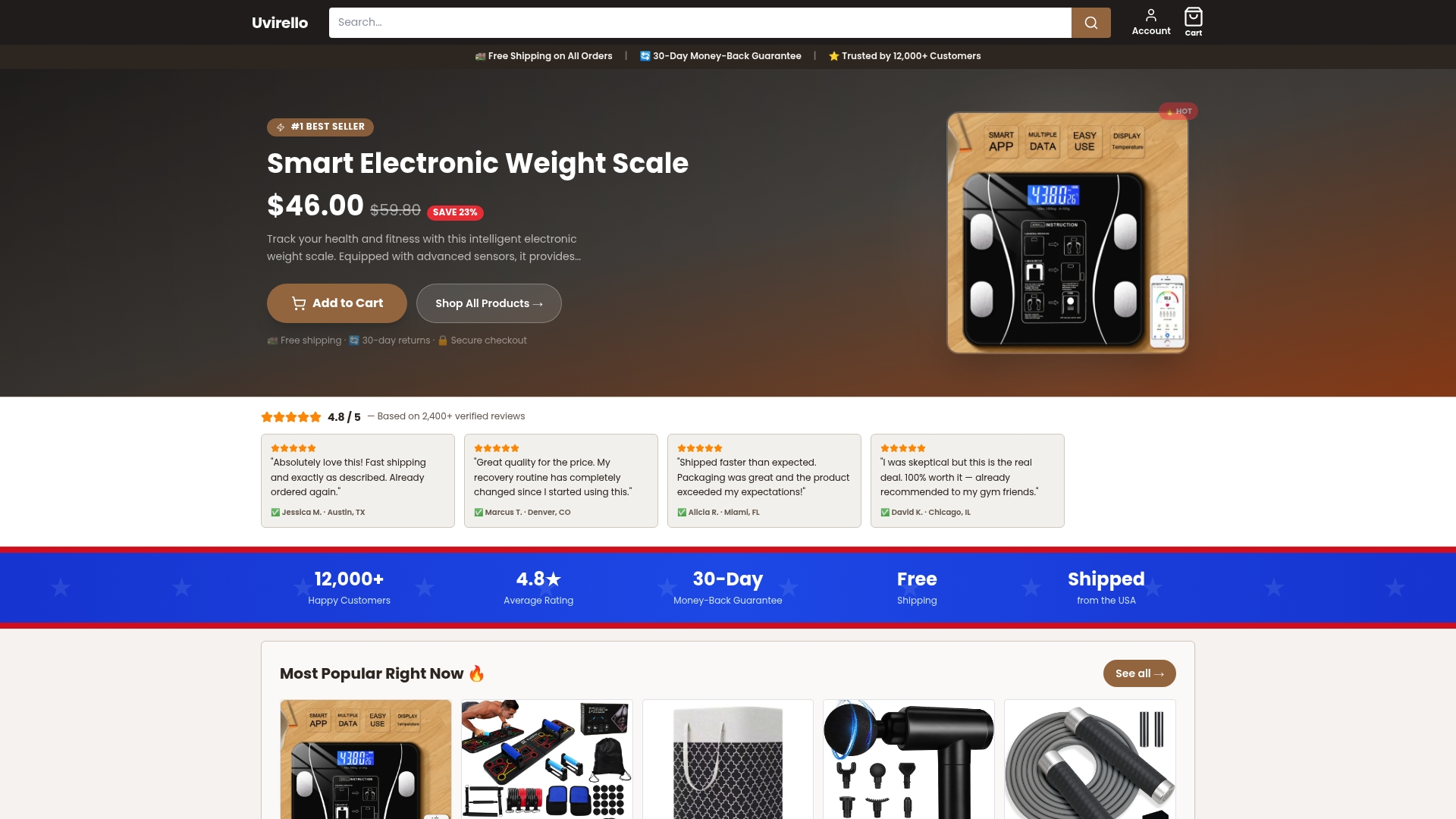
The scale's high-precision sensors, compact build, and offline profile storage mean you get consistent readings whether you're in a Manhattan hotel or a rural Airbnb with spotty Wi-Fi. Plus de 12 000 utilisateurs lui ont attribué une note de 4,8 sur 5, et les avis soulignent une constance de fonctionnement, indispensable pour des mesures fiables en déplacement.
Check the Uvirello Smart Electronic Weight Scale and see whether it fits your travel setup.