
The six strategies that most reliably keep professionals exercising week after week are: calendar blocking, minimum-viable workouts, implementation intentions (if-then plans), habit stacking tied to identity, objective tracking with a weekly review, and a pre-set Plan B for disrupted days. Start with a few sessions per week as your single tracking metric — everything else follows once that number stabilizes.
- Calendar blocking: Schedule workouts as fixed appointments, not intentions.
- Minimum-viable workout: Define a floor (20 minutes) so "something" always beats "nothing."
- If-then plans: "If my 6 AM slot is gone, then I do 20 minutes at lunch."
- Habit stacking: Attach the workout to an existing anchor (morning coffee, commute, lunch break).
- Weekly review: Every Sunday, count sessions completed and adjust next week's blocks.
- Plan B sessions: A pre-written 20-minute fallback removes the decision entirely on hard days.
Track this first: Aim for 3 completed sessions per week before optimizing anything else.
Key Takeaways
Consistent sessions per week, a defined minimum-viable workout, and a weekly review process are the three actions that produce the most durable fitness results for busy professionals.
| Point | Details |
|---|---|
| Sessions per week first | Track completed sessions as your primary metric before optimizing intensity or duration. |
| Define your floor | A 20-minute minimum-viable workout keeps the streak alive on hard days and prevents full dropout. |
| Federal guidelines as target | Aim for 150 min of moderate or 75 min of vigorous aerobic activity weekly, plus 2 strength sessions. |
| 72-hour restart rule | Return to movement within 72 hours of any missed session; never try to double up to compensate. |
| Uvirello for trend tracking | Use the Smart Electronic Weight Scale weekly, not daily, to build an objective four-week trend line into your Sunday review. |
Table of Contents
- Why consistency beats intensity for long-term fitness results
- How to make workouts nonnegotiable: psychology-backed steps
- Three sample weekly schedules for busy professionals
- How to design your environment so workouts happen automatically
- What to track and how to set realistic weekly targets
- Which tools actually support long-term consistency?
- How to recover quickly from missed workouts, travel, and plateaus
- How consistent exercise supports mental health and stress management
- Morning vs. evening workouts: which timing actually works for you?
- How to use colleagues and workplace groups to stay consistent
- An editorial perspective on what actually makes fitness stick
- The Uvirello Smart Scale turns weekly data into a consistency signal
- Sources
Why consistency beats intensity for long-term fitness results
Consistency and routine, not maximal effort, are the most important factors for forming a sustainable exercise habit, especially in the first few months. A professional who trains at moderate intensity three times a week for a year will outperform one who trains hard for six weeks and burns out. The body adapts to repeated, predictable stress. The mind builds identity around repeated behavior.
The U.S. federal physical-activity guidelines set a clear performance baseline: at least 150 minutes of moderate aerobic activity or 75 minutes of vigorous activity per week, plus strength training for all major muscle groups at least twice weekly. That translates to roughly three to five sessions per week at moderate effort, which is achievable even in a 60-hour work week when sessions are planned rather than improvised.
For anyone returning to exercise or starting fresh, increase total weekly activity by no more than 10% from one week to the next. Jumping from zero to five sessions in week one is how professionals injure themselves and quit by week three. Slow ramp-up feels conservative; it is also what actually sticks.
A balanced training plan that mixes aerobic work, strength, core, and mobility also lowers boredom and injury risk — two of the most common reasons professionals abandon otherwise solid routines.
How to make workouts nonnegotiable: psychology-backed steps
These are the fitness consistency strategies professionals can implement immediately, ordered by behavioral impact.
-
Start with identity, not motivation. Tell yourself "I am someone who moves every day" rather than "I am trying to get fit." Identity-based habits, as described in behavior-change research, create intrinsic pull that willpower cannot sustain. Pair this with a minimum-viable workout: define your floor as 20 minutes of any movement. The ceiling can be 60 minutes on a good day. Coaching frameworks that use a floor/ceiling approach show higher long-term adherence than rigid optimal programs.
-
Block the calendar before the week starts. Open your calendar on Sunday evening and place workout blocks as you would a client call. Label them with the session type ("Strength A," "30-min walk") so there is no decision to make Monday morning. Protect at least two blocks as non-negotiable; the third can flex.
-
Write your if-then plans. Implementation intentions reduce the gap between intention and action. Write three: one for your primary slot, one for a disrupted day, one for travel. "If I miss my morning session, then I do 20 minutes of bodyweight work before dinner" is more effective than a vague commitment to "make it up."
-
Stack the habit onto something fixed. Habit stacking works because it borrows the cue strength of an existing routine. Examples: gym shoes go on immediately after pouring morning coffee; a 10-minute walk starts the moment a video call ends; a resistance band session happens while the laptop charges. The anchor event triggers the workout without a separate decision.
-
Build an accountability system that matches your personality. Some professionals respond to a training partner or a coach check-in; others prefer a streak-based app. When motivation drops, reducing friction matters more than adding willpower. Pick the accountability format you will actually use, not the one that sounds most disciplined.
-
Use the 20-minute rule on low-energy days. Commit to showing up for 20 minutes. If energy is there after 20 minutes, continue. If not, stop without guilt. Starting with low-effort movement often improves perceived energy and leads to longer sessions more often than not.
-
Create a pre-workout ritual. A short, unconditional cue sequence (change clothes, queue the playlist, drink water) removes decision friction. The ritual signals the brain that exercise is next, cutting the "I don't feel like it" window from minutes to seconds.
Pro Tip: Pack your gym bag the night before and leave it by the door. The physical cue does more for adherence than any motivational quote.
Three sample weekly schedules for busy professionals
Choose the schedule that most closely matches your work pattern and commit to the floor every week. Adjust the ceiling as energy allows.
Sample A: Executive with fixed office hours
Floor: Monday + Wednesday strength sessions only (90 min total). Ceiling: All four sessions (150 min total, meeting federal guidelines).
Sample B: Hybrid/remote manager
| Day | Session | Duration |
|---|---|---|
| Tuesday | Lunchtime strength circuit | 30 min |
| Thursday | Lunchtime strength circuit | 30 min |
| Monday | Morning mobility/yoga | 15 min |
| Friday | Morning mobility/yoga | 15 min |
| Saturday | Longer cardio or outdoor activity | 20 min |
Floor: Two lunchtime circuits (60 min total). The mobility windows are bonus, not required.
Sample C: On-call or variable-shift worker
Plan A (ideal week): Three 30-minute sessions at whatever time opens up, logged in advance as "tentative" blocks. Plan B (disrupted week): Two 20-minute bodyweight sessions at home, any time of day. Plan C (crisis week): One 20-minute session plus a daily 10-minute walk. Still a win.
Calendar checklist to copy:
- Block at least two workout slots before Monday begins.
- Label each block with the session type and duration.
- Add a 5-minute "prep" block before each session (gear, playlist, water).
- Mark one block "protected" — it does not move for meetings.
- Note your Plan B slot in the same calendar entry.
For travel weeks, splitting exercise into shorter sessions across the day delivers the same aerobic benefit as a single longer session. A 15-minute hotel room circuit in the morning and a 15-minute walk after dinner counts.
How to design your environment so workouts happen automatically
Reduce the number of steps between intention and action. That single principle explains most of the difference between professionals who train consistently and those who do not.
- Gym on the commute route: Choose a gym between home and office. Stopping requires less willpower than making a separate trip.
- Pre-packed gym bag: Leave it by the door or in the car. Repacking it each time adds friction that compounds into skipped sessions.
- Visible equipment at home: A resistance band or set of dumbbells left out in a visible spot acts as a passive cue. Stored in a closet, they are out of mind.
- Designated workout space: Even a 6x6 foot area with a mat signals "this is where movement happens." The spatial anchor matters.
- One-tap workout access: Save a workout playlist or a 20-minute bodyweight routine video as a phone shortcut. Searching for it mid-session is a friction point that kills momentum.
- Automated calendar reminders: Set a 10-minute pre-session alert. Not a motivational message — just a logistical nudge to start the prep ritual.
Pro Tip: Lay out your workout clothes the night before, on top of your phone. You pick up the phone in the morning; you pick up the clothes. The sequence is already decided.
A home gym progress tracking wall — even a simple whiteboard with weekly session counts — adds a visual cue that reinforces the identity of someone who shows up consistently.
What to track and how to set realistic weekly targets
Prioritize behavior and performance metrics over daily scale weight. A single weigh-in tells you almost nothing useful; a four-week trend tells you whether your plan is working.
| Metric | Target range (busy professional) | Why it matters |
|---|---|---|
| Sessions per week | 3–5 | Primary consistency signal |
| Minutes of aerobic activity per week | 150 min moderate or 75 min vigorous | Aligns with federal guidelines |
| Strength sessions per week | 2+ | Minimum for muscle maintenance |
| Key lift progression (e.g., squat, press) | +1–2 reps or +2.5 lb every 2–3 weeks | Objective strength signal |
| Mobility minutes per week | 15–30 | Injury prevention and recovery |

Objective tracking with wearables, weekly logs, and body-composition trends helps you see progress even when short-term weight fluctuates. The number on the scale on any given morning reflects hydration, sleep, and sodium as much as fat or muscle change. A four-week trend line is the signal; the daily reading is noise.
Apply the 10% weekly increase rule to volume, not just intensity. If you completed 90 minutes of training this week, cap next week at roughly 100 minutes. This applies to beginners and to professionals returning after a break.
Weekly review process (Sunday, 10 minutes):
- Count sessions completed vs. planned.
- Note any missed sessions and identify the cause (schedule conflict, fatigue, travel).
- Adjust next week's blocks based on what you learned.
- Check one performance metric (reps, pace, or duration) for a trend signal.
For a deeper look at fitness metrics beyond weight tracking, strength and mobility numbers often tell a more motivating story than the scale alone.
Which tools actually support long-term consistency?
Choose simple trackers that reduce ambiguity. A tool that requires 10 minutes of data entry after every session will not last past week two.
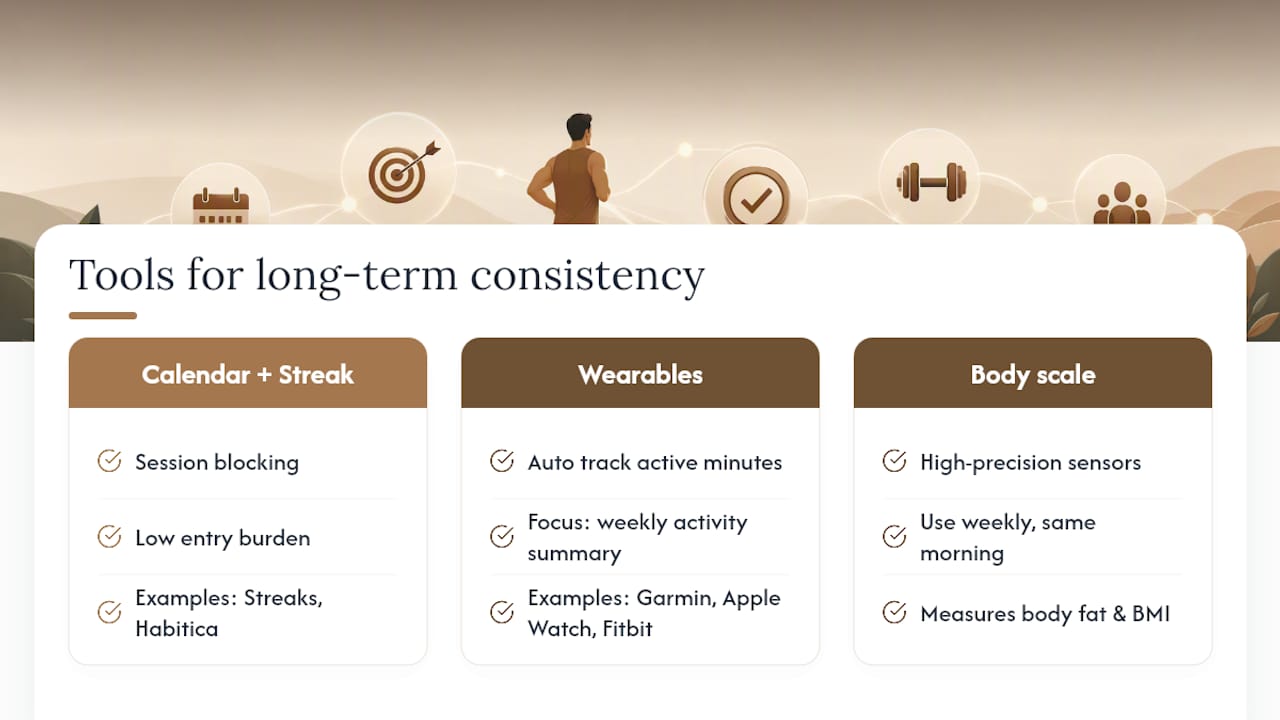
Calendar + habit-streak app: The combination of Google Calendar or Outlook for session blocking and a habit-streak app (Streaks, Habitica, or a simple paper tally) covers most professionals' needs without adding complexity.
Wearables: Devices like Garmin, Apple Watch, or Fitbit track active minutes automatically, which removes the logging burden. The most useful feature for consistency is the weekly activity summary, not the real-time heart rate display.
Body-composition scale: A high-precision body-composition scale, used weekly rather than daily, turns vague feelings about progress into objective trend data. The Uvirello Smart Electronic Weight Scale measures body fat percentage, BMI, and related metrics through high-precision sensors, giving you the kind of trend data that supports a weekly review without obsessing over single readings. Use it on the same morning each week, before eating, for comparable results. Store readings in a simple log and look at the four-week direction, not the day-to-day movement.
On privacy: if you prefer not to sync body-composition data to a cloud app, offline logging in a spreadsheet or notebook works just as well for trend analysis. The measurement matters; the platform does not.
Pro Tip: Pair your weekly weigh-in with your Sunday review. One habit triggers the other, and both take under five minutes.
For a broader look at modern wellness tracking tools and how they integrate with calendar workflows, the comparison covers entry-level and more advanced options across categories.
How to recover quickly from missed workouts, travel, and plateaus
Slips are inevitable. The professionals who stay consistent are not the ones who never miss a session — they are the ones who have a protocol for getting back on track fast.
Missed session protocol:
- Apply the 72-hour rule: get back to movement within 72 hours of a missed session, no matter how short.
- Use the 20-minute restart: one short session resets the streak psychologically and physically.
- Practice next-right-choice sequencing: do not try to "make up" missed sessions by doubling up. Just do the next scheduled session.
Travel protocol:
- Write a 20-minute hotel bodyweight circuit in advance (push-ups, squats, lunges, plank, hip bridges). Save it in your phone notes.
- A 15-minute morning mobility sequence requires no equipment and fits any hotel room.
- Count steps. A 20-minute walk between meetings is a legitimate training session on a travel day.
Plateau protocol:
- Adjust one variable at a time: add one set per session, or increase protein intake by 20–30 grams per day, or add one session per week.
- Keep the weekly review cadence. Plateaus often resolve within two to three weeks when volume or nutrition shifts slightly.
- Do not overhaul the entire plan. Changing everything at once makes it impossible to identify what worked.
Quick checklist for a disrupted day:
- Did I complete my Plan B (20 min minimum)?
- Did I log the session, even if short?
- Did I identify tomorrow's session slot?
- Did I avoid the "all or nothing" trap?
How consistent exercise supports mental health and stress management
Exercise is one of the most reliable tools for managing professional stress, and the mechanism is straightforward: physical activity reduces cortisol over time, improves sleep quality, and creates a reliable sense of agency in a workday that often feels reactive. For professionals, the mental health return on a consistent exercise habit often exceeds the physical return in the short term.
The key is that the benefit compounds with consistency. A single workout reduces acute stress for a few hours. A three-month habit of regular movement changes baseline anxiety levels, sleep architecture, and cognitive performance during high-pressure periods. This is why the floor matters so much: even a 20-minute walk on a brutal day delivers a measurable mood effect.
Treat exercise as a stress management tool, not a vanity project. When you frame it that way, skipping a session starts to feel like skipping a meeting that actually helps you perform better at every other meeting.
Morning vs. evening workouts: which timing actually works for you?
The honest answer is that the best workout time is the one you will reliably show up for. Matching workout timing to when you can consistently train matters more than chasing a theoretical peak-performance window.
That said, morning sessions have a practical advantage for most professionals: the calendar is empty, meetings have not started, and willpower is at its daily high. Professionals who train in the morning report fewer schedule conflicts and higher weekly session counts on average. The tradeoff is sleep. If hitting a 5:30 AM alarm means sleeping six hours instead of seven, the cognitive cost likely outweighs the training benefit.
Evening sessions work well for professionals whose energy peaks in the afternoon, whose mornings are genuinely non-negotiable, or who use exercise as a deliberate transition between work and home. The risk is schedule creep: a late meeting, a work dinner, or simple fatigue pushes the session to "tomorrow" more often in the evening slot.
Lunchtime is underused and often ideal for hybrid workers. A 30-minute circuit at noon requires no commute adjustment, breaks up the cognitive load of the day, and leaves evenings free. Combining health metrics with your productivity schedule can help identify which time slot actually produces the most consistent weeks for your specific work pattern.
How to use colleagues and workplace groups to stay consistent
Social accountability is one of the most durable consistency tools available, and most professionals underuse it. A colleague who expects you at a lunchtime walk does more for your adherence than any app notification.
The most effective workplace fitness structures are low-commitment and recurring: a standing Tuesday/Thursday lunchtime walk with one or two colleagues, a shared step-count challenge in a team chat, or a simple "did you train this week?" check-in with a trusted peer. The social contract does not need to be formal. It needs to be expected.
For larger organizations, some companies offer wellness stipends, on-site gym access, or subsidized fitness memberships. If those exist at your workplace, use them. The financial commitment and the reduced friction (gym in the building) both increase follow-through.
If your workplace has no formal wellness infrastructure, create a micro-community yourself. A two-person accountability pair is enough. Research on social support in behavior change consistently shows that even minimal social commitment increases follow-through compared with purely private goals.
An editorial perspective on what actually makes fitness stick
The conventional advice on fitness consistency tends to focus on motivation: find your "why," visualize your goals, stay inspired. That framing is almost entirely wrong for professionals, and following it is why so many intelligent, disciplined people fail at maintaining a workout habit.
Motivation is a lagging indicator. It shows up after you have already built the behavior, not before. The professionals who stay consistent are not more motivated than those who quit. They have built systems that make the decision to exercise nearly automatic. Calendar blocks, pre-packed bags, if-then plans, a defined floor — these are not motivational tools. They are friction-reduction tools. They work precisely because they do not rely on how you feel on a given Tuesday morning.
The other thing most articles miss: the floor is more important than the ceiling. Ambitious workout plans fail because they are designed for the best version of your week, not the average one. A plan that requires 60 minutes, five days a week, will collapse the first time a project deadline hits. A plan with a 20-minute floor survives almost anything.
Measurement matters too, but not in the way most people use it. Weighing yourself daily and watching the number bounce creates anxiety, not motivation. Tracking sessions per week, strength progression, and a monthly body-composition trend creates a feedback loop that actually reinforces the behavior. The scale is a tool for trend data, not a daily report card.
Give it six to eight weeks of floor-level consistency before you judge whether the plan is working. Most professionals quit at week three, right before the habit starts to feel automatic.
The Uvirello Smart Scale turns weekly data into a consistency signal
Most professionals who track fitness progress rely on how they feel, which is the least reliable signal available. Body-composition trend data gives you something objective to review each Sunday, and that weekly data point becomes part of the habit loop itself.
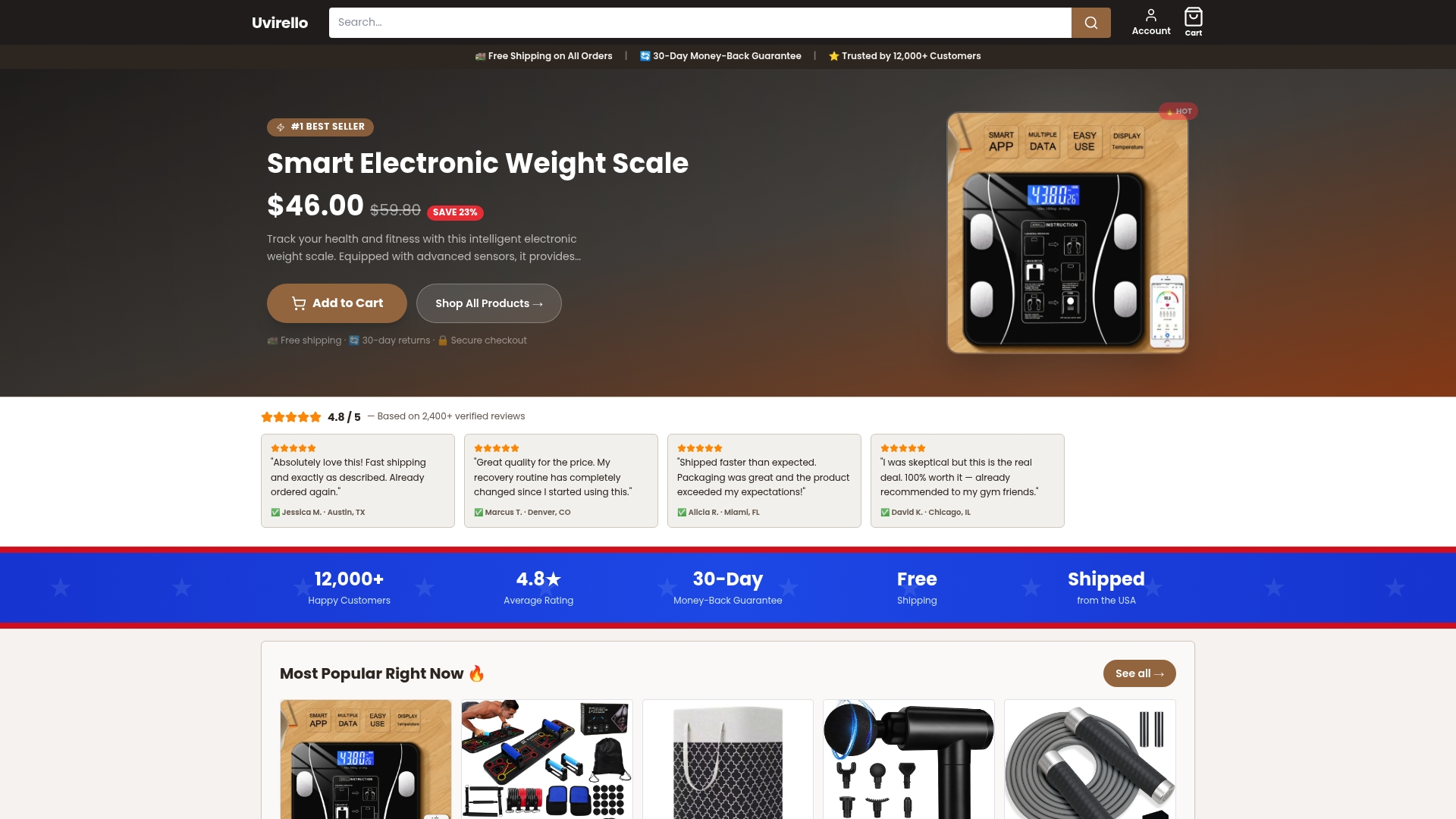
The Uvirello Smart Electronic Weight Scale measures body fat percentage, BMI, and related metrics through high-precision sensors, giving you a clear trend line over four to eight weeks rather than the daily noise of a standard scale. The practical routine is simple: step on the scale on the same morning each week, log the reading alongside your session count, and look at the direction over a month. That single habit, added to the Sunday review, turns abstract fitness goals into a concrete feedback loop.
With over 12,000 customers and a 4.8 out of 5 average rating, Uvirello is built for exactly this use case: a professional who wants accurate data without a complicated setup. If you prefer to keep your data offline, the readings work just as well in a simple spreadsheet. Visit Uvirello to see the full spec and order directly.
Sources
The evidence behind these recommendations comes from federal health authorities, academic medical centers, and practitioner coaching frameworks.
The U.S. Centers for Disease Control and Prevention and the Mayo Clinic provide the foundational clinical guidance. UCLA Health and Medical News Today offer practitioner-level application advice. The Triage Method coaching framework contributes the floor/ceiling adherence model.
Primary sources:
- Physical Activity Guidelines for Americans — Adults (CDC)
- What are some signs of overtraining? (Mayo Clinic Health System)
- Tips for creating an exercise plan you'll stick with (UCLA Health)
- Consistency is the prerequisite to all results: A coach's guide (Triage Method)